
- You are here:
- Home »
- Eschatology »
- The Scofield Bible Orgins and Agenda
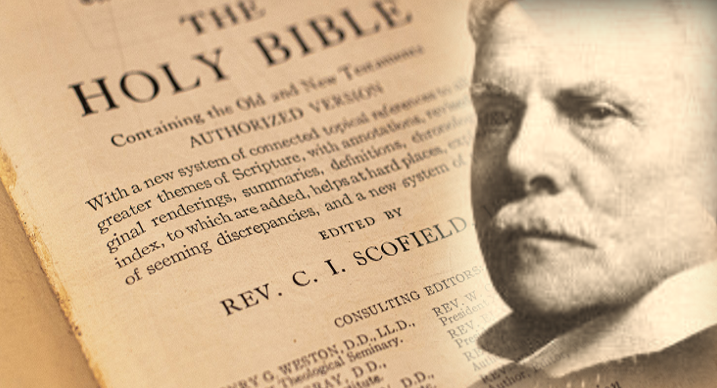
The Scofield Bible Orgins and Agenda
One Seed, One New Creation: The Biblical Case Against Dispensationalism
If you’ve been online lately, you’ve probably seen the heated debates, memes, and fiery threads about Israel, America’s unconditional support, and whether Christians have a biblical duty to “bless Israel” no matter what. The conversation often turns intense: some argue that supporting modern Israel is a direct command from Genesis 12:3, while others question why U.S. foreign policy seems so heavily influenced by end-times theology. Behind much of this passion lies something most people have never heard of — the Scofield Reference Bible footnotes.
First published in 1909, this study Bible added extensive notes that popularized a 19th-century system called dispensationalism. Those small-print footnotes convinced millions of Christians that God has two separate programs — one for national Israel and one for the Church — and that America must bless the modern State of Israel or risk divine judgment. The debate exploded when Tucker Carlson began questioning Christian Zionism and the prophecy-driven foreign policy it fuels. Critics quickly labeled him “anti-Semitic,” but the real issue isn’t hatred of Jews or denying the rapture. It’s whether this dispensational framework has turned the Bible’s clear message of one fulfilled covenant in Christ into a complicated two-track prophecy chart.
This dispensational framework exploded in popularity during the 1970s and beyond, largely through Hal Lindsey’s bestselling book The Late Great Planet Earth (1970), which sold tens of millions of copies worldwide. Lindsey presented a dramatic end-times scenario that included a pre-tribulation rapture, a distinct future program for national Israel, and current events as literal fulfillments of prophecy. Later, Tim LaHaye and Jerry Jenkins’ Left Behind series took these same ideas even further, turning them into blockbuster novels and films. While the core hope of the rapture — the catching up of believers to meet the Lord in the air — is solidly biblical (1 Thessalonians 4:16-17), the specific pre-tribulation timing has become closely linked to dispensationalism. John Nelson Darby developed this framework in the late 1820s through intense personal Bible study. As he sharpened the distinction between Israel and the Church, the pre-trib rapture emerged as a natural and convenient fit for his system — removing the Church before the final tribulation so God’s focus could return to national Israel. To many critics, this timing appeared to serve the dispensational structure too neatly. Whether seen as fresh biblical insight or a theological convenience, these teachings powerfully shaped modern evangelical thinking, making the sharp distinction between Israel and the Church — along with strong political support for the modern State of Israel — feel like plain Bible doctrine rather than a 19th-century interpretive development.
Let’s walk through how we got here — the historical roots of this system, what the Bible itself actually teaches, and why the old covenant’s clear fulfillment in Christ shows that dispensationalism is ultimately a human appendage imposed on the biblical narrative rather than something the apostles ever taught. We’ll examine the key passages that present one unified covenant people in Jesus, the beautiful picture of fulfillment rather than division.
The Scofield Reference Bible first appeared in 1909, with a major revision in 1917 — the same year Britain issued the Balfour Declaration promising a Jewish national home in Palestine. Cyrus I. Scofield, a former lawyer and pastor with ties to the growing Bible conference movement, added extensive footnotes, cross-references, and headings to the King James Version. On the surface, it looked like any other study Bible — helpful notes in smaller type, clearly separated from the inspired text. But those notes popularized dispensational premillennialism. They taught that God deals with humanity in distinct “dispensations” or eras, each with its own rules. The key innovation was a permanent, sharp line between national/ethnic Israel (with unconditional earthly promises of land, temple, and kingdom still awaiting literal fulfillment) and the Church (a “mystery parenthesis” with heavenly hopes, not predicted in the Old Testament). Many dispensationalists later pointed to the 1917 Balfour Declaration and, especially, the founding of the modern State of Israel in 1948 as dramatic prophetic fulfillments of passages such as Ezekiel 37 (the dry bones coming to life) and Isaiah 66:8 (“Can a country be born in a day?”). Yet these prophecies describe a regathering in the context of national repentance, spiritual renewal, and the Messianic kingdom — a millennial promise, not a secular political event. The 1948 establishment of Israel, while historically significant, does not fulfill these scriptures. True fulfillment is found only in Christ and the the promises in the New Covenant
The Scofield Footnotes written on Genesis 12:1-3, the Abrahamic Covenant, reveal the motivation. Scofield stressed that these promises were wholly gracious and unconditional, pointing to a future literal regathering of Israel, national conversion, and earthly exaltation. On Genesis 12:3 specifically—I will bless them that bless thee, and curse him that curseth thee—the note declared that history shows that persecution of the Jew brings judgment, and protection brings blessing, with even greater proof to come in the future. Later editions strengthened the language, calling anti-Semitism a national sin. These weren’t random opinions. They flowed from the bigger dispensational framework: Israel and the Church are distinct peoples with distinct destinies. The Mosaic Law was one failed dispensation, but the Abrahamic, Davidic, and “Palestinian” land promises remain tied to ethnic Israel apart from the Church.
Oxford University Press published the Bible because it saw a commercial opportunity in the booming American fundamentalist movement, hungry for prophecy teaching amid cultural upheaval. Henry Frowde, the key Oxford figure involved, had lifelong connections to the Exclusive Brethren — a strict branch of the Plymouth Brethren movement in which John Nelson Darby had taught similar ideas decades earlier. Scofield himself had built credibility through pastoring, conferences, and a correspondence course. He secured Protestant dispensationalist backers and worked on the project in Europe. The notes reflected Scofield’s own convictions, but we don’t really know the full story behind the influences or connections that may have shaped the final content, though some of those connections seem suspicious. Samuel Untermeyer, a prominent Zionist lawyer, is often alleged (along with other wealthy Zionists) to have helped fund Scofield’s European work, introduced him to elite circles, and supported the project in hopes of promoting a dispensational emphasis on a distinct future for national Israel and blessings for those who “bless” the Jewish people. These claims, drawn mainly from adversarial biographies, suggest possible efforts to cultivate Christian support for Zionism by embedding favorable interpretations into evangelical teaching. However, the allegations remain largely circumstantial without clear primary evidence of direct editorial control or intentional corruption of the text. It is not necessarily a coordinated Zionist plot, yet there could have been financial or social ties that influenced opportunities and emphasis. The Bible sold millions because its clear system made complex prophecy feel accessible and tied to current events. But popularity doesn’t make it apostolic.
By the time Scofield turned to editing the Reference Bible in the early 1900s, he presented himself as a reformed man who had left behind a troubled earlier life. In the 1870s, while working as a lawyer and briefly serving as the young U.S. District Attorney for Kansas (appointed in 1873), he resigned amid a scandal involving questionable financial dealings, including possible bribes from railroad interests and the mishandling of political funds. He soon faced multiple forgery charges in St. Louis, accused of falsifying signatures on promissory notes (including one for $900 using a relative’s name) to obtain money. Contemporary newspapers reported his arrest in Wisconsin in 1878 under an alias, his extradition back to St. Louis, and his time in the county jail while the cases were pending. Some accounts mention several months behind bars, though surviving public records show the charges were eventually dropped or settled without a clear final conviction in every instance. Around the same period, he separated from his first wife and two daughters, providing little support before their divorce in 1883 on grounds of desertion. These events—tied to heavy debts, alcohol struggles, and financial deception—occurred well before his claimed conversion around 1879.
Note: Scofield’s checkered background doesn’t automatically disprove every interpretive choice in his later footnotes, but it does remind us that the dispensational system he embedded was personal and motivated by outside influences. It was a relatively recent development, not the historic consensus of the church.
Some believers who emphasize the unity of God’s people in Christ are often accused of “replacement theology.” However, the New Testament does not teach that the Church has replaced Israel. Instead, it presents a beautiful picture of fulfillment and expansion. In Christ, God has created one new humanity out of Jews and Gentiles (Ephesians 2:15). The olive tree in Romans 11 remains one single tree — some natural branches were broken off because of unbelief, while wild Gentile branches have been grafted in by faith.
Romans 11:17 If some of the branches have been broken off, and you, though a wild olive shoot, have been grafted in among the others and now share in the nourishing sap from the olive root, 18 do not consider yourself to be superior to those other branches. If you do, consider this: You do not support the root, but the root supports you.
The root is the same, the tree is the same, and believing Jews and Gentiles now grow together as one people under the New Covenant. This is not a replacement, but the glorious fulfillment of God’s ancient promise to bless all nations through Abraham’s singular Seed, Jesus Christ.
The New Testament presents a far simpler picture—one covenant people rooted in the promises to Abraham, fulfilled and expanded in Jesus Christ as the singular Seed. Galatians 3:16 drives the point home: “Now the promises were spoken to Abraham and to his seed. Scripture does not say ‘and to seeds,’ meaning many people, but ‘and to your seed,’ meaning one person, who is Christ.” Then verses 28-29 seal it: “There is neither Jew nor Gentile… for you are all one in Christ Jesus. If you belong to Christ, then you are Abraham’s seed, and heirs according to the promise.” The old covenant—the Mosaic Law given at Sinai with its sacrifices, priesthood, temple rituals, and conditional national structure—was added because of transgressions until the promised Seed came (Galatians 3:19). It served as a guardian, a shadow pointing forward (Hebrews 8-10). Jesus fulfilled it perfectly (Matthew 5:17), absorbed its curse on the cross, and inaugurated the New Covenant in His blood (Luke 22:20; Jeremiah 31:31-34 fulfilled in Hebrews 8).
This New Covenant internalizes God’s law in hearts, forgives sins completely, and creates one new creation (2 Corinthians 5:17). In the book of Ephesians 2:11-22, Scripture shows that Gentiles, once “foreigners to the covenants of the promise,” are now brought near by Christ’s blood and become fellow citizens in one household. Romans 4 presents Abraham as the father of all who believe—circumcised or uncircumcised. Even in the Old Testament, we see a powerful picture of this unity: the marriage of the Gentile Ruth to the Jewish Boaz, a union that produced Obed, then Jesse, then David, and ultimately placed a Moabite woman directly in the lineage of Jesus Christ. This was no accident — it demonstrates that God’s covenant promise has always welcomed believing Gentiles into the same redemptive family under one covenant. First Peter 2:9-10 takes Old Testament “holy nation” language and applies it directly to the mixed Jew-Gentile church: You are a chosen people, a royal priesthood, a holy nation. The Davidic promises of an eternal throne find their “yes” in Christ’s current reign (Luke 1:32-33; Ephesians 1:20-23). Everything converges in the finished work of the cross. There is no need for a future reboot of national shadows, a rebuilt temple with animal sacrifices, or a parallel program. The old covenant is obsolete and ready to vanish(Hebrews 8:13).
Romans 11 fits this unity without contradiction. Paul uses the olive tree: natural branches (unbelieving Israel) are broken off for unbelief; wild branches (Gentiles) are grafted in. A partial hardening remains on Israel until the fullness of the Gentiles comes in, then “all Israel will be saved” through the Deliverer from Zion. This isn’t two separate trees or programs—it’s one tree, one people, with ethnic Jews called to repent and believe just like everyone else. God’s word to Israel has not failed (Romans 9:6), but fulfillment flows through Christ, not ethnic distinction. The apostles never treat the Church as a temporary detour while God resumes the old theocratic nation. The dividing wall has been removed. For he himself is our peace, who has made us both one and has broken down in his flesh the dividing wall of hostility. (Ephesians 2:14)
This biblical unity exposes why dispensationalism feels like such a departure. The system didn’t exist in anything like its modern form for the first 1,800 years of church history. Its architect was John Nelson Darby, an Irish clergyman and founder of the Plymouth Brethren in the 1820s and 1830s. During a period of illness and intense Bible study around 1827, Darby developed dispensationalism’s core: history divided into distinct eras, a literal hermeneutic for prophecy, and above all, an absolute separation between Israel and the Church. The Church, in his view, was a mystery parenthesis unknown to the Old Testament prophets. Therefore, God must have two peoples with two destinies—one earthly for restored Israel, one heavenly for the Church.
This two-peoples idea is what changed how many understood the timing and purpose of the rapture described in 1 Thessalonians 4:16-17. Before Darby, Christians who expected a future millennium (historic premillennialists among the early fathers, such as Irenaeus) saw the catching up as part of a single visible, climactic Second Coming. The dead in Christ rise, the living are changed, and believers meet the Lord as He returns in glory. Darby reframed the event around the Israel/Church divide: because the Church cannot be on earth during the final “week” of Daniel 9 (reserved for Israel’s program, the Antichrist, and tribulation), the catching up must occur secretly and imminently before the seven years begin, sparing the Church from wrath. Then, after the tribulation, Christ returns visibly with the Church to judge the nations and set up a literal millennial kingdom centered on restored national Israel.
The rapture passage itself—“we who are still alive and are left will be caught up together with them in the clouds to meet the Lord in the air”—remains solidly biblical. But dispensationalism tied its timing and secrecy directly to the two-peoples framework. Scofield’s footnotes embedded this system into millions of Bibles, and books like the Left Behind Series later made it mainstream. Most of the historic churches—Reformed, Lutheran, Orthodox, Catholic, and many evangelicals—never taught this specific dispensational package because it rests on the sharp Israel/Church distinction that the New Testament never lays down. The apostles expected one people enduring to the end in Christ.
This interpretive shift has real-world consequences. Many Christians today read Genesis 12:3 through Scofield’s lens and see unconditional political support for the modern State of Israel as a divine mandate, complete with end-times urgency about a rebuilt temple, or “Third Temple” talk. Tucker Carlson has pushed back hard, calling Christian Zionism a “brain virus” that distorts both Scripture and American interests. He questions why U.S. policy seems driven by prophecy charts rather than prudence, highlights how Scofield notes fueled the framework, and notes the entanglement of foreign aid, lobbies, and Middle Eastern Christian persecution. This political application of the doctrine has real human costs. It has helped fuel policies and conflicts that have led to the deaths and dispersal of many innocent lives — including young innocents in the Middle East whose lives bear silent witness to the heavy price paid by civilians caught in the middle of prophecy-driven geopolitics. Critics label him anti-Semitic for it, but that’s often a conversation stopper. Tucker isn’t denying God’s faithfulness to ethnic Jews or the hope of the rapture—he’s challenging a specific theological-political package that treats the secular state as the fulfillment of unfulfilled covenants while the New Testament says those covenants find their yes in Christ. Questioning endless foreign entanglements or end-times speculation isn’t hatred of Jews any more than criticizing other nations’ policies is bigotry. Genuine anti-Semitism is real and ugly; equating it with “read Galatians 3 without the footnotes” shuts down honest exegesis.
The Bible’s message is refreshingly straightforward once the layers are peeled back. The old covenant—Mosaic Law and all its national shadows—was fulfilled in Christ and made obsolete. The New Covenant creates one holy nation of believers from every background through the singular Seed, Jesus. Abraham’s promises bless all nations in Him. There are no separate tracks, no parentheses Church. God’s faithfulness endures—many ethnic Jews will turn to the Deliverer—but it all flows through the finished cross, not ethnic distinction or future national reboot.
In a striking irony, the very doctrine that presents itself as Israel’s greatest defender — dispensationalism — actually works against the clear covenant promises of Scripture. By insisting on two separate peoples and two separate programs, it keeps ethnic Israel on a distinct national track that Scripture never establishes. This leads to the tragic outcome that, in the final days, a regathered Israel in Jerusalem will look for its Messiah and, according to Daniel 9:27, enter into a covenant with the one the Bible calls the Antichrist — the ultimate false messiah. True biblical hope for Jewish people, as for every people, is not found in a future national reboot but in the finished work of the true Messiah, Jesus Christ, who has already fulfilled every promise and is the firstborn of a new Creation.
Will you answer the call? www.Liveandgrowonpurpose.com
About the Author Mark Thomas
Mark is a visionary leader and writer who helps others discover their God-given purpose. See his teaching series www.LiveandGrowonPurpose.com