
- You are here:
- Home »
- Church History »
- A House Divided Cannot Stand
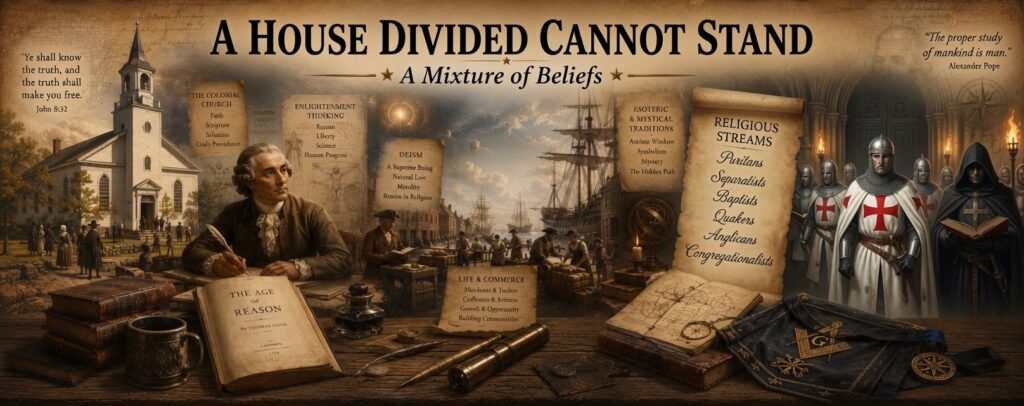
A House Divided Cannot Stand
Long before we begin to question what we believe, we are already looking at the world through an invisible lens—one shaped by our families, our churches, and our teachers, through school and the traditions passed down to us. These thoughts and impressions become part of our identity, our sense of self, until the currents of life quietly shape how we perceive reality itself.
Years ago, in the late nineties, I heard an Enlightenment-minded friend say to our group, “That’s your truth.” She was right, in a way—many people do live according to what they perceive as their own truth. Because God is immutable, truth itself does not change. What changes is the lens through which people understand it. Scripture presents truth very differently. Jesus did not teach that truth is something each generation is free to redefine according to its own perspective. Instead, He ties truth to relationship, obedience, and endurance in His word. Speaking to those who believed Him, He said, “If you abide in My word, you are My disciples indeed. And you shall know the truth, and the truth shall make you free.” (John 8:31–32).
Developmental psychologist Jean Piaget said, “Accommodation of mental structures to reality implies the existence of assimilatory schemata apart from which any structure would be impossible.” In other words, the mind cannot adjust to something new without already having some framework through which to understand it. Rather than approaching each new idea as a blank slate. We naturally interpret through patterns of understanding already formed by our experience.
This is why, as believers, we must build our lives on a sure foundation of God’s Word. We are exhorted to “rightly divide the truth” (2 Timothy 2:15), Greek orthotomeō, meaning “to cut straight” or “to handle correctly”), accurately interpreting and properly applying God’s Word without distortion —Greek strebloō: the twisting or distortion of Scripture’s meaning (2 Peter 3:16).
The farther a believer drifts from the meaning and intent of Scripture, the more difficult it becomes to recognize God’s voice and His call, and the more they move away from the light God gives through His Word. For this reason, the Bible repeatedly warns against adding to or taking away from God’s Word, for every distortion moves us farther from the truth He has revealed and obscures the path He has set before us. “The entrance of Your words gives light; It gives understanding to the simple”(Psalm 119:130)
Without God’s light, these strongholds are not easily abandoned. They reach back through centuries of tradition and have become deeply rooted in the minds of generations. Many were reinforced by persecution, imprisonment, and the blood of martyrs, making them extraordinarily difficult to question.
Frameworks: Individual and Collective
Deeply held beliefs are rarely held by individuals alone. What Jean Piaget described as a schema in the individual mind can become what Thomas Kuhn called a paradigm when it is shared and reinforced by a community. Families, institutions, and generations learn to see the world through the same interpretive lens. A group’s paradigm decides in advance which facts get a fair hearing. Anything that doesn’t line up with the narrative is often dismissed before it is seriously considered. But every so often, a stubborn person or two with facts refuses to go away. And when that happens, something telling occurs. Instead of engaging the claim, the group may view disagreement as betrayal. They may try to correct the dissenter or win them back. Or they may ultimately distance themselves. The more tightly a group’s identity is bound up with its belief, the sharper that reaction becomes. There is often a price to pay for questioning what the group has long accepted as true. For the dissenter, the cost is just as real, for it reaches into a person’s identity, relationships, and sense of belonging. When a deeply held narrative gives way, it disrupts a person’s entire worldview.
Some are willing to follow the evidence, even at the great personal cost. Jesus Himself warned that following Him could require the highest allegiance: “He who loves father or mother more than Me is not worthy of Me. And he who loves son or daughter more than Me is not worthy of Me” (Matthew 10:37).
This same dynamic also works in a positive direction. God often begins His work in the heart of one person before it spreads to many. As an individual’s understanding is renewed, what Jean Piaget described as a schema can become the beginning of a new paradigm shared by a community. Throughout history, many movements of renewal and reform have begun in just this way.
The Catalyst for Reformation
Throughout history, the pursuit of truth by a few courageous individuals has often become the catalyst for movements of renewal and reform. Nearly every genuine movement of reform has begun with a person or a small group of individuals willing to reexamine their beliefs. That process has been studied not only by historians but also by psychologists.
Jean Piaget called these mental frameworks schemas—the patterns an individual mind uses to interpret new experience. Historian of science Thomas S. Kuhn recognized the same dynamic at the level of an entire community, calling it a paradigm. Kuhn observed that people often “see new and different things when looking with familiar instruments in places they have looked before.” The data itself does not change—only the pattern imposed upon it does. Like a hidden image concealed in a painting, the lens can suddenly resolve and refocus on an unmistakable shape. After the shift, it’s difficult to unsee it.
Schemas and paradigms are reciprocal. Individual schemas reinforce the community’s paradigm, while the community’s paradigm continually reinforces the individual’s schemas. Together they become deeply ingrained patterns of thought that shape not only the answers people accept but even the questions they think to ask. The parallel is striking. A child develops a schema through which new experiences are understood. A scientific community, in much the same way, adopts a paradigm that shapes how evidence is interpreted. In both cases, the framework doesn’t just color the answers—it determines which questions are even asked in the first place.
The pages that follow trace this same dynamic throughout church history. Long before any believer sits down to examine Scripture for themselves, they inherit theological frameworks and interpretive assumptions already in place. Denominations become more than collections of doctrines; they become interpretive lenses through which successive generations understand the Bible. As a result, sincere Christians who confess the same Lord and read the same Scriptures often arrive at different conclusions—not because God’s Word has changed, but because they are reading it through different internal frameworks.
Christian psychologist Everett L. Worthington Jr. likewise emphasizes the importance of intellectual humility and explains it in the Journal of Psychology and Theology as “taking a humble stance in sharing ideas, especially when one is challenged or when an idea is threatening.” Such humility allows deeply held beliefs to be examined rather than merely defended. Once these frameworks are established, they are reinforced by what researchers call confirmation bias—the natural tendency to notice evidence that supports existing beliefs while giving less weight to information that challenges them. Over time, interpretations become so familiar that they feel self-evident.
When evidence challenges those assumptions, people may experience what psychologist Leon Festinger called cognitive dissonance—the psychological discomfort that arises when new information conflicts with deeply held beliefs. Resolving that tension may require either rejecting the new evidence or reexamining the framework itself.
This is not a static condition, however. Throughout history, reform movements have arisen when believers have become convinced that their framework no longer accounts for the whole counsel of Scripture. Returning to the biblical text, they discovered truths they had never seen. The words of Scripture had been obscured by their own theological perspectives and teachings from their own denomination. One fracture gave rise to another, each preserving certain convictions and rejecting others. Each movement passes down its interpretive framework to the next generation.
A House Divided Cannot Stand
History rarely changes course in a single generation. Ideas mature slowly. What begins as a subtle shift in belief can, over centuries, reshape a civilization. We often ask why America has drifted so far from the principles that once guided her. Many point to government and education, or the mainstream media. Cultural trends are visible currents on the surface, but Scripture directs our attention deeper—to the human heart, where every nation’s true course is first set.
Jesus taught that if a house be divided against itself, that house cannot stand. (Mark 3:25) Yet the leading figures of the thirteen American colonies did not speak with one voice. Some held firmly to the authority of Scripture. Others were drawn toward the Enlightenment’s confidence in reason. Many stood somewhere in between, by both colonial church life and classical learning. Although the framers shared common concerns about liberty and government, they did not arrive at those convictions by taking the same path.
This spectrum included orthodox Protestants from several traditions. The Puritans embraced covenant theology, believing the well-being of society was tied to faithfulness to God’s covenant and the moral teachings of Scripture. Anglicans retained the structured worship and episcopal government of the Church of England. Presbyterians, shaped by John Knox and the Reformed tradition, governed themselves through elected elders and representative church courts. Throughout the colonies, education and literacy were highly valued so ordinary people could read the Scriptures for themselves.
Baptists emerged from the English Separatist movement. The Separatists had already concluded that the Church of England had retained too much of Rome’s structure and practice, and they separated from it. Baptists carried that conviction a step further by rejecting infant baptism. They believed the New Testament pattern was believer’s baptism—that baptism should follow a personal confession of faith rather than be administered to infants as the sign of the covenant community. For them, baptism did not bring salvation but publicly testified to an inward work of God’s grace, identifying the believer with Christ in His death, burial, and resurrection.
Congregationalists, whose roots lay in the English Puritan and Separatist movements, likewise believed every local church stood directly under the rule of the Lord Jesus Christ. Like other Reformed churches, however, they retained infant baptism, viewing it as the New Covenant counterpart to circumcision and the covenant sign given to the children of believing families. Rather than receiving ministers appointed by distant church authorities, each congregation sought the mind of Christ through prayer and the Scriptures, recognizing those whom the Lord had called to labor among them. In practice, this local autonomy was never entirely separate from civil life. Church membership typically required the approval of the congregation and its ministers, and, for a time, only church members could vote in many colonial affairs..
The Printing Press: A Catalyst for Reform and Division
Long before the Protestant Reformation, Johannes Gutenberg’s invention of movable-type printing in the mid-fifteenth century transformed the spread of ideas. For the first time in history, books could be reproduced in large numbers rather than copied by hand. By the colonial period, Christians were no longer shaped solely by the teaching of their local minister. Its impact on the sixteenth through eighteenth centuries was, in many ways, comparable to the internet in our own day. Information that once traveled slowly through handwritten manuscripts or word of mouth could now be reproduced by the thousands and carried across kingdoms and oceans. Literacy steadily increased, universities expanded, and for the first time in history people gained unprecedented access to the world of ideas. The Bible was no longer the only book finding its way into homes. Sermons, theological debates, political arguments, and histories that had once circulated among scholars and clergy now passed from hand to hand among everyday readers. As people learned to read for themselves, they encountered competing interpretations of Scripture and were forced to wrestle with questions that earlier generations had often left to church authorities.
A sermon preached in London could be reprinted and read aloud in a Boston meetinghouse within months. Pamphlets crossed the Atlantic with merchant ships, and newspapers carried theological disputes alongside political news and shipping reports. Books once accessible only to wealthy libraries and scholars circulated through homes and churches. Conversations in taverns and meetinghouses were increasingly shaped by new ideas and competing opinions. The world of ideas had suddenly become both liberating and confusing, as ordinary believers encountered conflicting interpretations of Scripture, history, and the Christian faith.
The printing press became one of history’s most influential instruments for both the preservation and dissemination of Scripture. As vernacular translations spread, more believers could read God’s Word in their own language and compare what they heard from the pulpit with what they found on the printed page. Yet the same technology also accelerated the spread of competing interpretations, philosophical systems, political theories, religious controversies, and the emerging ideas of the Enlightenment. Voices that had once remained isolated now reached thousands. A new interpretation could cross Europe in weeks and the Atlantic in months. The result was renewed study of Scripture, vigorous theological debate, fresh movements of reform—and, at times, deeper divisions among Christian fellowships.
Once believers possessed both the Scriptures and the freedom to examine them, differences of interpretation became inevitable. The question was no longer whether people could read the Bible but how they understood it. The printing press democratized access to information and enabled God’s Word to spread far and fast. But it also gave believers an unprecedented opportunity to examine the Word for themselves, encouraging the Berean example of “searching the Scriptures daily to find out whether these things were so” (Acts 17:11).
The Roots of Denominationalism
The word denomination comes from the Latin denominare, meaning “to give a name.” By the early eighteenth century, it had acquired its religious meaning as a neutral way of identifying one Protestant body among several. In 1702, for instance, Presbyterians, Baptists, and Independents (later known as Congregationalists) formally united as “the body of the Dissenting Ministers of the Three Denominations in and about the City of London—dissenters from the established Church of England. They remained loyal to the Crown. It was more of a collective description than a mark of division. The abstract noun denominationalism described a broader pattern rather than any particular fellowship and would not appear until the nineteenth century. The recurring patterns of reform, however, were already centuries old by the time the term was coined.
As Protestant churches multiplied, believers increasingly found themselves living alongside fellow Christians who held different convictions while appealing to the same Scriptures. This encouraged a growing acceptance that sincere Christians could disagree on doctrine even while sharing a common source of authority. The example from 1702 shows how the term was used in practice. It referred to several Protestant groups as distinct bodies within the broader Protestant movement. This also explains why the word denomination was different from “sect,” which often implied that only one group possessed the truth.
The word denomination comes from the Latin denominare, meaning “to give a name.” By the early eighteenth century, it had acquired its religious meaning as a neutral way of identifying one Protestant body among several. In 1702, for instance, Presbyterians, Baptists, and Independents (later known as Congregationalists) formally united as “the body of the Dissenting Ministers of the Three Denominations in and about the City of London”—dissenters from the established Church of England who nonetheless remained loyal to the Crown. They acknowledged their doctrinal differences yet adopted the term as a collective description rather than a mark of division. Unlike the word sect, it carried no implication that one group alone possessed exclusive authority. The abstract noun denominationalism would not appear until the nineteenth century. The pattern, however, was already centuries old by the time it was given a name.
As Protestant churches multiplied, believers increasingly found themselves alongside other Christians who held different beliefs yet appealed to the same Scriptures. Over time, many came to accept that sincere believers could disagree on doctrine as long as they recognized the Bible as their final authority. For new believers, though, that can create a genuine dilemma.
I experienced this firsthand in the eighties when I turned twenty. Newly born-again in Christ, I discovered that Baptists believed differently than Pentecostals. They both claimed the Bible as their final authority, yet they reached very different conclusions about spiritual gifts. For me, it raised an unavoidable question—one that, at the time, I asked with a certain naïveté: If God’s Word is the standard, how can sincere believers arrive at such different conclusions?
What I have observed over the years is that people who do not study Scripture for themselves might become dependent on trusted teachers or religious authorities. Philosophers describe this as epistemic dependence—our natural reliance on the knowledge and judgment of others. Over time, confidence in one’s own ability to understand God’s Word can quietly diminish. Psychologist Albert Bandura observed that self-efficacy concerns “people’s beliefs in their capabilities to produce given attainments.” When confidence in one’s ability to search the Scriptures declines, dependence on the interpretations of others naturally increases. They become increasingly vulnerable to a stream of interpretations, opinions, and religious practices, often without knowing whether these are truly rooted in Scripture. Those early discrepancies in what believers believed—and how differently they interpreted the same Bible—ultimately became the catalyst that compelled me to attend Bible college in 1981.
The roots of the denominational fracture run far deeper than the colonial period. They reach back to Constantine’s legalization of Christianity in AD 313 and the establishment of Christianity as the Roman Empire’s official religion in AD 380. Over the centuries, the medieval Catholic Church became the dominant institutional expression of Western Christianity. It preserved and transmitted the Scriptures through generations of monks and scribes who copied biblical manuscripts by hand. For more than twelve centuries, they defined doctrine through councils and theologians, and claimed to speak with binding authority.
The Inquisition
As the centuries passed, growing numbers of clergy, laypeople, scholars, and civil leaders became deeply disturbed by the abuses within the medieval Catholic Church. The Renaissance and, later, the Enlightenment further encouraged many to question long-established religious and political authority. This created an intellectual climate in which people were waking up and increasingly receptive to calls for reform. To ecclesiastical authorities, however, this growing awareness threatened the established order. Working alongside civil rulers, church courts were often used to enforce religious conformity and suppress dissent. This included the Inquisition, which investigated and punished those accused of heresy or departing from the Church’s official teaching.
The medieval Inquisition took shape during the twelfth and thirteenth centuries. It began with Pope Lucius III’s decree Ad abolendam (1184), which instructed bishops to investigate heresy within their dioceses. Under Pope Gregory IX in 1231, these efforts developed into a more centralized papal institution with appointed inquisitors tasked with identifying and prosecuting suspected heretics.
The irony is striking: the protectors became the hunted. The Knights Templar were founded to protect Christian pilgrims and defend the Crusader states. As one of the Church’s most respected military orders, they answered directly to the pope rather than to any king. For nearly two centuries, they faithfully served the Church, earning a reputation for courage, discipline, and loyalty. Over time, generous donations made them one of the wealthiest institutions in Europe, and their extensive financial network allowed funds to be deposited in one region and withdrawn in another. Their wealth, influence, and independence increasingly threatened King Philip IV of France.
Follow the Money
On October 13, 1307, Philip ordered the mass arrest of the Templars. Many confessed to heresy only under torture. Under intense political pressure, Pope Clement V dissolved the Order in 1312, and its Grand Master, Jacques de Molay, was burned at the stake in 1314 after publicly withdrawing his confession. Most historians today conclude that the proceedings were driven more by political ambition and financial interests than by credible evidence of widespread heresy. The episode remains a sobering example of how ecclesiastical authority, political power, and wealth became dangerously intertwined. It also shows how the medieval Catholic Church, under intense political pressure, functioned as part of a system that protected its institutional power and influence at the expense of justice.
The fall of the Templars did not end the growing tensions within medieval Christendom. During the two centuries that followed, the papacy endured political struggles; rival popes divided the Western Church; reformers such as John Wycliffe and Jan Hus called for a return to the authority of Scripture. The rise of powerful dynastic families such as the Habsburgs, together with influential banking families like the Fuggers and the broader struggles among emerging European states, further reshaped the continent’s political and religious landscape. The Fuggers financed emperors, princes, and major projects of the Catholic Church, illustrating how wealth, political power, and ecclesiastical authority had become increasingly intertwined. By the early sixteenth century, the stage had been set for Martin Luther and the Protestant Reformation.
The Reformation
When Martin Luther posted his Ninety-five Theses at Wittenberg in 1517, he ignited the Protestant Reformation. He opposed the papacy’s sale of indulgences, challenging a practice he believed had no foundation in Scripture.
As his study of Scripture deepened, Luther experienced what later became known as his Tower Experience. The name comes from the tower of Wittenberg’s Black Cloister, the Augustinian monastery where he lived. The breakthrough came as he lay on the floor wrestling with Romans 1:17: “The just shall live by faith.” Luther later recalled this turning point in the 1545 Preface to the Complete Edition of His Latin Writings (Praefatio to the Opera Latina), writing that he felt himself to be “altogether born again” as his understanding of the gospel was transformed.“Though I lived as a monk without reproach, I felt that I was a sinner before God with an extremely disturbed conscience. I could not believe that He was placated by my satisfaction. I did not love, yes, I hated the righteous God who punishes sinners… At last, by the mercy of God, meditating day and night, I gave heed to the context of the words, ‘In it the righteousness of God is revealed… as it is written, “He who through faith is righteous shall live.”’ There I began to understand that the righteousness of God is that by which the righteous lives by a gift of God, namely by faith… Here I felt that I was altogether born again and had entered paradise itself through open gates.”
And as profound as that experience was, Luther did not seek to discard every aspect of the medieval church. He retained infant baptism and several church practices inherited from the Catholic tradition, believing they did not contradict the authority of Scripture. This pattern has repeated throughout church history. Reform movements often recover important biblical truths while retaining elements of the traditions from which they emerged. Over time, those movements develop their own traditions, which later generations may themselves seek to reform.
For centuries there had been little room for dissent, but this changed dramatically when the Reformers challenged the Church’s claim to final authority. That act of protest unraveled more than twelve hundred years of institutional religious authority in Western Christendom.
Martin Luther and the other Reformers championed the principle of sola scriptura—Scripture alone as the final authority for doctrine and practice. This freed believers to search the Scriptures for themselves. It also meant that sincere Christians would begin to reach different conclusions about doctrine, church practices, and traditions.
The Recurring Cycle of Reform
The Reformation did not produce a single Protestant church. It began a recurring cycle in which each generation sought to complete the work left unfinished by the one before. The movement that challenged inherited tradition soon found itself debating its own conclusions. While Luther disagreed with Rome, he soon found himself disagreeing with other Reformers. Huldrych Zwingli broke with Luther over the Lord’s Supper. The Anabaptists rejected both the Catholic and Magisterial Reformers on issues such as believers’ baptism and the relationship between church and civil government. John Calvin expanded and refined Reformed theology. In England, the Church of England separated from papal authority, yet many believed it retained too much of Rome’s structure and practice. Puritans sought reform from within, while Separatists concluded that true reform required separation altogether. Across the centuries, the cost was often severe. Within and between various Christian denominations and religious groups, countless believers paid heavy fines, lost their homes and livelihoods, endured imprisonment, faced exile, and in many cases were burned at the stake. Men and women on all sides of these disputes believed they were defending the truth, and generations bore the scars of those convictions.
This pattern continued beyond the sixteenth century. Lutheran, Reformed, Anglican, Baptist, and Methodist traditions each developed into multiple branches, and later movements such as the Holiness and Pentecostal traditions further expanded the landscape. Throughout church history, each generation has recovered biblical truths it believed had been neglected, while also forming new confessions, traditions, and institutional structures of its own.
Scripture points beyond every movement and denomination to a greater purpose: “…that we should no longer be children, tossed to and fro and carried about with every wind of doctrine… but, speaking the truth in love, may grow up in all things into Him who is the head—Christ…” (Ephesians 4:14–15).
The Danger of Inherited Tradition
To understand the mindset of the Separatists, one must recognize that church history is marked by recurring movements of renewal. As biblical truth is brought back into focus, believers seek the freedom to follow Scripture above the authority of men. Every generation inherits assumptions, traditions, and theological frameworks that continue to shape how Scripture is understood. Reformers recovered important biblical truths, yet they also carried forward elements of the traditions from which they emerged.
The pattern would recur throughout church history. One generation challenged inherited tradition. The next established new traditions. Their successors examined those traditions in turn, and the cycle repeated itself. Understanding that recurring cycle helps explain not only the rise of the Separatists but also the development of denominations and the continuing responsibility of every generation to examine its beliefs in the light of Scripture.
History demonstrates how easily spiritual responsibility can be transferred to religious systems. During much of the medieval period, the interpretation of Scripture was largely entrusted to church authorities, and ordinary believers often depended upon institutional structures to understand God’s Word. Spiritual responsibility increasingly flowed upward to institutions rather than outward to believers searching the Scriptures for themselves. It was into this world that the Reformers called the Church back to the authority of Scripture.
The goal of the Christian life is not simply to fit within a religious system or conform to the traditions of men, but to be transformed from the inside out. Jesus warned that outward expressions of religion can exist apart from a heart truly devoted to God:“These people draw near to Me with their mouth, and honor Me with their lips, but their heart is far from Me. And in vain they worship Me, teaching as doctrines the commandments of men.”(Matthew 15:8–9).
Through His Word, Jesus speaks directly to believers, revealing truth, correcting error, and shaping identity. The result is more than changed behavior—it is a new creation, a life being transformed through an ongoing relationship with Him. The apostles proclaimed a new covenant in which God Himself would transform His people from within: “I will put My laws in their mind and write them on their hearts” (Jeremiah 31:33). This principle of the heart extends far beyond politics and government, doctrines and denominations. God’s vision and purpose stand above traditions, theological systems, and the structured frameworks.
A Diverse and Divided Christianity
The Separatists broke from the Church of England, which had itself broken from Rome. Luther broke with Rome while retaining many inherited medieval practices. Calvin, building on the Reformation, nevertheless differed with Luther on matters such as the Lord’s Supper and church government. The pattern continued through the centuries. If believers could not reach complete agreement among themselves, how could they speak with a single theological voice capable of founding a distinctly “Christian nation?”
The delegates who gathered in Philadelphia inherited more than a century of colonial self-government shaped by Anglicans, Congregationalists, Presbyterians, Baptists, Quakers, Lutherans, Catholics, and other religious traditions. Some were devout Christians; others were influenced by Enlightenment thought and natural-rights philosophy. They understood that no single denomination could command the consensus necessary to become the nation’s established church. Rather than elevate one tradition above another, the Constitution prohibited a national church and protected the free exercise of religion, allowing differing convictions to coexist without any one claiming civil supremacy.
Yet civil liberty is not the same as spiritual unity. The Constitution protects freedom of conscience, but it cannot produce the unity of the faith. That work belongs to Christ alone through His Spirit. “We all come to the unity of the faith and of the knowledge of the Son of God, to a perfect man” (Ephesians 4:13).
Scripture’s greatest miracle is the unity of the faith. The goal is not merely agreement but maturity—to a perfect man—the full stature of Christ formed in His body. How else could people from different backgrounds, personalities, traditions, and convictions become one body in Christ? Such unity cannot be manufactured by legislation, denominational mergers, or ecumenical councils that simply agree to disagree. Genuine unity is not achieved by compromising truth but by growing together into Christ, who is Himself “the way, the truth, and the life” (John 14:6).
The Constitution protects freedom of conscience, and is a political arrangement that blends different ideas and interests to hold together a diverse society, but it is a very different kind of unity altogether. It is designed for civic order, not for spiritual life; a framework for coexistence, not a reality that makes many believers one in Christ.
It can safeguard liberty, but it cannot produce the unity of the faith. That work belongs to Christ alone through His Spirit, as believers are transformed into His likeness and grow together in Him. Genuine unity is not achieved by compromising truth but by growing together into Christ, who is Himself the Truth. The Constitution can protect freedom of conscience, but it cannot produce the unity of the faith.
Denominationalism – Sources and Further Reading
- Kuhn, Thomas S. The Structure of Scientific Revolutions. Chicago: University of Chicago Press, 1962.
- Piaget, Jean. The Origins of Intelligence in Children. Translated by Margaret Cook. New York: International Universities Press, 1952.
- Worthington, Everett L., Jr. Coming to Peace with Psychology: What Christians Can Learn from Psychological Science. Downers Grove, IL: InterVarsity Press, 2010.
- Festinger, Leon. A Theory of Cognitive Dissonance. Stanford, CA: Stanford University Press, 1957.
- Luther, Martin. Preface to the Complete Edition of Luther’s Latin Writings. 1545. (Source of Luther’s own account of his “Tower Experience” and the discovery of justification by faith.)
- Zwingli, Huldrych, and Martin Luther. The Marburg Colloquy, 1529. (Primary record of the Lord’s Supper dispute between Zwingli and Luther.)
- Bandura, Albert. Self-Efficacy: The Exercise of Control. New York: W. H. Freeman, 1997.
- Hardwig, John. “Epistemic Dependence.” The Journal of Philosophy 82, no. 7 (1985): 335–349.
About the Author Mark Thomas
Mark is a visionary leader and writer who helps others discover their God-given purpose. See his teaching series www.LiveandGrowonPurpose.com