
- You are here:
- Home »
- Leadership »
- The Curious Legacy of Benjimin Franklin
The Curious Legacy of Benjimin Franklin
Years ago, a friend pressed a book into my hands as a gift. It took its title, Fart Proudly, from a satirical essay Benjamin Franklin wrote around 1781. Franklin aimed his irreverence at the Royal Academy of Brussels, a respected learned society, because he thought its members were spending their intellectual energy on questions of little practical value. He countered with a mock proposal for a drug to make passing gas smell pleasant, joking that it would do more for everyday life than the work of Aristotle, Newton, or the Academy, which together were “scarcely worth a FART-HING.” Franklin’s wit proved no less formidable than his political wisdom. His point was simple: if brilliant minds are going to investigate something, why not pursue knowledge that genuinely improves everyday life?
That same practical mindset had appeared decades earlier. In proposing his Albany Plan of Union in 1754, Franklin looked beyond Europe’s conventional wisdom. Many colonists regarded the Haudenosaunee, a confederacy of Native American nations, as “savages,” but Franklin did not dismiss their political system on that basis. He studied how the Confederacy’s six distinct nations had remained united while keeping their independence, and in 1751 concluded: “It would be a very strange Thing, if Six Nations of ignorant Savages should be capable of forming a Scheme for such a Union… and yet that a like Union should be impracticable for ten or a Dozen English Colonies.” Franklin’s life and wit followed an unconventional path. He measured ideas by their usefulness, believing practical wisdom could be found in the least expected places. His life became one of the founding generation’s most remarkable stories.
Franklin’s Beginnings at Home and Abroad
Born in Boston in 1706 as the fifteenth of seventeen children, Franklin left school at ten to work in his father’s candle and soap shop. His formal education lasted only about two years: roughly one year at Boston Latin School and another at a school for writing and arithmetic. He never returned to a classroom. Instead, he educated himself by borrowing every book he could find, sharpening his prose by studying and rewriting essays from The Spectator, a London periodical, and later teaching himself French, Italian, Spanish, and Latin. The boy who left school at ten would later receive honorary degrees from Harvard, Yale, and Oxford. An honorary doctorate from St Andrews earned him the title he would keep for the rest of his life: “Dr. Franklin.”
At age twelve, Franklin was apprenticed to his older brother James in the printing trade. Five years later, after a bitter dispute, the seventeen-year-old left Boston and arrived in Philadelphia nearly penniless. He found work at Samuel Keimer’s printing shop, where his talent caught the attention of Pennsylvania Governor Sir William Keith. Impressed by the young printer, Governor Keith urged Franklin to establish his own printing business and promised to finance the venture. Young Franklin sailed to London to buy presses and equipment, only to discover the promised letters of credit did not exist. His first entrepreneurial venture collapsed before it began. He supported himself as a printer in London for nearly two years. Returning to Philadelphia with greater maturity and determination, he set about building his own business. Years later, Franklin reflected that Keith was “a compleat Promiser; but Performance was where he fail’d.” (Original eighteenth-century spellings) After overcoming that setback, Franklin opened his own shop in 1728 with partner Hugh Meredith, and in 1729, they bought Samuel Keimer’s struggling newspaper and renamed it the Pennsylvania Gazette.
Married with Children
At twenty-four, Franklin entered a common-law marriage with Deborah Read in 1730. Their union lasted more than forty years until her death. Deborah helped raise William, Franklin’s son from an earlier relationship. Together, they had two children: Francis Folger Franklin and Sarah Franklin. Their young son, Francis, died of smallpox at the age of four. Deborah did not bring wealth to the marriage, but her faithfulness became indispensable to Franklin’s growing success. With a steady partner at home and in the shop, Franklin turned to a new venture. An annual booklet centered on the satirical persona of the fictional Richard Saunders, Poor Richard’s Almanack blended weather forecasts, practical advice, and memorable proverbs. Franklin began publishing it in 1732. Poor Richard brings to mind the early seasons of Married… with Children: a perpetually broke husband struggling to make ends meet, enduring the constant complaints of his wife, Bridget, and always searching for another way to earn a few shillings. That was Franklin’s joke. Poor Richard’s everyday misery made him relatable, and readers returned each year not only for his practical advice but also to see how their old friend was getting along. For twenty-six years, Poor Richard Saunders wrote the Almanack’s prefaces, and in one he answered readers’ curiosity about himself: “Who is Poor Richard? People oft enquire, / Where lives? What is he?—never yet the nigher. / Somewhat to ease your Curiositie, / Take these slight Sketches of my Dame and me.” Poor Richard became one of colonial America’s best-known literary characters, and readers followed him from edition to edition, delighting in the fiction as much as the wisdom it conveyed. The Almanack became one of Franklin’s most profitable ventures, providing him with a healthy and dependable income for years.
A Curious Mind
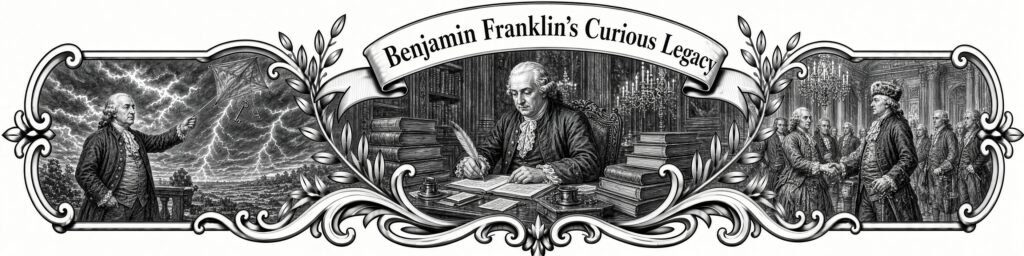
Franklin embraced the English empirical tradition of Sir Francis Bacon and Isaac Newton and their practice of careful observation and disciplined experiment. Even as a boy, Franklin collected facts and observations. Nature revealed its secrets to those willing to observe carefully and then test their conclusions. His curiosity led him to many places and filled his mind with interesting ideas. He made it a habit to record even the smallest details of the natural world. By comparing weather reports from different colonies, Franklin saw that storms followed predictable paths and devoted himself to studying their behavior. He was also famously fascinated by electricity, experimenting with sparks and static charges to investigate the nature of lightning, work that led to the invention of the lightning rod.
Financial independence freed Franklin to pursue his ambitions. Most men in his position might have settled into the comfortable life of a prosperous colonial gentleman, enjoying the rewards of success. Instead, in 1748, at age forty-two, he stepped away from the daily demands of his printing business and left it to his partner, David Hall, so he could pursue his many interests. Franklin still served as Clerk of the Pennsylvania Assembly and as Postmaster of Philadelphia, a position he took in 1737. His postal responsibilities expanded in 1753, when he became joint deputy postmaster general for British North America. The role brought him into closer contact with people across the colonies and broadened his knowledge of colonial life, commerce, and politics. He met many men who would later shape the American Revolution. He also remained in regular contact with officials in London, further expanding his influence on both sides of the Atlantic. The postal service was the British Empire’s communications network, and Franklin stood at its center in North America. He inspected post roads and post offices, established more efficient mail routes and delivery schedules, supervised local postmasters, and coordinated correspondence between England and America. Few men of his generation had a broader understanding of the colonies, their commerce, or the growing network of relationships that held the empire together.
Franklin’s curiosity extended to international cuisine, a trait he shared with Thomas Jefferson. Where Jefferson sketched a macaroni machine in France and later had one shipped from Naples, Franklin sent soybeans home from London to his friend John Bartram, along with a description of the Chinese “cheese” now known as tofu. Franklin also had an eye for talent, recognizing George Whitefield’s extraordinary gift for preaching and supporting his ministry despite their religious differences. Perhaps that same ability to see promise in others later led him to take an interest in the struggling Thomas Paine and give the young Englishman a letter of introduction that opened the door to a new life in America.
Franklin’s Years in England and France
In 1757, at age fifty-one, Franklin took leave of his wife and daughter and sailed to England as the Pennsylvania Assembly’s agent. The position combined lobbyist and diplomat, charged with bringing the colony’s interests before the British government. Public service kept him abroad for much of the next eighteen years. He represented colonial interests before the British government. Franklin repeatedly urged Deborah to join him, hoping she would overcome what he called her “unreasonable prejudice against the sea,” but she never crossed the Atlantic. Their letters show both affection and the quiet strain of their long separation. Franklin often closed with the words, “your affectionate husband.” Deborah stayed in Philadelphia, managing the household and family affairs until she died in 1774, while Franklin was abroad. He never saw her again. When Franklin returned to Philadelphia in May 1775, the war had already begun at Lexington and Concord. Within days, he took his seat in the Second Continental Congress, and the following year he helped draft, then signed, the Declaration of Independence.
Franklin’s curiosity extended beyond the natural sciences. It reached into distant realms of human and esoteric knowledge, sometimes highly controversial. Nowhere was this more apparent than in the company he kept. During his years in England, he formed a genuine friendship with Sir Francis Dashwood, the colorful aristocrat whose Hellfire Club gained a reputation for scandal and political satire. Dashwood was, in effect, Franklin’s superior. From 1766, he served as one of Britain’s two joint Postmasters General, the officials to whom Franklin answered as deputy postmaster for North America. Franklin was a repeated guest at Dashwood’s country estate and maintained a correspondence with him for several years. It is hardly surprising that a secretive society left no reliable membership rolls identifying all its participants. No credible primary documentation identifies Franklin as a member of the Hellfire Club. Much of the modern speculation traces to Donald McCormick, writing under the pseudonym Richard Deacon, whose books The Hell-Fire Club: The Story of the Amorous Knights of Wycombe (1958), A History of the British Secret Service (1969), and The Silent War (1978) advance claims many historians consider inadequately documented. Readers who wish to explore those arguments further are free to examine the evidence and draw their own conclusions. Still, it is hard to imagine that a man who repeatedly visited Dashwood and enjoyed such a close friendship remained entirely unaware of his reputation.
Franklin also took part in a surprising collaboration with Dashwood. In 1773, the two men produced an abridged version of the Anglican Book of Common Prayer. It was an unlikely project for the club’s founder, but by then the club had long since faded, and both men were in their sixties. Though Franklin doubted much of Christian doctrine, he valued religion for its practical good, and the project’s aim, shorter services that might draw more people to church, was one he could readily endorse.
Freemasonry Connection
Franklin’s openness to a wide range of intellectual and philosophical circles was also evident in Freemasonry. At twenty-five, after returning to Philadelphia, he joined St. John’s Lodge, the city’s first known Masonic lodge. Three years later, his election as Grand Master of Pennsylvania Freemasonry placed him at the head of one of the eighteenth century’s most influential English secret societies. That same year, he printed James Anderson’s Constitutions of the Free-Masons, the first Masonic book published in America.
Bound by solemn oaths and degrees of hidden knowledge, English Freemasonry drew on Hermetic and Kabbalistic symbolism, along with pagan influences. But in France, the esoteric strand flourished most. Freemasons there created dozens of elaborate higher degrees steeped in chivalric legend and ritual magic. Franklin’s lodges in Philadelphia, by contrast, adhered to the simpler three degrees of English Masonry, rich in allegory but far removed from the mysticism of the French higher degrees.
Franklin remained an active Mason for the rest of his life and later joined the Lodge of the Nine Sisters in Paris. Unlike the mystical French higher degrees, the Nine Sisters was devoted to reason and science. It was named for the nine Muses, the Greek goddesses who inspired the arts and sciences. The lodge gathered leading Enlightenment thinkers, artists, and scientists and rallied support for the American cause. In 1778, Franklin helped escort the aging Voltaire through his initiation, at which Voltaire received the Masonic apron of the late philosopher Helvétius. After Voltaire’s death that year, Franklin joined a Masonic memorial in his honor. The ceremony defied the Church’s condemnation of Voltaire and drew the wrath of the Grand Orient, the governing body of French Freemasonry. The following year, Franklin was elected the lodge’s Master, and his prestige helped restore its standing.
George Washington was also a Freemason. In 1793, he laid the cornerstone of the U.S. Capitol in a Masonic ceremony, wearing a richly embroidered apron made in France, a gift that reflected Franco-American goodwill. Yet the two men differed in temperament. The reserved Washington kept his convictions guarded, while the sociable Franklin openly engaged with unorthodox ideas that unsettled more conventional believers. Thomas Jefferson joined Franklin in Paris in 1784 and succeeded him as minister to France the following year. The two shared unorthodox religious views, but no credible evidence shows Jefferson ever became a Mason.
Controversy continued to follow old Franklin. In 1998, the remains of at least fifteen people were found beneath his former London home on Craven Street. Forensic investigators traced them to an anatomy school run there by surgeon William Hewson, one of Franklin’s closest friends. At the time, cadavers were scarce and often obtained through questionable means. Whether Franklin tolerated the practice or quietly supported it to advance medicine remains unknown. Whatever the answer, it reflects a man whose curiosity still stirs historical debate. To view Franklin, or any of his contemporaries, through a narrow lens is to miss the depth and difficulty of the era they lived in. No single trait, accomplishment, or moral failing defines a man’s life.
The Hutchinson Letters
Franklin retained his postal office while serving in England until 1774, when the British government dismissed him after the Hutchinson Letters Affair. Several royal officials in Massachusetts were worsening the crisis by urging the British ministry to tighten its control over the colonies. Hoping to expose the problem, Franklin quietly forwarded letters written by Thomas Hutchinson, later governor of Massachusetts, in which Hutchinson argued that the colonies should accept greater restrictions on their self-government under British authority. Franklin intended the letters for a small group of colonial leaders, hoping to identify the officials responsible and encourage reconciliation with Britain. Instead, they became public. Summoned before the Privy Council, Franklin accepted responsibility and endured a humiliating public denunciation. The affair marked a decisive turning point. Franklin lost one of the highest offices in British North America for refusing to compromise his principles. Long committed to reconciliation, he continued seeking a peaceful settlement, but his confidence in the British government had been deeply shaken. Events soon proved him right.
By 1776, the break with Britain had culminated in the American colonies formally declaring independence. Franklin played a central role in that historic moment as a member of the Continental Congress and one of the signers of the Declaration of Independence, which announced the colonies’ separation from British rule and set forth their case for self-government.
Paris and the Secret War
Late in 1776, Congress sent the seventy-year-old Franklin to France as one of three American commissioners seeking support for the war. Hailed in Paris as the man who “snatched lightning from the sky and the scepter from tyrants,” Franklin helped secure the 1778 Treaty of Alliance, which brought France into the war. Franklin served as America’s minister to France from 1779 and helped negotiate the 1783 Treaty of Paris, which ended the war, before returning home in 1785. Yet his years abroad also left behind some of the most enduring questions about his loyalties.
Some historians argue that Franklin’s decades in London made him more than a colonial postal official working within the British system. In their view, he was an active British intelligence asset throughout the Revolution. The evidence is circumstantial, but it is not trivial. Richard Deacon alleged that Franklin used the alias “Brother Benjamin of Cookham” in Sir Francis Dashwood’s circle, although no independent documentation has established the claim.
The Papers of Benjamin Franklin, edited by William B. Willcox and others, show that he was also acquainted with the Chevalier d’Éon, one of the era’s most notorious secret agents. He was also a founding investor in the Grand Ohio Company, a British land scheme that gave him a financial stake in the Crown’s favor. The scheme stalled and then collapsed with the coming of war, though Franklin had withdrawn his name from it by then. Then there were the leaks. In Paris, French and American diplomats complained that the British government seemed to learn every American move almost as soon as it was made.
Historians now trace those leaks to Edward Bancroft, the American commission’s own secretary and a paid British spy. Bancroft is one of the best-documented figures in Revolutionary War espionage history. British payment records and correspondence confirm this, and even the CIA’s own published history treats Bancroft’s role as a British spy as settled fact. King George III privately called Bancroft “the most valuable man” in British service, and the Crown granted him a pension of one thousand pounds a year when he retired. Bancroft’s treachery, however, points in two directions. It shows how deeply British intelligence had reached into Franklin’s circle, but it also suggests Franklin was likely a target of that intelligence rather than one of its agents. Still, the episode deserves attention because it reveals a recurring pattern throughout this history: the struggle to distinguish truth from fiction.
The men who built the republic often moved with ease between different worlds: colonial and British, public and secret, private brotherhoods and public loyalties. Franklin was hardly alone. George Washington ran spy networks, most famously the Culper Ring, a group of ordinary New Yorkers and Long Islanders who used code names, invisible ink, and secret couriers to report on the British army occupying New York City. John Jay led an early counterintelligence committee that hunted Loyalist plots in New York, and Paul Revere belonged to a Boston circle that tracked British troop movements. Because later generations can only work from the documents these men chose to keep, we may never fully understand how those worlds overlapped.
Back in Philadelphia, Franklin’s final years of public life carried him to the Constitutional Convention of 1787, where, at eighty-one, he was the oldest delegate present. Though age and infirmity limited his participation, Franklin made a final appeal for unity among the delegates. His famous observation that the sun carved on Washington’s chair was “a rising and not a setting Sun” became one of the Convention’s most enduring images.
A Correspondence of Faith and Reason
Just as Jefferson and Adams stayed in touch, Benjamin Franklin and George Whitefield maintained a warm correspondence for nearly three decades. Franklin always replied with courtesy and even affection, writing on one occasion, “Your frequently repeated Wishes and Prayers for my Eternal as well as temporal Happiness are very obliging.” Yet he never accepted Whitefield’s repeated calls to conversion.
Whitefield had moral contradictions of his own. In 1740, Franklin published an open letter in which Whitefield rebuked southern slaveholders for their cruelty, declaring, “I think God has a quarrel with you, for your abuse of and cruelty to the poor negroes.” He insisted that enslaved Africans were in no way inferior by nature and fully capable of salvation. Yet Whitefield stopped short of condemning slavery itself. During the early 1740s, Whitefield believed his Bethesda orphanage should rely on voluntary gifts and God’s provision. Franklin warned Whitefield that Georgia was the wrong place for his Bethesda orphanage, where materials and workers were scarce and costly. He urged him to build it in Philadelphia instead. Whitefield refused, and the financial pressures Franklin foresaw followed. When financial difficulties mounted, he began seeking a permanent source of income. Within a decade, the ordained Anglican priest lobbied to legalize slavery in a colony that had originally banned it, declared he had “no doubt” of its lawfulness, and eventually owned about fifty enslaved people. During that same decade, Whitefield also saw his audiences decline, at one point describing crowds shrinking from twenty thousand to only a few hundred.
Franklin was not free of the stain. Over his lifetime, he owned at least seven enslaved people, mostly domestic servants rather than plantation laborers. His newspaper also profited from advertisements for slave sales and runaways. As early as 1757, before sailing for London, Franklin drafted a will granting two of them, Peter and Jemima, freedom upon his death. By the time he died in 1790, he owned none; some had died, others had run away or been transferred, and Pennsylvania’s 1780 gradual emancipation law had further weakened the institution around him.
In his final years, Franklin served as president of the Pennsylvania Abolition Society and, about two months before his death, signed its petition urging Congress to act against slavery and the slave trade. The contrast with Whitefield is stark: the evangelist moved from criticizing the mistreatment of enslaved people to defending the institution itself and owning dozens of people to support his orphanage. Yet for all their differences, both men would ultimately face a question greater than anything they had accomplished in this world.
What Shall it Profit a Man?
Franklin died in Philadelphia in 1790 at the age of eighty-four, having outlived Deborah by more than fifteen years and helped birth a nation. Some twenty thousand people are said to have attended his funeral, a sign of how deeply his life had become woven into the city he once entered as a penniless seventeen-year-old. Franklin had a rare ability to question what others accepted and challenge convention, not to stand apart, but to discover what was true and useful. Every generation inherits philosophies, traditions, and frameworks that gradually harden into dogma and sacred cows. Some still illuminate, while other beliefs become intellectual baggage. Wisdom is measured not by how much we know, but by our willingness to examine what we have received, set aside what is not true, and keep pressing forward. As Solomon observed, “The simple believes every word, But the prudent considers well his steps” (Proverbs 14:15).
We live in an age flooded with information yet starved for discernment. Franklin’s satirical style reminds us that knowledge reaches its highest purpose not when it satisfies curiosity or displays brilliance, but when it serves people. Franklin’s jab at the Royal Academy of Brussels was never really about flatulence; it was a plea for brilliant minds to turn their attention toward what genuinely benefits mankind.
There is much to applaud in Franklin’s life: a generous concern for the common good and a lifetime of service. Few men of his generation gained as much of the world through intrigue, adventure, wealth, and renown. Yet even the noblest humanitarian virtues cannot open the door to heaven. Franklin spent a lifetime discovering what made the world work, but as life drew to a close, one can only hope he considered the one question that mattered more than all the rest: What had he gained for eternity? “For what will it profit a man if he gains the whole world, and loses his own soul?” (Mark 8:36).
About the Author Mark Thomas
Mark is a visionary leader and writer who helps others discover their God-given purpose. See his teaching series www.LiveandGrowonPurpose.com