
- You are here:
- Home »
- Spiritual Sonship »
- Our High Calling of God in Christ Jesus
Our High Calling of God in Christ Jesus
The strongest Christian influence in early America came through believers who, despite their many flaws and failures, sought to order their lives according to Scripture. Yet the idea of being a pilgrim did not begin with the voyage of the Mayflower.
Peter describes believers as “strangers and pilgrims” (1 Peter 2:11). Our citizenship is not rooted in any earthly nation, but in the Kingdom of God. Abraham himself “sojourned in the land of promise, as in a foreign country,” while looking for “the city which has foundations, whose builder and maker is God” (Hebrews 11:9–10).
The early settlers often understood their journey through a biblical lens. Seeking refuge from persecution, they established self-governing communities where Scripture shaped both daily life and public order. It is important not to romanticize these communities. Some were highly legalistic and enforced strict religious conformity, and many who professed Christian faith participated in practices that conflicted with those beliefs, including the enslavement of Africans and the violent displacement of Native Americans. These tensions reflect the complexity and inconsistencies found in man’s fallen nature.
Despite these moral failures, these communities cultivated habits of self-government through town meetings and local assemblies long before a national government existed. Freedom became part of the fabric of colonial life, though it was not experienced equally by all. The federal government that eventually emerged did not create that heritage—it inherited it.
Small self-governing communities were where Scripture shaped daily life. The Puritans followed, building tightly organized societies in which religious activities and daily responsibilities were closely connected. Pastors and ministers became central voices in shaping public morality in the colonies. Long before there was a unified national government, communities developed self-government through town meetings, church covenants, and local assemblies. This inherited tradition of faith and local governance had already shaped the colonies. The federal government that would later form did not create these influences; it inherited them.
The Called-Out Ones
The word translated “church” in our English Bibles is the Greek ekklesia, derived from ek (“out of”) and kaleō (“to call”). While it is often explained as “the called-out ones,” in its original usage it referred more broadly to an assembly or gathering, especially one summoned for a purpose.
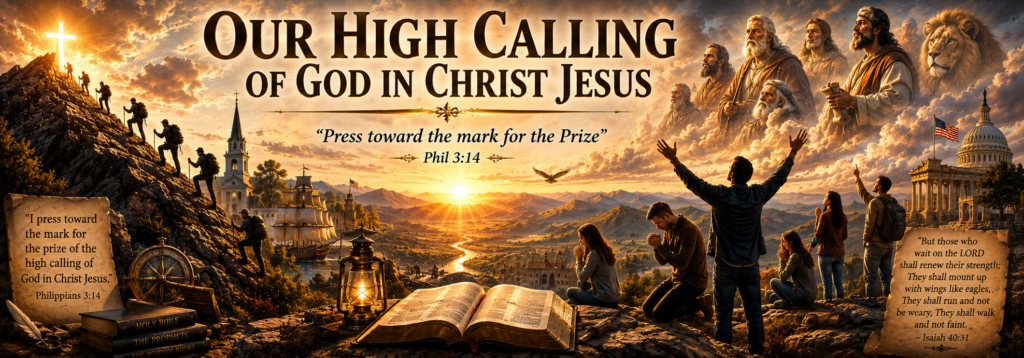
In the New Testament, it comes to describe those who are gathered by God through Christ. It is not a building, an institution, or a denomination. Rather, as used in Scripture, it points to a people who respond to the high calling of God in Christ Jesus. Those who are set apart by the redemptive work of Christ. They walk in the delegated authority of His Son. The believer’s identity is not defined by earthly allegiances but by the high call of God in Jesus Christ Himself:
” I press toward the mark for the prize of the high calling of God in Christ Jesus.” (Philippians 3:14)
England’s reach into colonial life didn’t end when the first ships landed. The authority of the Crown, English common law, and various forms of religious establishment followed the settlers across the Atlantic. It continued shaping colonial society for nearly seven generations.
I’ve often wondered how the colonists understood their own earthly journey. Living under the authority of the English Crown, established religion, and traditions—each with its own reading of Scripture. They sought the freedom to order their lives according to what they believed. Not all were driven by faith or religion. Some sought opportunity. Others just wanted to be left alone. Like every generation, they understood Scripture and the arduous demands of pioneer life.
The authority of the Crown, English law, and various forms of religious establishment were embedded in colonial life. The British Crown had a substantial interest in the establishment and success of the colonies, viewing them as an important extension of England’s economic and imperial interests. Yet beneath the surface, another spirit was quietly growing.
The Crown noticed the dissent and gradually strengthened its authority over the colonies. Many colonists came to believe that their liberties were being eroded by increasing government control and taxation. Events such as the Boston Tea Party had become powerful symbols of growing resistance. Conversations increasingly turned toward self-government and liberty of conscience. They had the right to govern their own affairs. After nearly seven generations of colonial life, colonists increasingly questioned the authority of a distant monarchy. Like dry wood catching flame, grievances fed each other, fueling an angry fire that wouldn’t die. Political strain and economic hardship had wounded men’s faith until anger sparked the American Revolution. In time, many colonists turned away from both crown and religion. They united around a cause of freedom. The cry for liberty was not just heard; it was felt, and it bound them together. Scripture says, “Where no wood is, the fire goeth out” (Proverbs 26:20). Yet here the fuel piled up year after year—unanswered wrongs, quiet suffering, and hope that would not fade. Some were wild, but most were resolute. Their desire for freedom could no longer be held back.
“By the rude bridge that arched the flood, their flag to April’s breeze unfurled, here once the embattled farmers stood, and fired the shot heard round the world.”
Let this mind be in you
The called-out ones are not merely summoned to believe differently; they are summoned to think differently—to perceive life, identity, and purpose through the mind of Christ rather than through the assumptions of the age. This is not a superficial shift in opinion or preference, but a profound reorientation of the inner life. It is a transformation that reaches into the very framework through which we interpret reality, moving us from self-centered reasoning to God-centered understanding.
Decades ago, Apple’s celebrated slogan urged a generation to Think Different, honoring those who defied convention and reshaped the world through imagination and innovation. It celebrated the rebels, the visionaries, the ones who refused to accept inherited limitations. In its own way, Steve Jobs touched on a genuine principle: progress often begins when assumptions are questioned, and boundaries are challenged. Humanity advances when it dares to see beyond what has always been.
Yet there is also a profound danger. Not every boundary exists to restrain us; some exist to protect us. From the beginning, humanity has been tempted to cross thresholds God never intended us to enter, believing that significance, wisdom, or fulfillment lay just beyond them. The first doorway was opened in Eden, where the promise was not merely greater knowledge, but the power to define reality apart from the Creator. Ever since, mankind has repeatedly mistaken forbidden paths for higher enlightenment. We search for significance through secret knowledge, autonomous reason, technological mastery, spiritual experiences, political ideologies, and countless other promises that assure us we can become more by looking beyond God’s revealed will. Yet every doorway opened apart from Him ultimately leads us farther from the One in whom true wisdom, identity, and life are found.
Yet the Gospel presses further still. It does not simply call us to diverge from the crowd, but to depart from our fallen nature. The world’s version of “thinking different” often leads to greater independence, greater self-definition, and a deeper confidence in human reasoning. But Scripture reveals that the root problem is not merely conformity to society—it is conformity to a nature estranged from God.
From Eden onward, humanity has grasped at the right to define truth for itself. The serpent’s temptation was not merely about disobedience; it was about autonomy—the promise that humanity could determine good and evil apart from God. That impulse has echoed through every age, shaping philosophies, cultures, and identities built on self-determination. Even our most celebrated innovations can carry this underlying assumption: that we are the ultimate authors of meaning.
In Christ, however, we are invited to relinquish that claim. The call of the Gospel is not to refine our independence, but to surrender it. It is not to elevate our own perspective but to receive an entirely new one. As Paul declares, we are given the mind of Christ (1 Corinthians 2:16). This is not merely an intellectual upgrade, but a relational reality—a participation in the very perspective of the Son, who lives in perfect union with the Father.
To think with Christ is to see as He sees: to value what He values, to discern truth through His Spirit, and to interpret life through the lens of His kingdom. It reshapes how we understand identity and purpose. It teaches us to measure reality not by cultural consensus or personal preference, but by divine revelation.
The deepest transformation, then, is not learning to think apart from God, but learning to think with Him. It is a movement from autonomy to communion, from self-definition to God-given identity, from isolated reasoning to shared understanding with the One who is Truth itself. In this, the call to “think differently” finds its fullest and truest expression—not in independence from God, but in intimate alignment with Him. Paul captures this with remarkable clarity: “Let this mind be in you which was also in Christ Jesus” (Philippians 2:5). Paul captures this with remarkable clarity: “Let this mind be in you which was also in Christ Jesus” (Philippians 2:5). Not a mind shaped by the spirit of this age, or one formed by the shifting opinions of the world, but one transformed by the renewing of the mind through Jesus, the Word of Truth. The call of the Gospel is not merely to think differently from the surrounding culture, but to be transformed by the renewing of our minds in Christ.
Jesus is the pattern Son—the prototype, typos (τύπος), meaning pattern, type, and example—the first model, “the firstborn among many brethren” (Romans 8:29). We are not called merely to admire Him, but to walk with Him. As His Father shaped Christ through obedience and suffering, so He shapes His sons and daughters. Jesus “increased in wisdom and stature, and in favor with God and men” (Luke 2:52); we too are being formed—little by little—into His likeness. Not by striving for others’ approval, but by learning to walk with the Father until the character Jesus is formed and reflected in our own.
The promise extends beyond individual transformation. Jesus declared, “He who believes in Me, the works that I do he will do also; and greater works than these he will do” (John 14:12). As the corporate body of Christ grows into the fullness of God, the ekklesia is called to demonstrate the life of Christ and continue His ministry of reconciliation. (2 Cor 5:18-20
Four Quadrillion to One
Consider for a moment the improbability of your own existence. Some statisticians have attempted to calculate the odds of being born, suggesting odds of one in the quadrillions. Even such staggering numbers fail to account for the countless generations and providential miracles that converged to bring a single life into existence. Given how improbable our existence is, our lives are not insignificant. We are not random accidents drifting through history. We were born at a specific moment with a unique calling.
As Scripture declares, “We are His workmanship, created in Christ Jesus for good works, which God prepared beforehand that we should walk in them” (Ephesians 2:10).
The Christian life is not passive. God does not merely prepare good works for us; He calls us to peripateō (περιπατέω)—to walk, conduct our lives, and order our daily steps in them.
Rotherham says it plainly: “A purpose sustained, thou wilt guard, saying, Prosper! Prosper! Because in thee, hath he been led to trust.”
God protects and sustains us as we live out the purpose He has intended for us. Along that path, step by step, we learn to trust. He shapes our character—patiently, deliberately—conforming us to the image of His Son. God does not leave the soul empty. He reveals Himself to His Church. Before there is a commission, there is communion. Each member possesses a unique role that contributes to the growth, maturity, and strength of the body of Christ.
As Scripture declares, “from whom the whole body, joined and knit together by what every joint supplies, according to the effective working by which every part does its share, causes growth of the body for the edifying of itself in love” (Ephesians 4:16).
The Christian life is not merely about avoiding sin or escaping judgment; it is about responding to His divine calling. He faithfully reveals what we could never discover on our own. “Call to Me, and I will answer you, and show you great and mighty things, which you do not know” (Jeremiah 33:3).
As we walk with Him, He reveals both our place within His body and our purpose in His Kingdom. Every believer is invited into a life of spiritual growth and faithful stewardship. Beyond debates over history, beyond national identity, and competing interpretations of the past, one question remains: Jesus asks all of us. Who do you say I am? The believer’s identity is not rooted in earthly systems or the purposes of earthly nations. It is rooted in a kingdom that cannot be shaken.
“For our citizenship is in heaven, from which we also eagerly wait for the Savior, the Lord Jesus Christ.” (Philippians 3:20).
Go Ahead – Roll the Dice
People spend fortunes chasing lottery jackpots, or striving after the next great achievement, yet everything this world offers is temporary. The question for eternity is: do you realize what you’re passing up? Go ahead — roll the dice.
Believers are “heirs of God and joint heirs with Christ” (Romans 8:17). Our inheritance is beyond anything we could imagine.
True to form, Satan offers a counterfeit transformation. He pulled out the same bag of tricks at the fall, but be careful; soon he will know his time is short. What Satan falsely promised in Eden, Yahweh Elohim alone fulfills—through the redemption of humanity and the glorification of His sons and daughters.
Paul declares that just as we have borne “the image of the man of dust,” we shall also bear “the image of the heavenly Man.” This corruptible will “put on incorruption,” and this mortal will “put on immortality” (1 Corinthians 15:49, 53). Our destiny is not merely to exist forever, but to bear His likeness, to share His glory, and to participate in His eternal Kingdom.
In light of eternity, the pursuits of this world quickly lose their appeal. James reminds us, “For what is your life? It is even a vapor that appears for a little time and then vanishes away” (James 4:14).
Many drift through life, hoping everything will somehow work out. Yet God extends an invitation to something infinitely greater—to be conformed to the image of His Son, and fulfill the purpose for which we were created. The odds of our existence are beyond comprehension, and the opportunity before us is here now. As Paul declared, “I press toward the goal for the prize of the upward call of God in Christ Jesus” (Philippians 3:14).
Will you answer the call? www.Liveandgrowonpurpose.com
Historical References and Sources
- William Bradford, Of Plymouth Plantation (1620–1647)
- John Winthrop, A Modell of Christian Charity (1630)
- The Mayflower Compact (1620)
- Mourt’s Relation (1622)
- John Cotton, The Way of the Churches of Christ in New England (1645)
- Thomas Hooker, A Survey of the Summe of Church Discipline (1648)
- The Fundamental Orders of Connecticut (1639)
- Records of the Massachusetts Bay Colony
- The Records of Plymouth Colony
- The Records of the Governor and Company of the Massachusetts Bay in New England
- The Winthrop Papers
Colonial America & Early American Religion
- Perry Miller, The New England Mind: The Seventeenth Century
- Perry Miller, Errand into the Wilderness
- Edmund S. Morgan, The Puritan Dilemma: The Story of John Winthrop
- Edmund S. Morgan, Visible Saints
- Sydney E. Ahlstrom, A Religious History of the American People
- Mark A. Noll, America’s God: From Jonathan Edwards to Abraham Lincoln
- George M. Marsden, Religion and American Culture
- George M. Marsden, The Soul of the American University
- Nathan O. Hatch, The Democratization of American Christianity
- Harry S. Stout, The New England Soul
- Patricia U. Bonomi, Under the Cope of Heaven
- Rhys Isaac, The Transformation of Virginia, 1740–1790
- David D. Hall, A Reforming People
- David D. Hall, Worlds of Wonder, Days of Judgment
- Francis J. Bremer, The Puritan Experiment
- Francis J. Bremer, John Winthrop: America’s Forgotten Founding Father
Pilgrims, Puritans, and Religious Liberty
- Plymouth Patuxet Museums (historical publications)
- General Society of Mayflower Descendants
- Francis Cooke, The Pilgrim Migration
- Geoffrey F. Nuttall, The Holy Spirit in Puritan Faith and Experience
- Michael P. Winship, Hot Protestants
- David Hackett Fischer, Albion’s Seed
- David Hackett Fischer, Washington’s Crossing (background on colonial culture)
Church History & the Ekklesia
- F. F. Bruce, The Spreading Flame
- Everett Ferguson, The Church of Christ
- Everett Ferguson, Backgrounds of Early Christianity
- Justo L. González, The Story of Christianity, Vol. 1
- Henry Chadwick, The Early Church
- I. Howard Marshall, New Testament Theology
- Leon Morris, New Testament Theology
- G. W. H. Lampe (ed.), The Cambridge History of the Bible
- Kittel & Friedrich, Theological Dictionary of the New Testament (entry on ekklesia)
- Walter Bauer, A Greek-English Lexicon of the New Testament (BDAG)
Identity, Spiritual Formation & Discipleship
- Dallas Willard, The Divine Conspiracy
- Dallas Willard, Renovation of the Heart
- Richard Foster, Celebration of Discipline
- A. W. Tozer, The Pursuit of God
- Andrew Murray, Abide in Christ
- Dietrich Bonhoeffer, The Cost of Discipleship
- Watchman Nee, The Normal Christian Life
- Oswald Chambers, My Utmost for His Highest
Theology of Sonship & New Creation
- Athanasius, On the Incarnation
- Irenaeus, Against Heresies
- John Calvin, Institutes of the Christian Religion
- John Owen, The Glory of Christ
- Thomas Goodwin, The Work of the Holy Spirit
Human Purpose & Calling
- Os Guinness, The Call
- Gene Edward Veith, God at Work
- Rick Warren, The Purpose Driven Life (popular treatment)
Probability of Human Existence
For the statement about the improbability of an individual’s existence:
- Ali Binazir, “What Are the Chances of You Existing?” (popular statistical essay)
- Melvin Vopson, discussions on probability and existence (popular science)
- David J. Hand, The Improbability Principle (probability theory)
Note: The often-cited figure of 400 quadrillion-to-one is not an established scientific calculation. It originates from popular discussions of probability rather than peer-reviewed demographic or mathematical research. If anything, it’s conservative.
Classical Church History
- Eusebius, Ecclesiastical History
- Philip Schaff, History of the Christian Church
Yahweh (יהוה), the covenant name by which God revealed Himself to Moses (Exodus 3:14–15), is joined with Elohim (אֱלֹהִים), the Hebrew title emphasizing God’s majesty, power, and sovereignty as Creator. See Francis Brown, S. R. Driver, and Charles A. Briggs, The Brown-Driver-Briggs Hebrew and English Lexicon (Peabody, MA: Hendrickson Publishers, 1996), s.vv. “יהוה” and “אֱלֹהִים.”
The odds of your existence are beyond comprehension, and the opportunity before you is here now. As Paul declared, “I press toward the goal for the prize of the upward call of God in Christ Jesus” (Philippians 3:14). Will you answer the call? www.LiveandGrowonPurpose.com
About the Author Mark Thomas
Mark is a visionary leader and writer who helps others discover their God-given purpose. See his teaching series www.LiveandGrowonPurpose.com