
- You are here:
- Home »
- Leadership »
- The Long Shadow of the Enlightenment
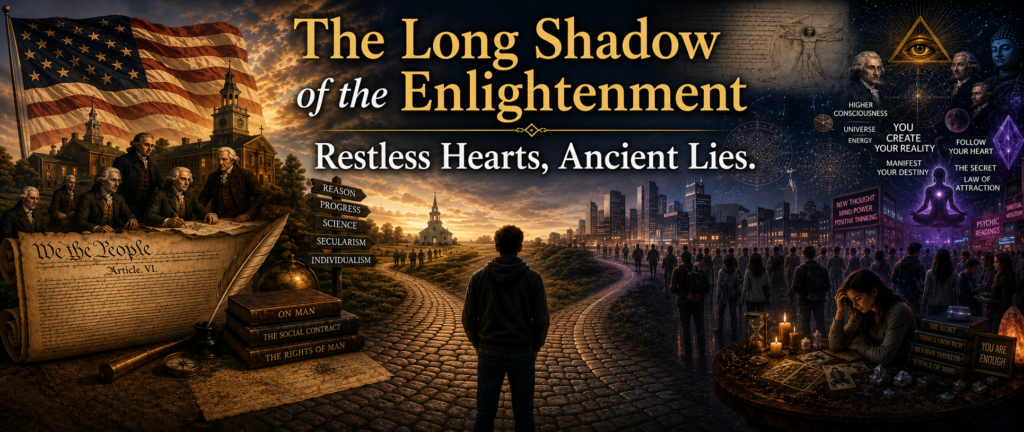
The Long Shadow of the Enlightenment
Across the centuries, humanity has searched for answers concerning God, eternity, and the purpose of life, questions that reason alone cannot settle. Philosophers sought wisdom through reason, while mystics pursued enlightenment through spiritual experience. Mystery religions and esoteric traditions promised hidden knowledge to those willing to undergo initiation. Yet beneath mankind’s pursuit of secret wisdom lies a deeper longing to understand why he exists and whether his life serves a greater purpose.
Psychiatrist and Holocaust survivor Viktor Frankl described this longing as the “will to meaning,” a fundamental human drive to find purpose in life. In Man’s Search for Meaning, he wrote, “There is nothing in the world, I venture to say, that would so effectively help one to survive even the worst conditions as the knowledge that there is a meaning in one’s life.”
The longing Frankl recognized is real, yet personal significance finds its fullest answer in Christ. Every man has a God-ordained purpose that awaits discovery through simple faith in Jesus Christ. It is neither a philosophical ideal to be mastered nor a reality to be manifested by the power of thought, but a divine calling into which he must grow. Its power lies not in what man can accomplish with his mind, but in what God accomplishes within him. God fashions His vessels, molding their lives like clay in the potter’s hand. He does not polish the outside of His vessels; He purges the inside, burning away the dross through refinement. Rich and poor, all must pass through the flame. “But now, O LORD, thou art our father; we are the clay, and thou our potter; and we all are the work of thy hand.” (Jeremiah 18:6)
The Age of Intellectual Discovery
Since antiquity, scholars have gathered the accumulated knowledge of their civilizations into comprehensive works. Around 295 BC, in Alexandria, Egypt, the Ptolemaic kings established the Mouseion, a center for study and research. Its associated library sought to collect every book in the known world. Its scholars calculated the earth’s circumference with remarkable accuracy, developed principles of geometry, and mapped the movements of planets and stars to predict eclipses. Alexandria became a center of Jewish scholarship, where translators began rendering the Hebrew Scriptures into Greek during the third century BC. They produced what became known as the Septuagint, which would later serve the early church.
Throughout the Middle Ages, scholars assembled and preserved vast collections of theology, philosophy, and practical knowledge. Educated elites kept much of this learning out of public reach. In 1450, the printing press expanded the circulation of such works, creating an unprecedented exchange of ideas. As Europe emerged from the Middle Ages in the fifteenth and sixteenth centuries, the printed word fueled an intellectual awakening that transformed the foundations of European civilization and later flourished in London, Paris, and Edinburgh.
The Rise of Written Knowledge
In 1728, amid the stirrings of the English Enlightenment, London writer Ephraim Chambers published his two-volume Cyclopaedia, a universal dictionary of arts and sciences that organized knowledge of mathematics, medicine, mechanics, astronomy, and the practical trades into a comprehensive reference work. French publishers initially proposed translating his work, but their plans soon grew into an ambitious project of their own. That project took shape in Paris, the intellectual heart of the French Enlightenment, where Denis Diderot and Jean le Rond d’Alembert began publishing the Encyclopédie (Systematic Dictionary of the Sciences, Arts, and Crafts) in 1751. Their undertaking would eventually fill twenty-eight volumes with some seventy-two thousand articles and thousands of illustrations.
At the front of the first volume, the editors placed a chart called the Figurative System of Human Knowledge, a framework showing how the different fields of learning related to one another. Drawing upon the earlier work of Francis Bacon, the diagram became known as a “tree of knowledge.” It divided human understanding into three principal branches: Memory, Reason, and Imagination. History drew upon Memory to preserve the experiences of the past, while Reason sought to explain the world through philosophy and science. Imagination gave rise to poetry and the arts, expressing what neither memory nor reason alone could capture. Notably, the knowledge of God received no branch of its own. Theology appeared under Reason as one subdivision of philosophy, listed alongside divination and black magic, no longer the unquestioned authority over all learning.
Seen through the lens of faith, the diagram represented a rejection of divine revelation in favor of human reason. It reflected an ancient pattern: men measuring God by their own limitations and binding Him to the rules He made for His creation. Long before, God had rebuked His own people; He reminded them, “You thought that I was altogether like you” (Psalm 50:21). Man’s enduring dilemma is defining good and evil for himself, reaching back to the forbidden tree in Eden.
What began with Chambers as a dictionary of useful knowledge became, in the Encyclopédie, a challenge to who held the authority to define truth. Its contributors included Voltaire, Rousseau, and the atheist Baron d’Holbach. Religious intolerance extended across Catholic and Protestant Europe. In France, Protestants faced legal restrictions on worship. In Scotland, authorities hanged Thomas Aikenhead, a student convicted of blasphemy, in 1697. More than sixty years later, in 1762, Protestant Geneva ordered the arrest of Jean-Jacques Rousseau and burned his books. A leading philosopher of the French Enlightenment, Rousseau had challenged the divine right of kings, arguing that legitimate government derived its authority from the people. Four years later, in Catholic France, authorities executed a young nobleman, the Chevalier de La Barre, for alleged blasphemy.
Many believers remained faithful, and countless parish priests and pastors continued to serve their congregations with humility. But wherever church and state were joined, Catholic and Protestant institutions used civil power to silence dissent.
Against such coercion, the Encyclopédie’s contributors championed reason over what they called “prejudice,” beliefs accepted on another’s authority rather than examined for oneself. Diderot praised the philosopher who, “trampling underfoot prejudice, tradition, antiquity, universal consent, authority,” dares “to think for himself.”
The Encyclopédie soon drew opposition from both Church and Crown. Church leaders feared its arguments would undermine the established order. In 1752, the king’s council suppressed the first two volumes. In 1759, the Crown revoked its publishing privilege, and the Pope placed it on the Index of Forbidden Books (Index Librorum Prohibitorum), the Church’s official list of works Catholics were forbidden to read or own without special permission. D’Alembert had already withdrawn from the editorship, but Diderot pressed on, shielded by sympathetic figures within the government. The final ten volumes of text appeared together in 1765, despite the prohibition, and the last volumes of plates followed in 1772. The Encyclopédie planted a new tree of knowledge, and once again man reached for its fruit on his own terms.
Three Currents of the Enlightenment
Three distinct intellectual currents emerged from Western civilization that influenced man’s understanding of the world and his relationship to God. The English stream focused on natural rights and the limits of government. The French stream challenged the Church and the Crown, elevating the conclusions of philosophers above the decrees of priests and monarchs. And the Scottish stream examined moral philosophy and human nature, often in conversation with Christian faith rather than in opposition to it. All three influenced the founding of America.
In England, John Locke gave the Enlightenment a powerful voice by challenging the idea that kings held an unquestionable divine right to rule. His writings defended natural rights, religious toleration, and government by consent. Locke was a Christian who believed faith and reason could coexist. He described reason as “natural revelation,” through which God communicates truth within the reach of human understanding. Scripture identifies God as the “Father of lights” (James 1:17), the unchanging source of wisdom and understanding. Locke’s philosophy helped establish a new understanding of political authority, one that influenced Jefferson’s language of natural rights in the Declaration of Independence. While Locke emphasized the natural rights of individuals, French Enlightenment thinkers challenged the institutions and abuses that threatened those rights.
In France, Montesquieu warned against concentrated power, and Voltaire mocked religious intolerance and royal abuses. Rousseau argued that sovereignty rests with the people. Voltaire and Rousseau became bitter enemies, yet their writings circulated widely throughout Europe. Within a generation, French revolutionaries would draw on all three men to overthrow Louis XVI and end the monarchy. During his years in London and Paris, Benjamin Franklin moved among scientists, philosophers, and political reformers. His experiments with electricity made him a celebrated figure in France. In 1778, Franklin and Voltaire famously embraced before an enthusiastic gathering in Paris, a public meeting of two men who had become symbols of the age. Thomas Jefferson also encountered the French Enlightenment directly. As America’s minister to France from 1785 to 1789, he joined its intellectual and political circles.
Scotland produced its own encyclopedia in Edinburgh. In 1768, William Smellie, a self-taught Edinburgh printer and naturalist, began compiling the first edition of the Encyclopædia Britannica, completed in three volumes by 1771. Scottish philosophers pursued similar questions differently. The Britannica was far more respectful of religion than its French counterpart, but it still embodied the same confidence in mankind’s ability to investigate the world and organize knowledge.
Scottish philosopher David Hume, whose skepticism we examined in the previous chapter, went further still, questioning the evidence for miracles and whether we can know with certainty that one event causes another. The Reverend Thomas Reid, a Presbyterian minister of the Church of Scotland’s Moderate party, challenged Hume’s skepticism in An Inquiry into the Human Mind on the Principles of Common Sense (1764). He argued that reason cannot prove everything, and that we must work from the basic foundation that our senses detect the real world around us. Reid believed that events have causes, even when we cannot explain them. As he wrote, “All reasoning must be from first principles.” He held that we could trust these natural abilities because the same Creator gave us both reason and our senses. His philosophy, known as Scottish Common Sense Realism, influenced American colleges and pulpits well into the nineteenth century. It became a foundation of the Princeton Theology developed by Archibald Alexander, the seminary’s first professor, whose first student, Charles Hodge, trained thousands of ministers.
John Witherspoon, a contemporary of Reid and a fellow Scottish Presbyterian minister, brought the intellectual debates of the Scottish Enlightenment into American classrooms in 1768. As president of the College of New Jersey, he taught a generation of American leaders, including James Madison and Aaron Burr, the latter of whom would later serve as Thomas Jefferson’s vice president. Witherspoon’s influence extended far beyond books into his writings and the classroom. Drawing upon the Scottish Enlightenment’s philosophy of common sense, he encouraged students to examine evidence and exercise sound judgment without abandoning their Christian convictions. Addressing Princeton’s graduating class in 1775, he expressed his educational philosophy: “It hath been generally a favourite point with me, to recommend the union of piety and literature.”
For centuries, religious institutions had held considerable authority over what people were allowed to teach and publish. The Enlightenment challenged that authority, creating tension between Christian defenders of divine revelation and those who increasingly trusted human reason. Some sought to reconcile faith and reason. A few, like Hume, doubted whether anything about God could be known at all. Old restraints were loosening, and a new age of intellectual freedom was emerging.
The Enlightenment’s Intellectual Influences
The founders received their earliest instruction in a culture steeped in Christian teaching, but the books circulating among educated men introduced them to a different intellectual current. Increasingly, philosophers appealed to the authority of reason rather than the authority of revelation. Franklin embraced scientific inquiry and religious toleration, founding the American Philosophical Society to advance “useful knowledge.” Adams warned that republican government depended upon the moral character of its people, writing that the Constitution “was made only for a moral and religious people.” Jefferson defended freedom of conscience and distrusted state-supported religion, drafting the Virginia Statute for Religious Freedom. Madison sought constitutional protections that would prevent government from exercising authority over religious belief. He argued in his Memorial and Remonstrance (1785) that religion must be left to “the conviction and conscience of every man.”
The intellectual struggle of the eighteenth century centered on the very foundations of truth and moral authority. America’s founders drew from the philosophical currents of their age, but they did not speak with one voice or arrive at the same conclusions. The Enlightenment advanced science, education, and political liberty, yet it held that mankind could discover truth and chart its moral course with or without God. The age helped loose men from the authority of the Church, but it did not free them from error and the temptation to make reason their new master. Scripture instructs believers not to be entangled in another yoke of bondage but to “Stand fast therefore in the liberty by which Christ has made us free. (Galatians 5:1). Ironically, men could escape the authority of the clergy only to become bound by the reasoning of philosophers. Diderot’s Encyclopédie was a remarkable achievement, but its editors were not merely preserving knowledge. By organizing and interpreting knowledge through their philosophical convictions, they risked binding their readers to those same limitations.
Curating the Past
The surviving writings of America’s founders show the importance of returning to the original historical record. Their letters, diaries, manuscripts, and published works allow later generations to see what they actually believed, rather than rely entirely on someone else’s interpretation. Without such evidence, historians could more easily portray the founders through the assumptions and convictions of their own time. History belongs to the past, but the telling of history belongs to those who write it. Yet no single quotation can fully capture a man’s beliefs or the circumstances that shaped them. The founders’ letters and public writings invite us to look more closely, allowing history to reveal its complexities rather than expecting it to confirm what we already believe.
The struggle over who tells the story continues today. The Smithsonian Institution has long been exempt from the Freedom of Information Act, and bills from both sides of the aisle to open its records have failed. In 2025, a presidential executive order accused federal museums of promoting ideological narratives, and the White House launched a review of Smithsonian exhibits. Critics countered that the review was itself an attempt to rewrite history. Whatever one concludes, whoever controls the institutions that tell the story holds enormous power over the narrative and what the public believes.
Freedom of conscience must include the God-given right to examine the evidence for oneself and investigate competing claims, weighing the sources behind them. Escaping the authority of kings and clergymen accomplishes little if men surrender their judgment to self-appointed guardians of knowledge. For the man who chooses to follow Jesus, the answer is clear: he learns to take his first bearings from God’s Word rather than letting the wisdom of others determine his convictions. “To the law and to the testimony! If they do not speak according to this word, it is because there is no light in them.” (Isaiah 8:20)
The Fallacy of Hidden Wisdom
After graduating from high school, but before coming to Christ, I enrolled at Montana State University, where I majored in film and minored in Earth Sciences. As part of my studies, I took a philosophy class that introduced me to the Socratic method. My natural mind was irritated and resisted the idea that relentless questioning and human reasoning alone could determine whether God exists. Yet the exercises challenged me to think more deeply about the nature of truth. After my first year of college, I spent the summer of 1978 working for a logging company deep in the Montana woods with a friend who was wavering in his faith. Our conversations often turned into fierce debates. I suppose I thought knowing how to spell Zinjanthropus gave me some authority to speak on the topic. Even in his backslidden condition, God’s Word spoke through him with authority and challenged what I believed about the origins of life. Those conversations left their mark on my soul, and my life began to change course.
Perhaps Socrates had taught me something after all. I began to question not only what I believed but why I believed it. My introduction to Greek philosophy led me to study ideas that shaped Western thought long before the Enlightenment, when I attended Bible College two years later. The college had a large academic library and a wealth of resources that helped students explore biblical writings, languages, manuscripts, and translations. The origins and meanings of Hebrew and Greek words like Logos sparked a lasting interest in etymology and a deeper appreciation for the richness of Scripture’s original languages. In later years, I built my own reference library and, chuckling over success philosopher Jim Rohn, who humorously remarked, “I feel smarter just walking in it.”
The Logos
Centuries before the Stoics, the Greek philosophers described the Logos as a rational principle that governed the order of the universe. Socrates later explored questions of truth and human understanding. His student Plato looked beyond the visible world to a higher, unchanging reality. The Stoics later understood logos as the universal principle of reason that governed the order and workings of the cosmos.
John drew upon this established philosophical term, Logos, meaning “word,” “speech,” “reason,” or “thought.” Beginning with Heraclitus around 500 BC, the Logos represented the underlying rational principle that ordered the universe. Yet John revealed a truth far greater than a philosophical idea. The Logos was not some distant force governing the universe, but the Word of God, fulfilling what He had spoken through the prophets. God’s eternal purpose, His vision and intent for mankind, found its living expression in Jesus Christ. John declared, “And the Word was made flesh, and dwelt among us” (John 1:14).
Greek philosophy sought to understand that order through observing the universe. Aristotle, a student of Plato, grounded his inquiry in careful observation of the natural world, believing that nature possessed an intelligible order discoverable through disciplined study. The Romans contributed republican government, civic virtue, and natural law. Greek writings survived the ancient world, with many collected at Alexandria, preserved by Byzantine scholars in Constantinople, and translated and expanded throughout the Islamic world before reaching medieval Western Europe. Yet for all their searching, the philosophers had glimpsed only the order of creation. John proclaimed the Person behind it. “Beware lest anyone cheat you through philosophy and empty deceit, according to the tradition of men, according to the basic principles of the world, and not according to Christ” (Colossians 2:8).
Such deception rarely presents itself as an enemy of the gospel; instead, it offers confidence in something other than Christ, dressed to look the same. To those who would seek hidden secrets, Moses declared, “The secret things belong to the LORD our God, but those things which are revealed belong to our children and to us forever” (Deuteronomy 29:29). True wisdom is found not by crossing forbidden thresholds, but by walking in the supernatural light God has already revealed.
The Rise of Naturalism
Religious groups in the colonies, from the Separatists and Puritans to the later Pietist and evangelical movements, welcomed the careful study of God’s creation. Francis Bacon’s understanding of creation as a Book of Nature, distinct from but complementary to Scripture, resonated with many Christians who believed that the natural world bore witness to its Creator’s handiwork. “For since the creation of the world His invisible attributes are clearly seen, being understood by the things that are made, even His eternal power and Godhead, so that they are without excuse.” (Romans 1:20)
The Puritans understood that the miraculous nature of creation bore witness to its Creator, leaving men without excuse, yet Eden’s Fall reminded them that mankind’s God-given capacity for reason and knowledge could lead to darkness when exercised apart from Him. Discerning colonial ministers welcomed discoveries in medicine, agriculture, and natural philosophy while insisting Scripture remained the final standard of truth. Yet as Enlightenment thought spread across the Atlantic world, rationalism and natural religion began to reshape religious thought, producing a mixture of inherited Christian beliefs and philosophical interpretations of God and Scripture.
Men like Francis Bacon, who championed empirical science through observation and experimentation, and Sir Isaac Newton, who formulated the laws of motion and gravity, transformed man’s understanding of the natural world. Newton also devoted considerable study to biblical prophecy and the end times. In his posthumously published Observations upon the Prophecies of Daniel, and the Apocalypse of St. John (1733), he warned against treating prophecy as a means of predicting events, believing instead that its fulfillment would reveal God’s providence over history.
Over the nineteenth century, however, the study of the natural world increasingly separated itself from divine revelation. Geology, astronomy, and biology sought explanations through natural processes rather than supernatural intervention, while emerging disciplines such as anthropology, sociology, and psychology increasingly examined human existence without appealing to divine authority
Darwin’s Origin of the Species
Charles Darwin’s On the Origin of Species (1859) presented perhaps the most significant challenge to traditional interpretations of biblical creation the modern world had yet seen, offering an account of the diversity of life through natural processes without reference to a divine creator. By the early twentieth century, evolutionary ideas gradually spread from university lecture halls into teacher-training colleges and later reached high schools and elementary education.
In the eighteenth and nineteenth centuries, men measured the heavens and calculated the movements of celestial bodies through astronomy. They examined Earth’s formations and estimated its age through geology. Through biology, they studied living organisms and sought to explain their origins by natural processes and human reasoning. In geology, this approach took the form of uniformitarianism, the view that the same natural processes observable today shaped the Earth over immense periods of time. Its advocates rejected miraculous explanations of Earth’s history.
In 1788, James Hutton described Earth as a self-sustaining system governed by natural laws and requiring no continual divine intervention, concluding that in the rocks “we find no vestige of a beginning,—no prospect of an end.” British geologist Charles Lyell later popularized these ideas in his influential three-volume Principles of Geology (1830–1833), challenging explanations that attributed Earth’s geological history to sudden catastrophes. Catastrophists and defenders of the Genesis account hotly contested these claims. Jesus, however, declared to the Pharisees that if His disciples were silenced, “the stones would immediately cry out” (Luke 19:40)
Beneath all of creation lie deeper questions: will mankind receive truth from its Creator, or will it decide for itself? Is mankind significant, created with divine purpose, or merely the product of random natural processes, with no certain origin and no ultimate meaning? “The fear of the LORD is the beginning of wisdom, and the knowledge of the Holy One is understanding” (Proverbs 9:10).
The real contrast, then, is not between knowledge and ignorance, nor between science and faith. It is between wisdom that begins with the fear of the Lord (Proverbs 9:10) and wisdom that recognizes no authority beyond human reason. Science serves a noble purpose when it humbly uncovers the order woven into creation. Discovering how the world works concerns what we observe, measure, and test. But why it exists and why we exist in it is a question beyond what empirical methods alone can establish. That understanding begins with the One who created it.
The Rise of English Deism
Across Europe, religious upheaval and scientific discovery sparked new questions about God, the natural world, and humanity’s ability to discern truth. Amid nearly two centuries of intellectual and religious ferment, Deism emerged. It held that God created the universe and established its natural laws but remained distant from His creation. John Locke was no Deist, yet his Reasonableness of Christianity (1695) and his defense of religious toleration helped create an intellectual climate in which Deism could flourish. Anthony Collins, an English gentleman and close friend of John Locke, wrote A Discourse of Free-Thinking (1713), which made “freethinker” a common term. Such freedom of thought extended to matters of faith.
Deists doubted the authenticity of biblical miracles, let alone the possibility of a personal relationship with God. Its proponents gained influence among European intellectuals as the Great Awakening swept across Britain and colonial America through preachers such as George Whitefield, John Wesley, and Jonathan Edwards. These revival preachers proclaimed a present, living God who revealed Himself through His Word and transformed men from the inside out. Scripture reveals a God who is neither absent nor distant. He asks His people, “Am I a God at hand, saith the LORD, and not a God afar off?” (Jeremiah 23:23).
Deism’s earliest systematic expression is usually traced to Edward Herbert, known by his title as Lord Herbert of Cherbury, often called the “Father of English Deism.” In his foundational book, De Veritate (1624). Herbert argued that the essential truths of religion were already implanted in the human mind and could be recognized without dependence on divine revelation. John Toland pressed the argument further. In 1696, he published Christianity Not Mysterious in London, insisting that true religion could contain nothing contrary to reason. The book caused such outrage that the Irish Parliament ordered it burned in Dublin, and Toland fled the country.
Matthew Tindal, a fellow of All Souls College, Oxford, completed the case in Christianity as Old as the Creation (1730). Tindal maintained that natural religion was already perfect and that “the truth of all revelation was to be judged of by its agreement with it.” Human reason, in other words, would decide whether God’s Word could be accepted as true. Supporters and critics alike came to know his book as “The Deists’ Bible,” a fitting title for a work that elevated human reason above biblical revelation. It provoked numerous replies. The most enduring came from Bishop Joseph Butler, whose Analogy of Religion (1736) turned Tindal’s confidence in reason back on itself. Finite minds, Butler warned, have no standing to sit in judgment over God’s ways: “Let not such poor creatures as we go on objecting against an infinite scheme, that we do not see the necessity or usefulness of all its parts, and call this reasoning.”
By the American founding, Deism had become one current among several, along with what historian Gregg Frazer calls “theistic rationalism,” a blend of Enlightenment philosophy and selective Christian morality. Christianity remained the dominant religious tradition in colonial America, strengthened by the Great Awakening, and only a minority of the founders could accurately be called Deists. Still, Deism’s emphasis on natural law, morality, and a Creator appealed to a much wider circle of educated statesmen, and its language echoes in the Declaration of Independence’s appeal to “the Laws of Nature and of Nature’s God.”
Thomas Jefferson resisted conventional religious labels, but his rationalist approach to Christianity appears clearly in his personal compilation The Life and Morals of Jesus of Nazareth, as already mentioned. Benjamin Franklin described himself as “a thorough Deist” in his youth, yet he continued to value public religion for its civic benefit. Thomas Paine went much further, openly attacking orthodox Christianity in favor of a religion grounded in reason and nature. Ethan Allen, the Revolutionary hero who captured Fort Ticonderoga, openly acknowledged his Deist reputation in Reason, the Only Oracle of Man (1784), declaring, “I have generally been denominated a Deist, the reality of which I never disputed, being conscious I am no Christian.
Throughout the nineteenth century, scholars increasingly subjected the Bible to higher criticism, examining it as a human document rather than accepting it as divine revelation. Meanwhile, scientific naturalism and Darwinian evolution encouraged the belief that the mysteries of existence could be explained through natural processes alone. For some intellectuals, Deism became a way station on the road to secular humanism or outright atheism, the rejection of God altogether. As Christianity’s cultural influence waned, others turned to Spiritualism, seeking transcendence through mystical experience and hidden knowledge. Though one appeals to reason and the other to personal experience, both find expression today in a “spiritual but not religious” outlook that places individual judgment above God’s Word.
The Occult Revival
The Enlightenment’s influence extended well beyond the eighteenth century. By the nineteenth century, many intellectuals were no longer asking whether they had permission to question religious authority. They had ceased to recognize that authority as having jurisdiction over their minds. Spiritualism and occult societies promised access to knowledge beyond the material world.
Ralph Waldo Emerson encouraged Americans to trust their spiritual intuition, challenging established churches and teaching that individuals could experience the divine without relying on religious institutions. A former Unitarian minister, he left the pulpit in 1832 and became the leading voice of Transcendentalism, which taught that the divine could be known directly through intuition and nature rather than through Scripture or the church. In his 1838 Divinity School Address at Harvard, he dismissed reliance on miracles and historical Christianity, and he drew freely on Hindu texts such as the Bhagavad Gita. Where Deism exalted reason, Transcendentalism exalted inner experience, and it prepared the ground for what followed.
In 1875, Helena Petrovna Blavatsky helped found the Theosophical Society to promote Theosophy, from the Greek theosophia, “divine wisdom”: the study of hidden spiritual truths believed to lie beneath all the world’s religions. She became a central figure in the nineteenth-century occult revival, a movement that attracted many who were wrestling with scientific materialism and Darwinian evolution. In Isis Unveiled (1877), Blavatsky challenged conventional science and Christian theology. She drew upon Eastern religious thought and older Western esoteric traditions, including Hermeticism, Gnosticism, and Neoplatonism. She expanded these teachings in The Secret Doctrine (1888), presenting an elaborate account of cosmic origins, human evolution, and hidden spiritual laws. Her synthesis remained influential in Western esotericism well into the twentieth century. Blavatsky claimed that hidden spiritual knowledge was preserved by enlightened “Masters” and could be attained through spiritual development and initiation. Within Theosophy, Jesus was not presented as the unique Son of God but as a great spiritual teacher alongside figures such as the Buddha and Krishna.
Among those influenced by these esoteric currents was Aleister Crowley, the English occultist and ceremonial magician who openly identified himself as “The Great Beast 666.” In the early 1900s, he established Thelema, from the Greek thelēma, “will,” teaching that every individual possesses a unique “True Will” and that life’s highest purpose is to discover and fulfill it. Its slogan “Do what thou wilt” eventually appeared on T-shirts, album covers, and posters. Beneath its simplicity lay a profound claim: the self, not God, is the highest authority.
Though these movements differed in doctrine and practice, they reflected a growing fascination with spiritual knowledge drawn from ancient traditions, mystical experiences, and the belief in the hidden powers of the human mind. By the late nineteenth century, many intellectuals no longer regarded religious institutions as having authority over their thinking. Thomas Henry Huxley, who coined the word “agnostic,” expressed the growing divide between independent inquiry and church authority in Agnosticism and Christianity (1889), declaring, “But, as between Agnosticism and Ecclesiasticism … there can be neither peace nor truce.” Although these intellectual and spiritual movements followed different paths, they reflected an age in which inherited religious authority no longer commanded unquestioned allegiance. Beneath them all lay the deeper question of whether human reason, mystical experience, or personal will could take the place of divine revelation.
The Rise of New Thought
The New Thought movement gained momentum in the 1880s, drawing on Emerson’s Transcendentalism. It advanced the belief that thoughts carried spiritual energy capable of influencing reality. It emphasized positive expectations, spoken affirmations, and mental visualization, promising to attract any desired outcome. As science opened new possibilities, metaphysical thinkers explored reality beyond the physical world. They searched for unseen principles governing human experience. Orison Swett Marden carried the broader philosophy of self-improvement into popular publishing with Success magazine in 1897. Around that time, James Allen’s As a Man Thinketh (1903) and Wallace D. Wattles’ The Science of Getting Rich (1910) popularized the belief that wealth could be attained through the power of the mind
Napoleon Hill’s Think and Grow Rich (1937) introduced success philosophy to a mass audience, emphasizing disciplined thought as a means of achievement. Hill drew on accounts of successful industrialists, including Thomas Edison and Henry Ford. He later claimed Andrew Carnegie had challenged him to develop a philosophy of success, though historians dispute that account. Success-oriented teachings entered Christian circles and began dominating much of the preaching within certain charismatic movements. In The Two Kinds of Faith (1942), E. W. Kenyon (1867–1948) emphasized the power of faith-filled words and positive confession, teachings that later became central to the Word of Faith movement. Kenneth E. Hagin, Kenneth Copeland, and Charles Capps popularized similar doctrines in the decades that followed. Meanwhile, Norman Vincent Peale’s The Power of Positive Thinking (1952) brought positive-thinking principles to a broad Christian audience, encouraging readers to believe and expect favorable outcomes.
Scientific progress did not diminish humanity’s fascination with unseen powers. In 1950, science fiction writer L. Ron Hubbard published Dianetics: The Modern Science of Mental Health, promising freedom from painful buried memories. He subsequently established the Church of Scientology, combining claims about mental improvement with spiritual teachings about past lives. By the 1970s, Eastern spirituality, metaphysics, and New Age beliefs had entered popular culture, while books and films explored psychic phenomena, altered consciousness, and the paranormal. Interest in UFOs grew alongside these movements.
Within American Christianity, Robert Schuller’s Possibility Thinking reached millions through his Hour of Power broadcasts, blending religious language with messages of self-esteem and personal achievement. Through these movements and their growing influence within churches, ideas once confined to philosophical circles and esoteric societies gradually entered mainstream culture. Self-help gurus began spreading the belief that the human mind possessed the power to influence reality and bring about desired outcomes.
When Success Invades Church
For much of my professional life, I worked as a success coach, teaching principles of leadership and personal growth. Breaking through mental barriers and discovering one’s full potential were popular themes during this time. My own education began in 1987, when a friend loaned me Tony Robbins’s Unlimited Power cassette program. My truck became my traveling classroom, sharpening my thinking and strengthening my approach to business.
Other influential voices soon became part of my education. Jim Rohn and Zig Ziglar, both gifted speakers and philosophers of personal development, drew on biblical stories to teach personal responsibility and success. John Maxwell, a Wesleyan pastor, carried biblical principles of character, integrity, and servant leadership into the secular business world. Among his successful books was the bestseller The 21 Irrefutable Laws of Leadership (1998).
I valued the principles of personal growth, but throughout the nineties, as I worked alongside other pastors teaching God’s Word, I grew increasingly concerned when those same ideas began reshaping the message of the Church. During the late 1980s and 1990s, seeker-sensitive ministries adopted less traditional worship and teaching to attract those outside organized religion. Gradually, the language of purpose, prosperity, and positive thinking became so prominent in some churches that the biblical call to self-denial and discipleship received less attention.
Law of Attraction: The Counterfeit Faith
For generations, the principles of positive thinking and personal achievement had gained influence, but the Law of Attraction would carry their metaphysical foundations into popular culture worldwide. In 2006, Bob Proctor produced and appeared in Rhonda Byrne’s The Secret, a short film that carried the Law of Attraction to a worldwide audience. The Secret was the promise of the rewards of faith through the power of the human mind. Many of my business associates enthusiastically embraced the ideas. The Secret repackaged the Law of Attraction as a compelling metaphysical belief system, and followers found parallels in Christian prosperity teachings, gaining acceptance among charismatic pastors. The Secret’s teachings held that unseen mental and spiritual forces could influence physical reality, that thoughts emitted “frequencies,” and that visualization and belief could attract desired outcomes. Science has established that the brain produces measurable electrical activity and magnetic fields. Yet the mind is more than electrical impulses; it carries a spiritual dimension beyond scientific observation. As artificial intelligence and neurotechnology advance, we are approaching tools capable of probing, interpreting, and even influencing the human mind. This raises a sobering question: who will control them, and to what ends?
The danger lies not in what mankind may discover or achieve, but in exalting human knowledge and mental abilities above God’s wisdom without the moral restraint needed to govern them. What begins as a search for knowledge becomes a quest for personal significance, leading some to explore beyond God’s boundaries. Paul confronted a similar danger among believers in Rome. False teachers promoted their own religious practices. They claimed special spiritual knowledge through visions and religious practices involving angels. Paul warned against those who became “vainly puffed up by his fleshly mind” (Colossians 2:18).
Through my years as a Bible teacher and success coach, I saw personal growth conferences and seminars blend biblical language with success philosophy. Similar ideas found their way into Christian ministries, where the language of faith increasingly resembled the language of personal achievement. Intentional thinking and overcoming limiting beliefs have their place. However, by anchoring human potential in the mind and personal ability alone, these methods offer a mere fraction of what God has promised His people. “But we have this treasure in earthen vessels, that the excellence of the power may be of God and not of us” (2 Corinthians 4:7).
Echoes Through History
The Enlightenment did not invent the divide between revelation and reason, but it transformed that ancient tension into open conflict. Some sought to understand creation through observation while acknowledging a Creator; others elevated human reason above divine revelation. The editors of the Encyclopédie organized human knowledge into a tree rooted in reason, yet Scripture tells of two trees in Eden: the tree of knowledge of good and evil and the tree of life. Every age we have examined has confronted the choice they represent. Man’s hidden rites, secret powers and intuition began reshaping their reality. Each path promises to elevate mankind, yet none can impart the life and truth that come from God alone. As the Apostle Paul declared, “The wisdom of this world is foolishness with God” (1 Corinthians 3:19).
The pursuit of knowledge has carried mankind from ancient philosophy to the remarkable discoveries of modern science. Men are constantly tempted to trust that their own human understanding is sufficient to determine truth and purpose. Gradually, the desire to know becomes the desire to control, to define what is true, and what began as a search for wisdom can end with man placing himself at the center of everything. Knowledge without God can inform the mind without changing the heart, but no amount of learning or human effort can accomplish God’s inward transformation. Jesus revealed another way.
Over the years, as I have reflected upon the decision Jesus made in Gethsemane, I have come to realize that far more was at stake than the unbearable physical agony of crucifixion. Jesus willingly surrendered Himself to the prospect of eternal separation from the Father He loved. Never had He known a moment apart from His Father’s fellowship. Yet as darkness descended upon the land and He bore the sins of mankind, the light of His Father’s presence was withdrawn. In the anguish of that moment, He cried out, “Eli, Eli, lama sabachthani?” that is, “My God, My God, why have You forsaken Me?” (Matthew 27:46). Consider the magnitude of the decision He had made the night before. He yielded not only His earthly life but the very fellowship with His Father that had sustained Him throughout His life. Rich or poor, every believer must yield to the refining work of God. Our highest calling is not to master life through our own understanding, but to pray as Jesus prayed in Gethsemane: “Not my will, but thine, be done” (Luke 22:42).
About the Author Mark Thomas
Mark is a visionary leader and writer who helps others discover their God-given purpose. See his teaching series www.LiveandGrowonPurpose.com