
- You are here:
- Home »
- Leadership »
- The Evolving Colonies – A Mixture of Beliefs
The Evolving Colonies – A Mixture of Beliefs
History rarely changes course in a single generation. Ideas mature slowly. What begins as a subtle shift in belief can, over centuries, reshape a civilization. We often ask why America has drifted so far from the principles that once guided her. Many point to government and education, mainstream media, and cultural trends. These are only the visible currents on the surface, for most, but scripture directs our attention deeper—to the human heart, where every nation’s true course is first set.
“Keep your heart with all diligence, For out of it spring the issues of life.” — Proverbs 4:23
Here lies the great irony of this book. “Freedom of Conscience” is not a gift of modern civilization; it is a gift of God. From the beginning, Adam possessed the freedom to obey or to rebel. Yet God never granted mankind the authority to redefine truth. The freedom to choose was never the freedom to determine good and evil for ourselves. That distinction, first challenged in Eden, continues to shape every civilization and every generation that has followed; Western thought slowly moved away from dependence on the Creator. And still today, some retain belief in God while limiting and redefining His role. Some scholars lock Biblical history into a framework. Others trust science and enjoy tfhe banter of philosophy for the answers. People trust and depend on political narratives and geopolitics. Some seek an ascended human consciousness as the highest authority, and others seek hidden wisdom through esoteric traditions and alternative spiritualities. They are all free to exercise their freedom of conscience, their free will. Across generations, humanity has steadily moved away from God’s revealed truth as the final authority, choosing instead “their truth.”
Introduction: A Spectrum, Not a Single Voice
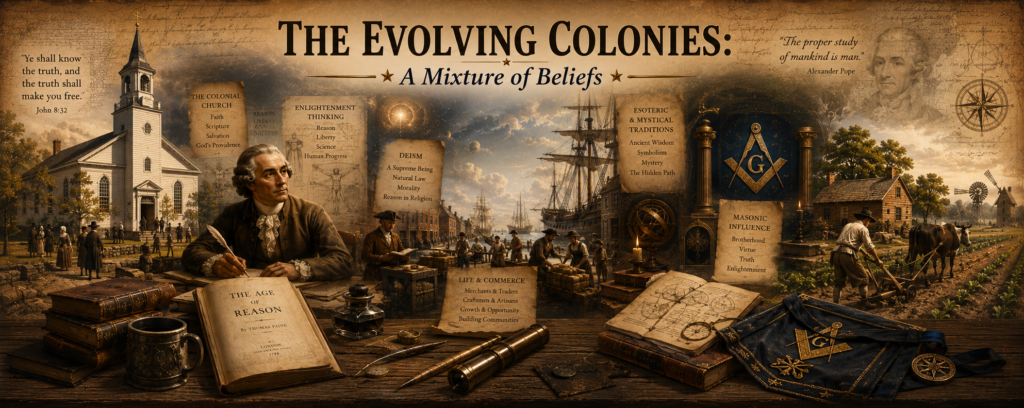
The leading figures of the thirteen American colonies did not speak with one theological voice. Some held firmly to the authority of Scripture. Others were pulled toward the Enlightenment’s confidence in reason. Many stood somewhere in between, shaped by colonial church life, classical learning, political philosophy, and their own theological reflections. They shared common concerns about liberty and government. They rarely arrived at those convictions the same way. Among the principal architects of the new republic were men with deeply traditional Christian convictions, and a mixture of Enlightenment rationalism ran alongside them.
This spectrum included orthodox Protestants from several traditions. The Puritans embraced covenant theology, believing the well-being of society was tied to faithfulness to God’s covenant and the moral teachings of Scripture. Anglicans carried the structured worship and episcopal governance of the Church of England. Presbyterians, shaped by John Knox and the Reformed tradition, governed themselves through elected elders and representative church courts — self-governing instincts that fed directly into American political life — and placed a high value on education and literacy. Baptists were forged through persecution in England and the colonies, and they emerged as some of the era’s strongest voices for religious liberty, insisting on believers’ baptism and the separation of church and civil authority. Congregationalists believed each local church answered to God for its own affairs rather than to a distant ecclesiastical authority, a conviction that translated naturally into New England’s town-meeting self-government.
Alongside these orthodox traditions stood two very different currents. Deists and theistic rationalists elevated reason alongside or above traditional dogma; they believed God was known primarily through the natural world rather than through revealed Scripture. And men shaped by esoteric fraternal traditions such as Freemasonry blended moral philosophy, symbolic ritual, and Enlightenment ideals into something that crossed denominational lines. These varied influences produced real tension and real disagreement, and out of that disagreement came the constitutional framework that would define the Republic. Both currents grew out of the broader rise of Enlightenment thought, which is where this chapter turns next.
A quieter but real current ran alongside these Protestant traditions: Hebraic and Jewish biblical influence. Colonial ministers and political writers drew on the moral and legal framework of the Hebrew Scriptures — covenant, the Ten Commandments, the Exodus, the conviction that even kings answer to a higher law — as a vocabulary for liberty and justice. An early proposed design for the Great Seal depicted Moses parting the Red Sea beneath the motto “Resistance to Tyrants is Obedience to God.” A small but active Jewish community, present in North America since 1654, contributed to civic and commercial life. Haym Salomon’s support for the Revolutionary cause and George Washington’s 1790 letter to the Touro Synagogue — promising a nation that “gives to bigotry no sanction, to persecution no assistance” — mark its most visible traces. This influence was real, but it worked mainly through moral language and imagery, not through constitutional mechanics.
The Rise of the Enlightenment
The Enlightenment did not emerge from a single belief. It was the culmination of intellectual currents that had been developing for centuries. Socrates questioned. Plato searched for truth through reasoned dialogue. Aristotle observed the natural world with care. Rome added an emphasis on republican government, civic virtue, and natural law. Out of all this, Western civilization cultivated the conviction that human reason could discover order in creation. Heraclitus had already formalized the Logos as the rational principle governing the universe, and Plato, Aristotle, and later the Stoics carried that confidence further. The Renaissance rediscovered these classical writings and studied them closely, handing new generations the tools to examine tradition, question inherited assumptions, and evaluate claims of authority. Christian scholars pushed in a similar direction from a different angle: Augustine and Thomas Aquinas argued that God revealed Himself not only through Scripture but also through the created order too —reason, rightly used, was a gift from God, not a rival to revelation.
The Reformation and the Wars of Religion
Philosophy alone cannot explain the Enlightenment’s rise. Ideas gain their greatest force when they collide with the hardships of history. By the seventeenth century, Europe had endured generations of religious conflict, political oppression, and a corrosive union of church and state. The medieval Roman Catholic Church had accumulated enormous temporal and spiritual authority, often through alliance with kings and princes. The sale of indulgences, restrictions on the use of vernacular Scripture, inquisitions, and church tradition, when placed alongside biblical authority, convinced many that the institutional church had drifted far from the simplicity of apostolic Christianity.
The Protestant Reformation set out to correct those abuses by returning to the authority of Scripture. Martin Luther insisted on sola Scriptura, justification by faith, and the priesthood of all believers, restoring to ordinary Christians the privilege and the burden of reading God’s Word for themselves. The printing press made that recovery possible at scale. The Reformation also taught habits of personal inquiry that outran its own intentions: once believers were encouraged to test church tradition against Scripture, many learned to question inherited authority more broadly still. And the Reformation did not end religious coercion. New Protestant establishments built their own forms of conformity, and dissenters — Catholic or Protestant — often paid for their convictions in fines, imprisonment, exile, or worse.
These tensions erupted into the religious wars that scarred Europe. The Thirty Years’ War (1618–1648) alone killed roughly six million people through combat, famine, and disease — one of the deadliest conflicts in European history. It convinced many that forcing church and state together had produced neither peace nor genuine faith. John Locke championed religious toleration and liberty of conscience in its aftermath, and later Enlightenment thinkers built on that toward broader arguments for natural rights, limited government, and freedom of inquiry. Those ideas would eventually cross the Atlantic.
The Scientific Revolution
At the same time, the Scientific Revolution was reshaping how educated Europeans saw the natural world. Francis Bacon, an English statesman and philosopher who served as Lord Chancellor under King James I, laid early groundwork for empirical inquiry. Copernicus, Kepler, Galileo, Boyle, and especially Isaac Newton built on that foundation and revealed a universe of astonishing order — one governed by laws that could be observed, measured, understood. Many concluded that creation reflected the wisdom of an intelligent Designer whose laws could be discovered through careful observation and reason. Newton himself remained deeply religious, and for many believers his laws simply displayed the Creator’s wisdom. Others read the same discoveries differently. If the universe ran on fixed laws, perhaps God’s relationship to the world could be understood through those laws alone, without miracle or revelation — and for these thinkers, confidence increasingly shifted toward human reason and natural process, while God’s active involvement in the world gradually receded from view.
John Locke: Reason, Rights, and a Personal Contradiction
John Locke carried empirical thinking beyond science and into philosophy and politics. In his Essay Concerning Human Understanding (1689), he argued that knowledge comes primarily through experience, not inherited assumption. His political writings — Two Treatises of Government and A Letter Concerning Toleration, both 1689 — articulated natural rights, limited government, and the consent of the governed. His defense of toleration deeply influenced the American colonies and helped shape the push for independence.
Locke considered himself a Christian. In The Reasonableness of Christianity (1695), he argued that Christian faith was compatible with reason. He believed in God, accepted Scripture’s authority, and affirmed much of its central doctrine. Through the combined work of Bacon, Newton, and Locke, reason and careful inquiry pushed outward — into philosophy, into politics, into education and religion — and together these thinkers profoundly shaped the intellectual climate that many of America’s founders inherited.
Yet Locke’s own life did not match his philosophy. His theory of natural rights held that no person could be legitimately enslaved. He owned shares in the Royal African Company anyway, and helped draft colonial constitutions that protected slavery. Principle and practice pulled apart in him — a contradiction that would echo through the founding generation itself.
Three Streams of Enlightenment
The Enlightenment unfolded across Europe from roughly the 1680s through the 1790s, though its roots reached back to antiquity. It was never a single movement with a single voice. Historians generally identify three major streams — English, Scottish, and French — each convinced of reason’s importance, each pulling in a different direction on religion, government, and morality.
The English Enlightenment stayed practical. Locke argued that legitimate government required the consent of the governed, and that natural rights came from nature and nature’s God rather than from kings. Colonists who prized both the rights of Englishmen and the moral lens of Scripture found this easy to embrace.
The Scottish Enlightenment turned toward moral philosophy, education, and the study of human nature. Francis Hutcheson and Adam Smith brought rigorous reason to virtue and to economics. David Hume went further, challenging miracles and divine revelation, and arguing that knowledge should rest on observation and experience alone; his skepticism about causality quietly undercut many traditional philosophical arguments for God’s existence and later influenced secular philosophy more broadly. Thomas Reid pushed back, developing what became known as Common Sense Realism — the conviction that certain truths are self-evident and don’t need to survive philosophical doubt to be trusted. Reid’s thought shaped American colleges for two generations and helped form the intellectual habits of many early American leaders.
The French Enlightenment traveled a more radical road. Montesquieu’s separation of powers became one of the Constitution’s most lasting influences. But Voltaire, Rousseau, Diderot, and later Kant pushed past political reform toward something more sweeping — human reason answerable to no authority above itself. Those ideas helped ignite the French Revolution rather than the American one.
It was the British stream, far more than the French, that shaped the founding. Jefferson’s language in the Declaration drew on Locke. Madison’s constitutional framework reflected Montesquieu. And the English common law tradition — codified for colonial lawyers in William Blackstone’s Commentaries — supplied a structural foundation that neither Voltaire nor Rousseau could offer. The founders borrowed selectively rather than swallowing the Enlightenment whole: ideas that strengthened liberty under law and fit alongside Scripture and England’s constitutional heritage were welcomed; ideas that undermined moral order or rejected religious foundations were not. What emerged was a blend of inherited English liberties, selected Enlightenment principles, and a people whose sense of justice had long been shaped by the Bible.
Deism: Reason as the Final Judge
Deism developed gradually, over nearly two centuries, out of the Renaissance recovery of classical learning, the Reformation’s emphasis on individual responsibility before God, the disillusionment left by Europe’s religious wars, and the growing confidence in reason that the Scientific Revolution had fostered.
Its earliest systematic expression is usually traced to Edward Herbert, Lord Herbert of Cherbury, the “Father of English Deism.” In De Veritate (1624), he argued that the existence of God, moral responsibility, and future judgment were all discoverable through reason alone, with no need for special revelation. John Toland, Anthony Collins, and Matthew Tindal carried the idea further by the end of the seventeenth century. Toland held that true religion could contain nothing contrary to reason. Collins championed free inquiry over church tradition. Tindal argued in Christianity as Old as the Creation (1730) that true religion had existed since creation itself and required no supernatural revelation at all. Locke was no Deist, but his defense of reason and toleration gave the movement momentum he never intended.
Admiration for Newton’s ordered universe fed an image of God as a Divine Clockmaker — one who set natural law in motion and then largely withdrew. Deism began with human observation of nature and reasoned upward toward God, rather than starting with God’s self-revelation in Scripture.
By the American founding, Deism — along with what some historians call theistic rationalism, a blend of Enlightenment philosophy and selective Christian morality — had become one current among several circulating through Britain and the colonies. Theistic rationalism retained much of natural religion and Christian ethics while letting human reason serve as the final judge of religious truth — morality was retained, miracles were questioned. While only a minority of the founders could be accurately described as Deists, this emphasis on natural law, reason, morality, and belief in a Creator appealed to a wider circle of educated statesmen. Thomas Jefferson’s own leanings show up clearly in his compilation The Life and Morals of Jesus of Nazareth, which strips out the miracle accounts and keeps the ethical teaching. Benjamin Franklin drifted through Deism in his youth but still believed public religion did real civic good. Thomas Paine and Ethan Allen sat at other points on the same spectrum.
Alongside these men stood orthodox Christians like Patrick Henry and John Jay — a genuinely wide range of belief among the founders. They disagreed about the divinity of Christ, the authority of Scripture, the reality of miracles, salvation by grace, and the point at which church and state should meet. No single philosophical tradition unified them; instead, biblical Christianity, English constitutionalism, classical republicanism, natural law, and Enlightenment thought all intersected, at odd angles, in different minds. Jefferson later fused several of these strands — biblical morality, natural law, English constitutional heritage, classical republicanism, selected Enlightenment principles — into the Declaration.
Deism’s Later Legacy
Classical Deism didn’t stand still. Through the nineteenth century, higher criticism, scientific naturalism, and Darwinian evolution kept eroding confidence in anything beyond autonomous reason, and for many intellectuals Deism became a way station toward secular humanism, or further still, atheism. A different path opened up too, as traditional Christianity lost cultural ground: renewed interest in Hermeticism, Rosicrucianism, Spiritualism, and Theosophy, seeking transcendence through mystical experience and hidden knowledge rather than through God’s Word. By now, the two paths have largely merged into a “spiritual but not religious” sensibility — one enthroning reason, the other experience — both departing from the same biblical foundation, which submits reason and experience alike to God’s self-revelation, not the other way around.
Freemasonry belongs in this same family of currents. It drew on the same Renaissance and Enlightenment soil that produced Deism, and, in some of its higher degrees, on Hermetic and Rosicrucian traditions as well. The fraternity gave men like Washington, Franklin, and Paul Revere a space where denominational differences could be set aside in favor of shared ideals. Its ceremonies drew heavily from the building of Solomon’s Temple. Later critics such as Ed Decker pointed to Albert Pike’s Morals and Dogma as evidence of deeper esoteric layers within the Scottish Rite. Its mark on the founding, though, was social rather than structural — it left no clear trace in the founding documents, and claims about its influence on the capital’s design remain unresolved in the historical record.
A Mixture of Belief
Running alongside all these intellectual currents was something very different — the First and Second Great Awakenings. While European philosophers debated reason and revelation in salons and universities, Jonathan Edwards preached with theological precision in New England meetinghouses, and George Whitefield covered five thousand miles of American coastline in a single year, speaking to crowds of thousands. Their message was personal conversion, individual conscience, and direct accountability before God.
Gilbert Tennent preached that a “regenerated plowman was worth more than an unconverted prince,” challenging the assumption that truth and authority belonged only to kings and clergy. It planted a seed: that all men are equal, not in ability or station, but in dignity, and in their possession of God-given rights.
James Madison watched Baptist dissenters be persecuted in Virginia, which made him one of the era’s fiercest advocates for religious freedom. John Witherspoon, the Presbyterian minister who became president of Princeton and the only clergyman to sign the Declaration, taught Madison directly, shaping his understanding of human depravity and the necessity of limiting power. Jefferson drew from Locke, sure. But the language of the Declaration also came from a culture whose entire moral vocabulary was steeped in Scripture.
A Diverse and Divided Christianity
Christians had never been fully unified. The Separatists broke from the Church of England, which had itself broken from Rome. Luther broke with Rome but kept plenty of Catholic assumptions. Calvin, building on Luther, still disagreed with him on the Lord’s Supper, church government, and predestination. Researchers now count tens of thousands of Christian denominations worldwide. If believers across the centuries couldn’t settle these questions among themselves, the idea that colonial Christians shared a single unified faith capable of founding a “Christian nation” deserves serious scrutiny.
The founders weren’t building on a blank slate. They inherited more than a century of colonial self-government. That diversity is exactly what made the Constitution such an achievement — rather than impose one religious vision from Washington, the framers prohibited a national church, protected free exercise, and left most religious matters to the states and to individuals, so that differing convictions could coexist without any one tradition claiming national supremacy.
The Biblical Role of Government
That constitutional instinct — keeping civil authority separate from religious establishment — echoes something Jesus taught long before any nation put it into practice.
When the Pharisees tried to trap Him over paying taxes, Jesus pointed to Caesar’s image on a coin: give Caesar what bears his image, give God what bears His (Matthew 22:21). Civil government has real authority, but it is limited, always subordinate to the Creator. Before Pilate, He went further: “My kingdom is not of this world” (John 18:36), a kingdom that advances by truth, not the sword. Paul develops this in Romans 13:1–7, describing government as divinely ordained but not absolute — accountable to God’s higher law, such that when rulers command what God forbids, believers have appealed to a different principle: “We ought to obey God rather than men” (Acts 5:29).
Government exists to preserve justice and public order. The Church exists to proclaim the Gospel. Confusing the two has never gone well. The founders built a framework of ordered liberty that protects freedom of conscience rather than forcing religious uniformity.
Power, Privilege, and Moral Compromise
Slavery had existed for millennia across cultures and civilizations before colonial America inherited it. Still, the contradiction runs deep. George Whitefield, whose preaching ignited the Great Awakening, owned enslaved people to help fund his Bethesda orphanage in Georgia. John Witherspoon kept enslaved people while serving at Princeton. George Washington held authority over more than 300 enslaved people at Mount Vernon. Thomas Jefferson, who wrote that all men are created equal, owned more than 600 over his lifetime. Even James Madison, chief architect of the Constitution, owned more than 100 enslaved people, despite recognizing slavery as both a moral evil and a threat to everything the republic claimed to stand for.
Jefferson understood that slavery stood in direct tension with both Scripture and the principles he’d written into the Declaration. But dismantling it meant unraveling an economic system woven through Virginia’s commerce, agriculture, and social order — including his own life. He believed liberty belonged to all men. He remained bound, all the same, to a world of privilege, land, and status that slavery sustained.
Jefferson’s contradictions don’t diminish him in my eyes; they make him profoundly human. They remind us that philosophies are never merely ideas on paper. They shape our desires, justify our choices, and reveal themselves most clearly when principle demands personal sacrifice.
The Abolitionist Movement
The Quakers were outspoken from early on. They condemned slavery and eventually prohibited it among their own members. John Woolman spent decades urging slaveholders to free the people they owned. Some Mennonite and Moravian communities took the same stand. None of it slowed the trade much. Virginia’s 1705 Slave Codes made slavery hereditary and self-perpetuating. South Carolina’s entire rice economy ran on enslaved labor from the 1670s onward. By the founding era, slavery was legally entrenched in all thirteen colonies — North and South alike.
A human being made in God’s image (Genesis 1:27) was bought, sold, and denied the most basic freedom — directly contradicting Paul’s declaration that in Christ “there is neither slave nor free” (Galatians 3:28). Men and women who read that same Scripture eventually concluded no human being could be owned by another, and that conviction became the abolitionist movement. Frederick Douglass, once enslaved himself, appealed directly to the Declaration of Independence and the teachings of Christ. Churches split bitterly along sectional lines before the Civil War, and that division eventually forced the moral reckoning the nation needed.
Slavery doesn’t erase the genuine faith and sacrifice of colonial Christians. But it settles one thing: no nation whose founding rested on the enslavement of hundreds of thousands of people made in God’s image can claim that abuse was viewed favorably by God. The founders’ choice to keep civil and religious authority separate was, in part, a hard lesson learned from exactly this history.
Bloody Conflicts with Native Peoples
Relations with Native peoples followed a similarly painful arc. Early settlers depended on trade and alliance simply to survive — the Pilgrims on the generosity of Squanto and the Wampanoag. John Eliot, later called the “Apostle to the Indians,” translated the entire Bible into Wampanoag by 1663, and his work helped produce Native Christian leaders such as Samson Occom. As colonial populations grew and competition for land sharpened, cooperation gave way to cycles of retaliation. The Pequot War of 1637 left hundreds dead and survivors enslaved. King Philip’s War of 1675–1676 became one of the bloodiest conflicts in early American history. Genuine faith and genuine violence sat side by side here too — the same fallen nature at work.
The Constitutional Convention: A Fragile Consensus
Fifty-five men, carrying profoundly different theological convictions and political philosophies, produced a governing document that has now endured for two and a half centuries. Deists sat beside orthodox Christians. Enlightenment rationalists argued with men shaped by Reformed theology. Slaveholders and abolitionists occupied the same room. They agreed on almost nothing that mattered theologically. What they shared instead was harder to manufacture: a conviction that human nature is fallen, that power corrupts, that liberty needs protecting even from the government built to secure it, and that no single man, church, or tradition should hold unchecked authority.
The American founders inherited this whole tangled landscape. Some stayed deeply orthodox. Others took up Enlightenment philosophy while still holding on to providence. Still others found Deism appealing precisely because it kept a Creator while setting the supernatural aside. They never resolved which path was right. What they built instead was a Republic where the question could still be asked, generation after generation.
The Evolving Colonies — Sources and Further Reading
- Blackstone, William. Commentaries on the Laws of England. 4 vols. Oxford: Clarendon Press, 1765–1769.
- Decker, Ed. The Question of Freemasonry. Issaquah, WA: Saints Alive in Jesus, 1992.
- Herbert, Edward, Lord Herbert of Cherbury. De Veritate. Paris, 1624.
- Jefferson, Thomas. The Life and Morals of Jesus of Nazareth. 1820. Reprint, Washington, DC: Smithsonian Institution, 2011.
- Locke, John. An Essay Concerning Human Understanding. London: Thomas Basset, 1689.
- Locke, John. A Letter Concerning Toleration. London: Awnsham Churchill, 1689.
- Locke, John. The Reasonableness of Christianity, as Delivered in the Scriptures. London: Awnsham and John Churchill, 1695.
- Locke, John. Two Treatises of Government. London: Awnsham Churchill, 1689.
- Pike, Albert. Morals and Dogma of the Ancient and Accepted Scottish Rite of Freemasonry. Charleston, SC: Supreme Council of the Thirty-Third Degree, 1871.
- Tindal, Matthew. Christianity as Old as the Creation. London, 1730.
- Washington, George. “Letter to the Hebrew Congregation in Newport, Rhode Island.” August 18, 1790.