
- You are here:
- Home »
- Leadership »
- Was the United States Founded as a Christian Nation?
Was the United States Founded as a Christian Nation?
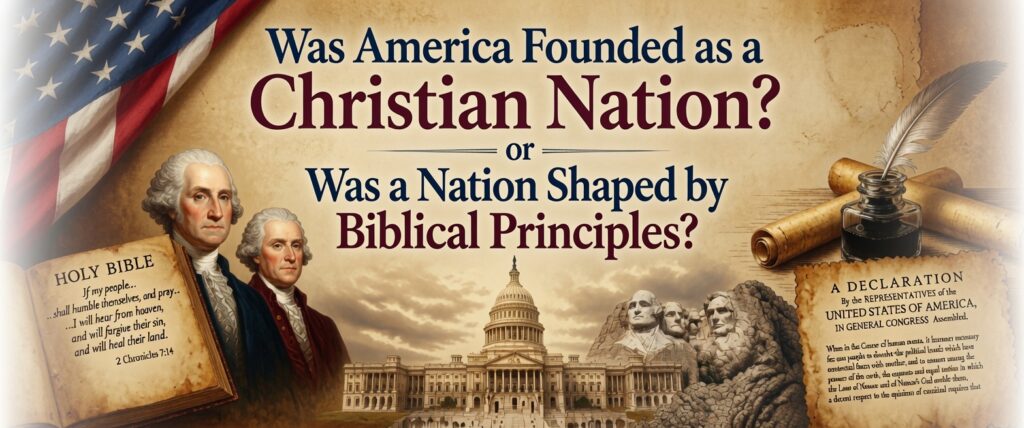
Was America founded as a Christian nation? Or was it a nation shaped by biblical principles? At first glance, those two questions appear to point toward the same answer. But historical documents and the Constitution itself reveal that America wasn’t founded purely as a Christian nation — it was shaped by biblical values and principles woven together with English Enlightenment thought and common law. The closer one examines history, the more the distinction matters — and the more one comes to appreciate the founders for their discernment and wisdom.
The Christian saga in America is both remarkable and complicated, marked by genuine faith and grievous contradiction. The story began centuries ago, in oppression and the conviction that a man’s faith in God should answer to no crown. Those memories are the roots, planted deep in colonial soil, a wilderness carved by hardship. Yet the faith that sustained the colonists was far from unified. For many, religious identity was largely inherited, shaped less by personal conviction than by the denomination or family name. New England was predominantly Congregationalist. Virginia and the southern colonies were largely Anglican. Pennsylvania carried a strong Quaker presence. The Carolinas were home to a mix of Presbyterians, Baptists, and Anglicans. New York had Dutch Reformed communities alongside Anglicans. Religion was less a personal choice than an inheritance, passed down through family, church, and community. The remarkable story is not simply that the colonists survived, but that they preserved their religious traditions of England. Even in crude settlements of timber, mud, and hardship, denominational customs continued to shape family, church, and community.
Most can agree that America was shaped predominantly by biblical principles. Yet the designation “Christian nation” is imprecise. Christianity, understood as a historical religion, is a compilation of centuries of theological development, reflecting many denominational traditions and differing interpretations of Scripture. The gospel of Jesus Christ, however, was never the start of a religion. Salvation began in the work of Christ Himself, the firstborn of an entirely new creation of believers.
What many call “Christianity” today has been shaped through centuries of additions, subtractions, and private interpretation of Scripture. Even the word “Christian” wasn’t a name believers chose for themselves — it was first used in Antioch, likely coined by outsiders, its Greek form echoing labels like “Herodian” (followers of Herod), a term marking a political faction rather than a self-claimed identity.
The disciples simply called themselves followers of “the Way” — an echo of Jesus’ own words, “I am the way, the truth, and the life.” Luke repeatedly uses this designation in Acts, describing “the Way” as the believer’s earliest identity, long before the Christian religion developed into the diverse traditions known today.
The Waves of Denominations
About a century after Jamestown was established in 1607, waves of Separatists and Puritans followed, carrying their faith across the Atlantic to settle the New World. A century later, during the two movements of the Great Awakening, a spiritual movement transformed countless lives as many hearts turned toward God. Alongside these authentic works of the Holy Spirit, however, excesses emerged — an emotional contagion, as people experienced what many critics of the day called “enthusiasm.” These were accounts of religious experiences driven more by emotion than by discernment. They exposed a tension that has accompanied the Church throughout its history: the delicate line between authentic faith and fanaticism, and between lifeless religion and living faith.
James Davenport was Yale-educated, but his ministry gradually crossed the line from conviction into fanaticism. He urged crowds to burn religious books, making his own spiritual discernment the measure of faith and genuine conversion. His behavior became so extreme that the Connecticut General Assembly concluded he was “under the influence of enthusiastical impressions and impulses, and thereby disturbed in the rational faculties of his mind.” Another, Gilbert Tennent, publicly condemned many established ministers as unconverted and urged believers to leave churches under their care, a message he proclaimed in his famous 1740 sermon, “The Danger of an Unconverted Ministry.” Both Tennent and Davenport later repented of their excesses.
Jonathan Edwards spent considerable energy distinguishing the genuine work of the Spirit from its imitators — a task that has accompanied every revival in church history. In his landmark work The Distinguishing Marks of a Work of the Spirit of God, he argued that outward manifestations — weeping, trembling, physical collapse — were neither proof of genuine conversion nor evidence against it. The true measure, he insisted, was a transformed life marked by repentance, humility, and an increasing love for Christ. Edwards understood that the failures and excesses of men could never invalidate the genuine work of God. Within the visible institutions of religion — however flawed, however divided — are true believers with hearts after God.
Throughout history, Separatists, Puritans, Anglicans, and countless other Christian traditions sought to preserve what they believed was the true understanding of the Gospel. Had any one of those traditions alone been entrusted with framing the United States Constitution, each would likely have envisioned a Christian nation differently—and many would have been tempted to embed their own interpretations and expectations into the nation’s laws.
The Awakenings
Despite differences, the power of the Gospel was evident throughout the colonies. Roughly half a century later, the Second Great Awakening swept across America’s expanding frontier through circuit riders — traveling preachers who rode hundreds of miles on horseback to reach scattered settlements. The riders worked largely without oversight, traveling alone across vast distances with minimal accountability. Families traveled for miles and set up camps for several days, drawn by the expectation of a personal encounter with God. Places such as Cane Ridge, Kentucky, drew thousands who camped for days beneath the open sky. Contemporary accounts describe scenes that were inspiring to some and unsettling to others. There were remarkable conversions, weeping, and shouting. People trembled and fell to the ground as they experienced what they described as God’s overwhelming presence. Real transformation occurred alongside moments of disorder. Genuine spiritual hunger, untethered from God’s Word, becomes vulnerable to deception.
Much later, Charles Finney coined the phrase “burned-over district” in his 1876 autobiography to describe western New York — a region so repeatedly swept by revival that he said there was no spiritual fuel left to ignite. These were not tidy spiritual movements; they were contested, sometimes excessive. Genuine transformation unfolded amid manipulation and misplaced zeal. Authentic spiritual hunger was often overshadowed by religious performance, driven by attendees’ expectations. And yet God moved. He is faithful to meet those who genuinely seek Him.
Which Christian denomination, then, preserved the most faithful understanding of the gospel? These were not minor doctrinal footnotes. The deepest divisions were not between believers and skeptics, but among believers themselves—over what authentic faith required and who possessed the authority to define it. The Founders understood that these differences could not be resolved by civil government. Rather than establishing one Christian tradition over another, they framed a Constitution that reflected enduring biblical principles while protecting every citizen’s freedom of conscience and guaranteeing the same constitutional protections to every religion.
The Rise of a Secular Narrative
My mother taught first grade from the late 1960s into the 1990s. She witnessed firsthand the repercussions of how cultural changes affected children and families. She watched public education increasingly reflect a different set of moral and philosophical values. The rulings were already in place when she became a first-grade teacher. Over the decades that followed the Supreme Court’s landmark rulings in Engel v. Vitale (1962) and Abington School District v. Schempp (1963), which displaced long-standing school-sponsored prayer and devotional Bible reading from public education.
Public education was formally established by Horace Mann beginning in 1837. The Bible was part of the curriculum. Mann himself included biblical moral teaching as foundational to the school’s purpose. Prayer and Scripture had been woven into the daily life of American public schools for more than 120 years before the Court removed them.
In Engel, the Court ruled 6-1 that a brief nondenominational prayer composed by the New York State Board of Regents violated the First Amendment’s Establishment Clause. Justice Potter Stewart was the lone dissenter, arguing the prayer was voluntary and that preventing students from reciting it denied them a part of the nation’s religious heritage.
The following year, Schempp extended that ruling, determining that school-sponsored Bible readings and recitation of the Lord’s Prayer were likewise unconstitutional. The decisions caused widespread public outrage — the Court received more mail over Engel than any prior case, and a Gallup poll found roughly 79 percent of Americans opposed the ruling. Together the two decisions effectively removed organized religious practice from the daily life of American public education. This was more than a legal matter. It was a cultural signal about where the secular world believed religion belonged in public life. What had once been presented as neutrality gradually became the active separation of religion from public life. The secular groundwork for that shift had been building for years, and is part of the congressional record.
A believer’s fate is not determined by the rulings of any earthly court. We should live our lives for Christ, pursue righteousness, seek to influence society toward what is good, and protect our loved ones. Our highest calling is not political but spiritual. We proclaim the Gospel of Jesus Christ. Faith cannot be legislated or imposed. It is a voluntary response of the human heart to God. For the believer, Scripture is clear—the conflict at the heart of human history is ultimately spiritual, not political. The removal of school prayer doesn’t diminish our civic responsibility. We are called to “render to Caesar the things that are Caesar’s, and to God the things that are God’s” (Matthew 22:21). Our commission is not to force God’s Kingdom back into public institutions, but to proclaim the Gospel of Jesus and transform hearts. Christ did not pour “new wine into old wineskins” (Matthew 9:17), and neither can spiritual life be produced through political power. Godly faith has always flourished apart from man’s institutions and in spite of them. Jesus’ teaching is consistent: His kingdom advances through transformed hearts, not civil authority. As Jesus declared before Pilate, “My kingdom is not of this world” (John 18:36). And Paul likewise reminds believers that “our citizenship is in heaven” (Philippians 3:20). Together, these truths remind us that Christ’s Kingdom is distinguished not by earthly borders or political power, but by transformed lives.“Let your light so shine before men, that they may see your good works, and glorify your Father which is in heaven.” (Matthew 5:16)
The Signing of the Constitution
The Constitution, signed on September 17, 1787, established a deliberately secular framework for the federal government, one that did not rest on a single religious identity. The founders opposed a state-sponsored religion and instead sought to protect religious liberty for all.
The nation’s founders were not untouched by God. They were deeply shaped by the Christian beliefs of colonial life. Not one founder denied the moral authority of Jesus, whatever their personal theology. His ethical teaching commanded respect across the spectrum of belief. The question was never whether the founders were influenced by God. They were — the question is: Would men who had lived through the violence and coercion of state-sponsored religion write a Constitution that bound them to the same chains of political and religious conformity?
Every delegate carried the memory of what established, unbending institutions cost—in England, in Europe, and in their own colonial experience. The Constitution was not an act of secularism or religion. It was an act of hard-won wisdom.
It’s improbable that God, who raises up kingdoms and removes them and directs the course of nations and the hearts of rulers, was absent from one of the most important moments in American history. His providence neither sanctifies every decision the founders made nor establishes America with a special covenant purpose. But it does remind us that God remains sovereign over the affairs of men. Such convictions should not be confused with covenant status or a divine endorsement. God is busy with his new Creation; He is involved with His creation through His Son Jesus.
What emerged from the founding was a constitutional framework that protected every human being’s freedom to respond to God without coercion. Jesus has never operated through compulsion. He stands at the door and knocks — “If anyone hears My voice and opens the door, I will come in to him” (Revelation 3:20). The response belongs entirely to the one who hears. Jesus needs no human endorsement to be who He is. When the Pharisees, the Jewish religious authorities of the day, demanded that Jesus silence His disciples who were proclaiming Him King as He rode into Jerusalem, He answered without hesitation — “if these should keep silent, the stones would immediately cry out” (Luke 19:40).
The testimony of Christ as King requires no government, tribe, or nation to validate it. A government designed to protect the freedom of conscience does not diminish God — it reflects the way He has always worked: not through force, but through the willing response of the human heart. Even Christ Himself, when offered earthly kingdoms, refused them.
The Birth of Constitutional Government
James Madison, often called the Father of the Constitution, was educated in the Presbyterian tradition under the Preacher, John Witherspoon — one of the leading Christian thinkers of the Revolutionary era. His education gave him a deep appreciation for biblical morality and the necessity of religious liberty. Convinced that faith must be genuine rather than compelled by government, he became one of the strongest advocates for protecting the free exercise of religion. That conviction was not merely theoretical; it was tested. When Virginia proposed a bill to tax citizens to fund Christian ministers, Madison saw it as a direct threat to the very principle he had come to hold most firmly.
His response was the Memorial and Remonstrance Against Religious Assessments of 1785 — a document arguing that compelling support for religion, however well-intentioned, was a dangerous abuse of power. His reasoning went to the heart of freedom of conscience — that religion “can be directed only by reason and conviction, not by force or violence.” The bill failed. The following year, Jefferson’s Virginia Statute for Religious Freedom passed — the first unreserved guarantee of religious liberty in American history. Madison brought that conviction directly into the Constitutional Convention in 1787, and it found its national expression in the First Amendment, which Madison himself authored and introduced to Congress in 1789. The 45 words Madison wrote were precise and elegant expressions of five essential freedoms — beginning with the two that made all the others possible: “Congress shall make no law respecting an establishment of religion, or prohibiting the free exercise thereof.” No establishment. No prohibition. The government would neither impose religion nor obstruct it.
In September 1774, delegates from twelve colonies gathered for the First Continental Congress to formally address their grievances against Britain, with Georgia being the lone absence. Those grievances would ultimately ignite the Revolutionary War. Out of that war, the thirteen colonies emerged as independent states. On July 4, 1776, the Second Continental Congress adopted the Declaration of Independence, principally drafted by Thomas Jefferson and revised by Benjamin Franklin, John Adams, Roger Sherman, and Robert R. Livingston. More than a declaration of political ideals, it was a formal announcement that the colonies were severing their ties with Great Britain. The document presented a carefully argued case for independence, listing the colonists’ grievances against King George III to justify the dissolution of their political bonds. In effect, it publicly declared that the colonies no longer recognized British authority, making continued armed conflict inevitable. In signing it, they were openly committing high treason against the British Crown. If the Revolution failed, the penalty would almost certainly be death. They understood they were, in effect, signing their own death warrants. Congress then governed the emerging nation through the difficult years of the Revolutionary War.
Victory secured the nation’s independence, but peace exposed another challenge. Winning the Revolution proved easier than governing the republic it had created.
By 1787, it had become clear that the Articles of Confederation, the young nation’s first attempt at a governing framework ratified just six years earlier in 1781, were too weak to hold the republic together. From May through September of that year, delegates from twelve of the thirteen states gathered in the Assembly Room of the Pennsylvania State House, today known as Independence Hall in Philadelphia. Rhode Island was again absent, this time out of deep suspicion of a stronger federal government. Together the attending delegates debated, revised, and refined every article behind closed doors, forging the constitutional framework that would govern the United States. Rhode Island’s absence did not exempt it from the outcome; under significant economic pressure, it eventually ratified the Constitution in 1790, becoming the last of the original thirteen states to do so.
Patrick Henry was a fierce Anti-Federalist and later became one of the Constitution’s loudest critics during the ratification debates, arguing it lacked sufficient protections for individual rights. His opposition became one of the principal forces behind the adoption of the Bill of Rights. Despite intense debate, competing interests, and considerable drama, the Convention ultimately produced a framework capable of uniting thirteen remarkably different states.
Madison worked alongside Washington, whose Anglican upbringing produced a sincere but carefully restrained public faith. Madison understood the dilemma—a nation this religiously diverse could not afford a Constitution captured by any single doctrinal tradition, and he helped shape one broad enough to preserve both union and liberty. Gouverneur Morris, who gave the Constitution much of its final language, spoke openly of Divine Providence yet moved comfortably within Enlightenment philosophical circles. Roger Sherman, the only man to sign all four of the founding era’s major documents, brought the convictions of an orthodox Congregationalist shaped by Reformed theology—a counterweight to the rationalists in the room. Alexander Hamilton admired Christianity’s moral framework and, in his later years, moved toward a more explicit faith, perhaps sobered by the costs of the Revolution and the fragility of the republic. James Wilson, one of the Convention’s most influential legal minds and one of only six men to sign both the Declaration and the Constitution, drew simultaneously on Scottish Enlightenment philosophy and the Christian natural law tradition, arguing that the sovereignty of the people was itself a component of God-given natural law. Neither pure rationalist nor simple pietist, he embodied the intellectual complexity of a generation that refused to separate reason from conscience.
Together, these men did not represent a unified theological vision. They represented something rarer—the capacity to reason together across profound disagreement toward a common purpose.e.
A Diverse Generation, A Common Framework
Despite their theological differences, the founders united around the conviction that human rights were derived from the Creator, not granted by the state. Together they produced a constitutional framework for civil government, while the Declaration of Independence expressed one of the nation’s most enduring principles. Jefferson wrote, “We hold these truths to be self-evident, that all men are created equal, that they are endowed by their Creator with certain unalienable Rights.” Those words would take on even deeper significance for Jefferson in the decades that followed.
The Constitution that emerged was not the product of any one man’s theology but of nearly two centuries of colonial experience — an experiment in self-government tested through hardship and failure. Men with deeply differing beliefs shared a common commitment to secure liberty and build something that could endure. To reduce that achievement to a simplistic Christian nation narrative is to miss what makes the Constitution truly remarkable.
The historical record reveals no single religious consensus among the founders. Twentieth-century historian Thomas S. Kidd has observed that “the major founding fathers are a mixed bag as far as their personal faiths.” Historian Gordon S. Wood likewise portrays the founding generation as men of “diverse convictions rather than a unified religious movement.” Together, their scholarship reminds us that the founders cannot be reduced to a single theological vision but instead represented a broad spectrum of religious belief, philosophical influence and political thought. The founding generation drew from many sources — Scripture, English common law and even classical antiquity.
The Founders Spoke of God and Providence
There is overwhelming evidence that Christianity profoundly influenced the culture, the colonies, and many of the men who helped shape the nation. At the same time, several founders whose personal beliefs differed from orthodox Christianity frequently acknowledged God’s guiding hand in human affairs. Their appeals to God’s sovereign guidance reflected a shared conviction that history unfolds under a higher authority. What united them was not a common creed but a common conviction: that government does not create rights. It exists to secure and protect rights that already belong to the individual. That conviction is deeply consistent with biblical principles concerning human dignity, moral accountability, and mankind’s relationship with the Creator.
George Washington repeatedly referred to Divine Providence in his inaugural and other public addresses and famously declared in his Farewell Address that “religion and morality are indispensable supports” of political prosperity. John Adams wrote: “Our Constitution was made only for a moral and religious People. It is wholly inadequate to the government of any other.” Congress appointed chaplains, opened its sessions with prayer, and proclaimed national days of thanksgiving and prayer. In 1799, President Adams proclaimed a national day of fasting and prayer using explicitly Christian language. These documents are authentic and deserve careful consideration by anyone seeking to understand the religious influences surrounding America’s founding.
When the Constitutional Convention met in Philadelphia in 1787, delegates brought with them religious convictions and political philosophies. They were not attempting to establish a single religious tradition or elevate one denomination above another. Their task was to create a durable framework capable of uniting thirteen states with different histories, denominations, and established beliefs.
This raises an important question. After years of colonial hardship, religious conflict, and the long struggle for liberty, why would these same men create a federal government that merely recreated the very system they and their ancestors had crossed an ocean to escape? Such a course would have defeated the very purpose of the American experiment. Their aim was not to remove Christianity from public life but to prevent the federal government from granting religious privilege by law.
No Religious Test Shall Ever Be Required
The founders established a federal framework that did not interfere with the free exercise of religion. It protected all beliefs from federal coercion while allowing individual states to retain many of their own religious traditions during the early years of the Republic.
I have no difficulty believing that the hand of God was present in the founding of the United States. History is filled with examples of God working through imperfect people, governments, and nations to accomplish His purposes. Providence should not be confused with endorsement. God may guide events without affirming every belief, motive, or institution involved.
The founders were also students of history. They drew from Scripture, but not from Scripture alone. English common law provided a legal inheritance stretching back to Magna Carta — the right to trial by jury, due process, habeas corpus, and protection from arbitrary search and seizure. The founders did not invent these rights. They codified what English subjects had long claimed to possess and what the Crown had repeatedly violated. They understood that liberty was best protected when power was limited, divided, and held accountable. They had witnessed the abuses of monarchs, state churches, and governments that treated rights as privileges granted by rulers rather than gifts from the Creator. Rather than creating a federal government that favored one denomination, they established a framework that allowed religious communities to flourish without federal coercion — carefully structuring it to prevent the consolidation of power that had historically threatened both conscience and freedom.
Their wisdom deserves recognition. They built a constitutional order designed to endure — one that protected civil and religious liberty not by establishing the right religion but by ensuring that no single authority could impose one. Recognizing both God’s sovereign purposes and the complexity of the historical record gives us a fuller and more honest understanding of what they built.
Identity is Found in Jesus
I deeply appreciate America’s history and the profound influence Christianity has had on its culture and development. The central theme of the New Testament is that a believer’s identity is found in Jesus, the Christ, son of the living God. Paul repeatedly reminded believers that they were “in Christ” before they were Romans, Greeks, or Jews. Peter described God’s people as “strangers and pilgrims” on the earth (1 Peter 2:11). The believer’s highest allegiance belongs to the Kingdom of God. It is right to appreciate America’s heritage and honor the wisdom of those who established its constitutional system. But no nation, however greatly blessed, occupies the place reserved for the Kingdom of God.
To understand how that heritage formed, we must return to where it began — not in Philadelphia in 1776 or 1787, but in the lives of the men and women who crossed an ocean generations earlier, carrying their convictions into an unknown world. That story is told in the next chapter — The Great American Migration — where the American character was first shaped, long before anyone called it a nation.nts of disorder. Genuine spiritual hunger, untethered from God’s Word, becomes vulnerable to deception.
Much later, Charles Finney coined the phrase “burned-over district” in his 1876 autobiography to describe western New York — a region so repeatedly swept by revival that he said there was no spiritual fuel left to ignite. These were not tidy spiritual movements; they were contested, sometimes excessive. Genuine transformation unfolded amid manipulation and misplaced zeal. Authentic spiritual hunger was often overshadowed by religious performance, driven by attendees’ expectations. And yet God moved. He is faithful to meet those who genuinely seek Him.
Which Christian denomination, then, preserved the most faithful understanding of the gospel? These were not minor doctrinal footnotes. The deepest divisions were not between believers and skeptics, but among believers themselves—over what authentic faith required and who possessed the authority to define it. The Founders understood that these differences could not be resolved by civil government. Rather than establishing one Christian tradition over another, they framed a Constitution that reflected enduring biblical principles while protecting every citizen’s freedom of conscience and guaranteeing the same constitutional protections to every religion.
The Rise of a Secular Narrative
My mother taught first grade from the late 1960s into the 1990s and often witnessed firsthand the repercussions of how cultural changes affected children and families. She watched public education increasingly reflect a different set of moral and philosophical values over the decades that followed the Supreme Court’s landmark rulings in Engel v. Vitale (1962) and Abington School District v. Schempp (1963).
What makes those rulings significant in historical context is not simply what they decided but what they displaced. American public education was formally established by Horace Mann beginning in 1837, and from its earliest days, the Bible was part of the curriculum. Mann himself included biblical moral teaching as foundational to the common school’s purpose. Prayer and Scripture had been woven into the daily life of American public schools for more than 120 years before the Court removed them.
In Engel, the Court ruled 6-1 that a brief nondenominational prayer composed by the New York State Board of Regents violated the First Amendment’s Establishment Clause. Justice Potter Stewart was the lone dissenter, arguing the prayer was voluntary and that denying students the opportunity to recite it denied them a share in the nation’s spiritual heritage.
The following year, Schempp extended that ruling, determining that school-sponsored Bible readings and recitation of the Lord’s Prayer were likewise unconstitutional. The decisions caused widespread public outrage — the Court received more mail over Engel than any prior case, and a Gallup poll found roughly 79 percent of Americans opposed the ruling. Together the two decisions effectively removed organized religious practice from the daily life of American public education — not merely as a legal matter but as a cultural signal about where religion belonged in public life. What had once been presented as neutrality gradually became the promotion of an alternative worldview. The infrastructure behind that shift had been building for years, and much of it is now part of the congressional record.
A Kingdom Not of This World
Believers in Jesus should never acquiesce to evil. We should vote our conscience, pursue righteousness, and seek to influence society toward what is good. Yet our highest calling is not political but spiritual — to proclaim the Gospel of Jesus Christ. Faith cannot be legislated or imposed. It is the voluntary response of the human heart to God. For the believer, Scripture is clear — the conflict at the heart of human history is ultimately spiritual, not political. That conviction does not diminish civic responsibility. Godly faith has always flourished apart from man’s institutions and in spite of them. Jesus’ teaching is consistent: His kingdom advances through transformed hearts, not civil authority. As Jesus declared before Pilate, “My kingdom is not of this world” (John 18:36). Paul likewise reminds believers that “our citizenship is in heaven” (Philippians 3:20). Together, these truths remind us that Christ’s Kingdom is distinguished not by earthly borders or political power, but by transformed lives.
The believer’s calling was never to transform earthly institutions but to be transformed by the renewing of the mind (Romans 12:2) and walk in “the high calling of God in Christ Jesus” (Philippians 3:14). Rather than trying to reinstate a narrative or impose faith on a worldly institution, we should simply live it — in our homes, our churches, our communities and our relationships.
This does not negate the believer’s civic responsibility. Scripture calls us to render to Caesar what is Caesar’s (Matthew 22:21), to pray for those in authority (1 Timothy 2:1–2). Even to the Jewish exiles living under Babylonian rule, God said, “Seek the peace of the city… and pray to the LORD for it” (Jeremiah 29:7). Placing righteous men and women in positions of influence is not only appropriate; it is part of faithful stewardship. I believe we are not called to defend a national story, but to bear witness to Christ’s eternal Kingdom.“Let your light so shine before men, that they may see your good works, and glorify your Father which is in heaven.” (Matthew 5:16)
The Signing of the Constitution
The Constitution, signed on September 17, 1787, established a deliberately secular framework for the federal government, one that did not rest on a single religious identity. The founders opposed a state-sponsored religion and instead sought to protect religious liberty for all.
The nation’s founders were not untouched by God. They were deeply shaped by the Christian beliefs of colonial life. Not one founder denied the moral authority of Jesus, whatever their personal theology. His ethical teaching commanded respect across the spectrum of belief. The question was never whether the founders were influenced by God. They were — the question is: Would men who had lived through the violence and coercion of state-sponsored religion write a Constitution that bound them to the same chains of political and religious conformity? Every delegate carried the memory of what established, unbending institutions cost—in England, in Europe, and in their own colonial experience. The Constitution was not an act of secularism. It was an act of hard-won wisdom.
It is difficult to believe that the God who raises up kingdoms and removes them, who directs the course of nations and the hearts of rulers, was absent from one of the most consequential moments in American history. His providence neither sanctifies every decision the founders made nor establishes America with a special covenant purpose, but it does remind us that God remains sovereign over the affairs of men. Such convictions should not be confused with covenant status or divine endorsement.
What emerged from the founding was a constitutional framework that protected every human being’s freedom to respond to God without coercion. Jesus has never operated through compulsion. He stands at the door and knocks — “If anyone hears My voice and opens the door, I will come in to him” (Revelation 3:20). The response belongs entirely to the one who hears. Jesus needs no human endorsement to be who He is. When the Pharisees, the Jewish religious authorities of the day, demanded that Jesus silence His disciples who were proclaiming Him King as He rode into Jerusalem, He answered without hesitation — “if these should keep silent, the stones would immediately cry out” (Luke 19:40).
The testimony of Christ as King requires no government, no nation, and no legislation to sustain it. A government designed to protect the freedom of conscience does not diminish God — it reflects the way He has always worked. Not through force but through the willing response of the human heart.
The Birth of Constitutional Government
James Madison, often called the Father of the Constitution, was educated in the Presbyterian tradition under the Preacher, John Witherspoon — one of the leading Christian thinkers of the Revolutionary era. His education gave him a deep appreciation for biblical morality and the necessity of religious liberty. Convinced that faith must be genuine rather than compelled by government, he became one of the strongest advocates for protecting the free exercise of religion. That conviction was not merely theoretical; it was tested. When Virginia proposed a bill to tax citizens to fund Christian ministers, Madison saw it as a direct threat to the very principle he had come to hold most firmly.
His response was the Memorial and Remonstrance Against Religious Assessments of 1785 — a document arguing that compelling support for religion, however well-intentioned, was a dangerous abuse of power. His reasoning went to the heart of freedom of conscience — that religion “can be directed only by reason and conviction, not by force or violence.” The bill failed. The following year, Jefferson’s Virginia Statute for Religious Freedom passed — the first unreserved guarantee of religious liberty in American history. Madison brought that conviction directly into the Constitutional Convention in 1787, and it found its national expression in the First Amendment, which Madison himself authored and introduced to Congress in 1789. The 45 words Madison wrote were precise and elegant expressions of five essential freedoms — beginning with the two that made all the others possible: “Congress shall make no law respecting an establishment of religion, or prohibiting the free exercise thereof.” No establishment. No prohibition. The government would neither impose religion nor obstruct it.
In September 1774, delegates from twelve colonies gathered for the First Continental Congress to formally address their grievances against Britain, with Georgia being the lone absence. Those grievances would ultimately ignite the Revolutionary War. Out of that war, the thirteen colonies emerged as independent states. On July 4, 1776, the Second Continental Congress adopted the Declaration of Independence, principally drafted by Thomas Jefferson and revised by Benjamin Franklin, John Adams, Roger Sherman, and Robert R. Livingston. More than a declaration of political ideals, it was a formal announcement that the colonies were severing their ties with Great Britain. The document presented a carefully argued case for independence, listing the colonists’ grievances against King George III to justify the dissolution of their political bonds. In effect, it publicly declared that the colonies no longer recognized British authority, making continued armed conflict inevitable. In signing it, they were openly committing high treason against the British Crown. If the Revolution failed, the penalty would almost certainly be death. They understood they were, in effect, signing their own death warrants. Congress then governed the emerging nation through the difficult years of the Revolutionary War.
Victory secured the nation’s independence, but peace exposed another challenge. Winning the Revolution proved easier than governing the republic it had created.
By 1787, it had become clear that the Articles of Confederation, the young nation’s first attempt at a governing framework ratified just six years earlier in 1781, were too weak to hold the republic together. From May through September of that year, delegates from twelve of the thirteen states gathered in the Assembly Room of the Pennsylvania State House, today known as Independence Hall in Philadelphia. Rhode Island was again absent, this time out of deep suspicion of a stronger federal government. Together the attending delegates debated, revised, and refined every article behind closed doors, forging the constitutional framework that would govern the United States. Rhode Island’s absence did not exempt it from the outcome; under significant economic pressure, it eventually ratified the Constitution in 1790, becoming the last of the original thirteen states to do so.
Patrick Henry was a fierce Anti-Federalist and later became one of the Constitution’s loudest critics during the ratification debates, arguing it lacked sufficient protections for individual rights. His opposition became one of the principal forces behind the adoption of the Bill of Rights. Despite intense debate, competing interests, and considerable drama, the Convention ultimately produced a framework capable of uniting thirteen remarkably different states.
Madison worked alongside Washington, whose Anglican upbringing produced a sincere but carefully restrained public faith. Madison understood the dilemma—a nation this religiously diverse could not afford a Constitution captured by any single doctrinal tradition, and he helped shape one broad enough to preserve both union and liberty. Gouverneur Morris, who gave the Constitution much of its final language, spoke openly of Divine Providence yet moved comfortably within Enlightenment philosophical circles.
Roger Sherman, the only man to sign all four of the founding era’s major documents, brought the convictions of an orthodox Congregationalist shaped by Reformed theology—a counterweight to the rationalists in the room. Alexander Hamilton admired Christianity’s moral framework and, in his later years, moved toward a more explicit faith, perhaps sobered by the costs of the Revolution and the fragility of the republic. James Wilson, one of the Convention’s most influential legal minds and one of only six men to sign both the Declaration and the Constitution, drew simultaneously on Scottish Enlightenment philosophy and the Christian natural law tradition, arguing that the sovereignty of the people was itself a component of God-given natural law. Neither pure rationalist nor simple pietist, he embodied the intellectual complexity of a generation that refused to separate reason from conscience.
Together, these men did not represent a unified theological vision. They represented something rarer—the capacity to reason together across profound disagreement toward a common purpose.e.
A Diverse Generation, A Common Framework
Despite their theological differences, the founders united around the conviction that human rights were derived from the Creator, not granted by the state. Together they produced a constitutional framework for civil government, while the Declaration of Independence expressed one of the nation’s most enduring principles. Jefferson wrote, “We hold these truths to be self-evident, that all men are created equal, that they are endowed by their Creator with certain unalienable Rights.” Those words would take on even deeper significance for Jefferson in the decades that followed.
The Constitution that emerged was not the product of any one man’s theology but of nearly two centuries of colonial experience — an experiment in self-government tested through hardship and failure. Men with deeply differing beliefs shared a common commitment to secure liberty and build something that could endure. To reduce that achievement to a simplistic Christian nation narrative is to miss what makes the Constitution truly remarkable.
The historical record reveals no single religious consensus among the founders. Twentieth-century historian Thomas S. Kidd has observed that “the major founding fathers are a mixed bag as far as their personal faiths.” Historian Gordon S. Wood likewise portrays the founding generation as men of “diverse convictions rather than a unified religious movement.” Together, their scholarship reminds us that the founders cannot be reduced to a single theological vision but instead represented a broad spectrum of religious belief, philosophical influence and political thought. The founding generation drew from many sources — Scripture, English common law and even classical antiquity.
The Founders Spoke of God and Providence
There is overwhelming evidence that Christianity profoundly influenced the culture, the colonies, and many of the men who helped shape the nation. At the same time, several founders whose personal beliefs differed from orthodox Christianity frequently acknowledged God’s guiding hand in human affairs. Their appeals to God’s sovereign guidance reflected a shared conviction that history unfolds under a higher authority. What united them was not a common creed but a common conviction: that government does not create rights. It exists to secure and protect rights that already belong to the individual. That conviction is deeply consistent with biblical principles concerning human dignity, moral accountability, and mankind’s relationship with the Creator.
George Washington repeatedly referred to Divine Providence in his inaugural and other public addresses and famously declared in his Farewell Address that “religion and morality are indispensable supports” of political prosperity. John Adams wrote: “Our Constitution was made only for a moral and religious People. It is wholly inadequate to the government of any other.” Congress appointed chaplains, opened its sessions with prayer, and proclaimed national days of thanksgiving and prayer. In 1799, President Adams proclaimed a national day of fasting and prayer using explicitly Christian language. These documents are authentic and deserve careful consideration by anyone seeking to understand the religious influences surrounding America’s founding.
When the Constitutional Convention met in Philadelphia in 1787, delegates brought with them religious convictions and political philosophies. They were not attempting to establish a single religious tradition or elevate one denomination above another. Their task was to create a durable framework capable of uniting thirteen states with different histories, denominations, and established beliefs.
This raises an important question. After years of colonial hardship, religious conflict, and the long struggle for liberty, why would these same men create a federal government that merely recreated the very system they and their ancestors had crossed an ocean to escape? Such a course would have defeated the very purpose of the American experiment. Their aim was not to remove Christianity from public life but to prevent the federal government from granting religious privilege by law.
No Religious Test Shall Ever Be Required
The founders established a federal framework that did not interfere with the free exercise of religion. It protected all beliefs from federal coercion while allowing individual states to retain many of their own religious traditions during the early years of the Republic.
I have no difficulty believing that the hand of God was present in the founding of the United States. History is filled with examples of God working through imperfect people, governments, and nations to accomplish His purposes. Providence should not be confused with endorsement. God may guide events without affirming every belief, motive, or institution involved.
The founders were also students of history. They drew from Scripture, but not from Scripture alone. English common law provided a legal inheritance stretching back to Magna Carta — the right to trial by jury, due process, habeas corpus, and protection from arbitrary search and seizure. The founders did not invent these rights. They codified what English subjects had long claimed to possess and what the Crown had repeatedly violated. They understood that liberty was best protected when power was limited, divided, and held accountable. They had witnessed the abuses of monarchs, state churches, and governments that treated rights as privileges granted by rulers rather than gifts from the Creator. Rather than creating a federal government that favored one denomination, they established a framework that allowed religious communities to flourish without federal coercion — carefully structuring it to prevent the consolidation of power that had historically threatened both conscience and freedom.
Their wisdom deserves recognition. They built a constitutional order designed to endure — one that protected civil and religious liberty not by establishing the right religion but by ensuring that no single authority could impose one. Recognizing both God’s sovereign purposes and the complexity of the historical record gives us a fuller and more honest understanding of what they built.
Identity is Found in Jesus
I deeply appreciate America’s history and the profound influence Christianity has had on its culture and development. The central theme of the New Testament is that a believer’s identity is found in Jesus, the Christ, son of the living God. Paul repeatedly reminded believers that they were “in Christ” before they were Romans, Greeks, or Jews. Peter described God’s people as “strangers and pilgrims” on the earth (1 Peter 2:11). The believer’s highest allegiance belongs to the Kingdom of God. It is right to appreciate America’s heritage and honor the wisdom of those who established its constitutional system. But no nation, however greatly blessed, occupies the place reserved for the Kingdom of God.
To understand how that heritage formed, we must return to where it began — not in Philadelphia in 1776 or 1787, but in the lives of the men and women who crossed an ocean generations earlier, carrying their convictions into an unknown world. That story is told in the next chapter — The Great American Migration — where the American character was first shaped, long before anyone called it a nation.
Was America Founded as a Christian Nation? — Sources and Further Reading
- Abington School District v. Schempp, 374 U.S. 203 (1963). United States Supreme Court.
- Davenport, James. The Reverend Mr. James Davenport’s Confession and Retractions. Boston: S. Kneeland and T. Green, 1744.
- Edwards, Jonathan. The Distinguishing Marks of a Work of the Spirit of God. Boston: S. Kneeland and T. Green, 1741.
- Engel v. Vitale, 370 U.S. 421 (1962). United States Supreme Court.
- Finney, Charles G. Memoirs of Reverend Charles G. Finney Written By Himself. New York: A. S. Barnes, 1876.
- Jefferson, Thomas. Virginia Statute for Religious Freedom. 1786. In The Papers of Thomas Jefferson. Vol. 2. Edited by Julian P. Boyd. Princeton: Princeton University Press, 1950.
- Kaestle, Carl F. Pillars of the Republic: Common Schools and American Society, 1780–1860. New York: Hill and Wang, 1983.
- Kidd, Thomas S. God of Liberty: A Religious History of the American Revolution. New York: Basic Books, 2010.
- Madison, James. Memorial and Remonstrance Against Religious Assessments. 1785. In The Papers of James Madison. Vol. 8. Edited by Robert A. Rutland et al. Chicago: University of Chicago Press, 1973.
- Mann, Horace. Twelfth Annual Report of the Secretary of the Massachusetts Board of Education. Boston: Dutton and Wentworth, 1848.
- Noll, Mark A. America’s God: From Jonathan Edwards to Abraham Lincoln. New York: Oxford University Press, 2002.
- Ravitch, Diane. The Troubled Crusade: American Education, 1945–1980. New York: Basic Books, 1983.
- Spring, Joel. The American School, 1642–2004. 7th ed. New York: McGraw-Hill, 2005.
- Tennent, Gilbert. The Danger of an Unconverted Ministry. Philadelphia: Benjamin Franklin, 1740.
- Tyack, David, and Elisabeth Hansot. Managers of Virtue: Public School Leadership in America, 1820–1980. New York: Basic Books, 1982.
- Urban, Wayne J., Jennings L. Wagoner Jr., and Milton Gaither. American Education: A History. 6th ed. New York: Routledge, 2019.
- Wood, Gordon S. The Creation of the American Republic, 1776–1787. Chapel Hill: University of North Carolina Press, 1969.
About the Author Mark Thomas
Mark is a visionary leader and writer who helps others discover their God-given purpose. See his teaching series www.LiveandGrowonPurpose.com