
- You are here:
- Home »
- Leadership »
- The Birth of Modern Zionism
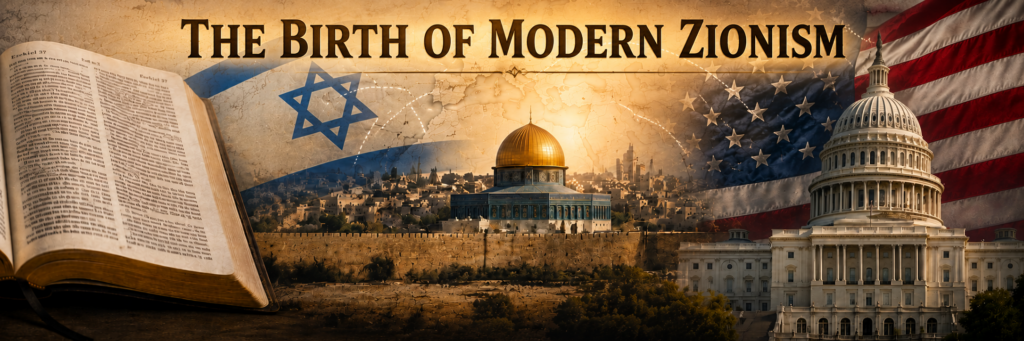
The Birth of Modern Zionism
Throughout history, nations have often been assigned identities and prophetic roles that go beyond what Scripture itself declares. America has frequently been portrayed as a uniquely covenanted nation with a special place in God’s redemptive plan.
I mention this not to equate America with Israel, but to show how easily assumptions about national identity can take on theological weight. Likewise, many assumptions have been made about Israel’s covenant identity and prophetic role. Before building our understanding on tradition or popular interpretation, we must ask a simpler question: What does the New Testament actually say?
Scripture does not leave the question of covenant identity to speculation—it answers it directly through the Apostle Paul. As he writes, “Now to Abraham and his Seed were the promises made. He does not say, ‘And to seeds,’ as of many, but as of one, ‘And to your Seed,’ who is Christ” (Galatians 3:16). Paul then extends that promise to all who belong to Christ: “And if you are Christ’s, then you are Abraham’s seed, and heirs according to the promise” (Galatians 3:29).
From this perspective, the promises first given to Abram (later named Abraham)—“And in you all the families of the earth shall be blessed” (Genesis 12:3)—find their fulfillment not in an earthly nation alone, but in the promised Seed, Jesus Christ, and in all who are united to Him by faith. Through faith in Christ, both Jew and Gentile become heirs of the promise. As Paul declares, “For you are all sons of God through faith in Christ Jesus… There is neither Jew nor Greek… for you are all one in Christ Jesus. And if you are Christ’s, then you are Abraham’s seed, and heirs according to the promise” (Galatians 3:26–29).
Writing to the Ephesians, Paul explains that Christ “has made both one” and “created in Himself one new man from the two, thus making peace” (Ephesians 2:14–16). He goes on to say that believing Gentiles are “no longer strangers and foreigners, but fellow citizens with the saints and members of the household of God” (Ephesians 2:19).
Paul also speaks of the “Israel of God” (Galatians 6:16), pointing to God’s redeemed covenant people whose identity is found in Christ. Likewise, Peter describes believers as “a chosen generation, a royal priesthood, a holy nation, His own special people” (1 Peter 2:9), language once applied to Israel but now centered on both Jews and Gentiles who belong to Christ. Throughout the New Testament, the emphasis consistently rests on Jesus Christ—the promised Seed—and on the people united to Him by faith, rather than on ethnicity or geography alone.
Christian Zionism
Historical Christian Zionism developed gradually over centuries. Its roots can be traced to the Protestant Reformation, when many Reformers anticipated the future conversion of the Jewish people, though they did not generally teach the restoration of a separate covenant nation. During the seventeenth century, some English Puritans began interpreting biblical prophecy as including a future return of the Jewish people to their ancestral land. By the nineteenth century, these restorationist hopes gained greater influence in Britain through evangelical leaders and statesmen such as Anthony Ashley-Cooper, the seventh Earl of Shaftesbury, whose advocacy for Jewish resettlement in Palestine helped lay the intellectual and political groundwork for the Balfour Declaration of 1917. Across the Atlantic, William Eugene Blackstone’s famous memorial (1891) urged American leaders to support the establishment of a Jewish homeland, reflecting a growing conviction among many evangelicals that God’s covenant purposes for Israel were not yet complete.
These ideas also found expression in American religious communities. Around 1900, John Alexander Dowie founded Zion, Illinois, envisioning it as a Christian community inspired by biblical themes. Though his movement ultimately failed, it illustrates how deeply the language and imagery of Zion had already entered the American religious imagination long before the establishment of the modern State of Israel in 1948. For many believers, Zion was not primarily a political aspiration, but a biblical symbol of God’s covenant faithfulness, His promises, and the hope of living under His righteous rule.
Dispensational Doctrine
Only afterward did John Nelson Darby (1800–1882), an Anglo-Irish theologian and leading figure in the Plymouth Brethren movement, provide a comprehensive prophetic framework connecting the return of the Jewish people to the land with the end times. His system taught that God administers history through a series of distinct dispensations and that Israel and the Church occupy separate roles within God’s redemptive plan. This distinction became especially significant because it provided the theological basis for a pre-tribulation rapture, in which the Church would be removed before the Tribulation, allowing God to resume His prophetic dealings with national Israel.
Darby himself would likely have rejected the notion that America occupied a unique covenantal place in God’s redemptive plan. Throughout his writings, he insisted that the Church is a heavenly people whose calling is distinct from every earthly nation. For Darby, no modern nation — not Britain, not America, nor any other Gentile power — could properly be identified as God’s covenant nation. The believer’s hope was never to be found in the destiny of an earthly kingdom but in Christ’s return and the heavenly calling of His Church.
At the same time, Darby taught that God’s dealings with Israel were distinct from those with the Church. He argued that the promises made to Israel in the Old Testament were not transferred to the Church but would be fulfilled literally to Israel in the future. In this sense, Darby clearly maintained a distinction between Israel and the Church, though it served more as a guiding framework than as a fully systematized doctrine.
Darby’s system later spread widely through the Scofield Reference Bible — first published in 1909 by Oxford University Press and revised in 1917 — whose extensive study notes popularized his dispensational framework among millions of English-speaking Christians. Yet there is a striking development in how Darby’s ideas were later interpreted and expanded. Through the popularizing influence of Scofield and others, dispensational thought became more formally systematized, and the distinction between Israel and the Church was often expressed in sharper, more rigid terms — sometimes described as involving separate covenantal programs or dispensations.
This raises an important question: did Scofield and later interpreters carry Darby’s framework into territory he himself articulated less formally? While Darby clearly distinguished Israel from the Church, later dispensationalism tended to codify that distinction in ways that went beyond his original presentation, shaping how many readers came to understand the relationship between Israel, the Church, and God’s unfolding plan.
As this interpretive system gained widespread influence through prophecy conferences and Bible schools, many evangelicals came to understand biblical prophecy — the end times, the restoration of Israel, the Antichrist, Armageddon, and the Second Coming, as parts of a single unified prophetic framework. Within this tradition, the reestablishment of the State of Israel in 1948 and the return of Jewish people to their historic homeland were often taught as a pivotal fulfillment of biblical prophecy. As a result, prophetic interpretations and eschatological timelines came to be anchored in the events of 1948, an approach that has proven problematic. God is not limited by our understanding or bound to human timelines. Our confidence lies in allowing Scripture to interpret Scripture carefully rather than imposing such frameworks on the biblical narrative.
The Testimony of Scripture
Some theologians have noted that this framework can unintentionally draw attention away from the New Testament’s emphasis upon Christ as the fulfillment of God’s covenant promises. These concerns come not from outside evangelical scholarship but from within it — serious biblical scholars writing from covenant-theology traditions who have raised careful questions about the Israel-and-Church distinction that Darby’s dispensationalism introduced. Others have observed that reading contemporary events primarily through a prophetic lens carries its own interpretive risks. At the same time, many who hold this view would respond that their support for Israel arises from a sincere desire to take biblical prophecy seriously and to affirm God’s continuing faithfulness to His promises.
My own conviction follows the apostle Paul’s teaching concerning the Abrahamic covenant. Writing to the Galatians, he explains that God’s promise was ultimately directed not to many descendants but to one — “And to your Seed,” who is Christ (Galatians 3:16). This establishes Christ as the promised Seed through whom God’s covenant of grace finds its fulfillment. He is the Firstborn of the new covenant people, and all who belong to Him — Jew and Gentile alike — become heirs according to the promise (Galatians 3:29).
This glorious union was foreshadowed long before Christ in the marriage of Boaz, an Israelite, and Ruth, a Moabite. Their son Obed became the grandfather of King David, revealing that God’s redemptive purpose was never confined to one ethnic people but always looked forward to the gathering of the nations through the promised Seed. In Christ that mystery is fully unveiled as Jew and Gentile are made “one new man,” reconciled “in one body,” and become “fellow citizens with the saints and members of the household of God” under one King (Ephesians 2:14–16, 19).
The Believer’s Call to Discernment
In contemporary discourse, ideas sometimes converge in movements, where the desire to preserve America’s biblical heritage becomes closely connected with end-times expectations and national renewal. Many who embrace this perspective are responding to genuine concerns. They grieve abortion, the breakdown of the family, the erosion of religious liberty, and the growing influence of secularism. They also recognize the profound role Christianity has played in shaping America’s history. The New Testament consistently centers God’s redemptive plan on Christ and His Kingdom. For that reason, believers should be careful not to interpret Scripture through the framework of any modern nation or geopolitical agenda, but to allow Scripture to interpret itself according to God’s redemptive purpose in Christ.
American history offers an important lesson. The nation’s greatest seasons of spiritual renewal did not begin with political victories or government mandates. The First Great Awakening spread through the colonies under the leadership of Jonathan Edwards and George Whitefield, transforming countless lives through repentance and personal conversion. A century later, the Second Great Awakening swept across the frontier — from Cane Ridge, Kentucky, eastward through New York’s Burned-over District — drawing entire communities into searching questions of faith and inspiring missionary work, social reform, and the abolitionist movement.
New missionary societies carried the Gospel around the world. Bible and tract societies sprang up. Colleges and seminaries were established. Reform movements gained momentum as many believers sought to confront slavery and drunkenness, poverty, and other social evils. Once again, the nation was changed from the inside out—not because government imposed righteousness, but because countless hearts were transformed by the Spirit of God.
Believers should always serve their communities with faithfulness. At the same time, history reminds us that lasting spiritual renewal begins with the Gospel, discipleship, and lives surrendered to Christ. Earthly nations rise and fall, but the Kingdom of God advances through faithful men and women whose allegiance is ultimately to Jesus, the King of kings.
Preserving Gratitude Without Idolatry
As a believer, I understand the deep appeal of viewing America in the light of God’s providence. I share the gratitude many Christians feel when leaders uphold biblical morality, defend religious liberty, or affirm values consistent with Scripture. These desires should not be dismissed. They reflect a sincere longing for truth, justice, and righteousness within society.
My own appreciation for this nation has only deepened as I have studied its history. The more I have learned about the founding generation, the greater my respect has become for their courage, wisdom, and extraordinary achievement. My patriotism has not diminished; it has matured. Yet genuine love for one’s country is strengthened—not weakened—when it is willing to distinguish historical gratitude from biblical conviction.
America’s story bears the unmistakable imprint of Christianity. From its earliest settlements, the Scriptures shaped the conscience of many of its people, its churches nurtured generations of families, and its faith inspired schools, acts of charity, public virtue, and a deep concern for moral responsibility. That legacy is woven into the fabric of the nation’s history and deserves both honest recognition and genuine gratitude.
Yet the New Testament draws our eyes beyond every earthly nation. It reserves covenant identity not for a political people or a geographical land, but for those who belong to Jesus Christ. A nation may be profoundly influenced by biblical truth and still not be a covenant nation. The everlasting covenant is found not in the rise of any republic, but in the promised Seed through whom God is redeeming people from every tribe, tongue, and nation.
The strength of early American Christianity did not rest primarily in governments or political institutions. It grew through faithful men and women who faithfully proclaimed the Gospel, discipled their families, and endured hardship. Recognizing the limited role of the federal government in matters of religion does not diminish America’s Christian heritage. It simply distinguishes the Kingdom of God from the kingdoms of this world. The Founders created a constitutional system that protected religious liberty without establishing a national church. At the same time, countless Christians helped shape the nation’s moral character through faithful service in their homes, churches, schools, businesses, and communities. Both realities belong to America’s story.
For believers, the central question is not whether America has been greatly used by God. History leaves little doubt that it has. The question is where our ultimate allegiance belongs. Paul reminds us, “Our citizenship is in heaven, from which we also eagerly wait for the Savior, the Lord Jesus Christ” (Philippians 3:20). Peter likewise calls believers “strangers and pilgrims” (1 Peter 2:11). Our hope rests not in any nation, political movement, or historical narrative, but in the reign of Christ.
As Christians, we should steward history with both gratitude and honesty. We need not exaggerate America’s Christian identity to appreciate its remarkable heritage, nor should we diminish God’s covenant purposes in Christ for the people of Israel. Truth requires neither romanticizing the past nor dismissing it. It calls us instead to humility, recognizing that God’s redemptive purposes unfold according to His Word rather than our assumptions or interpretations. The prophets speak of God’s everlasting covenant with the people of Israel under the reign of Israel’s Messiah. His promises are grander than our expectations, deeper than our traditions, and more glorious than our imaginations. Scripture ultimately lifts our eyes beyond the rise and fall of earthly nations to behold the everlasting Kingdom of God, where every promise finds its perfect fulfillment in Christ.
Historical References and Sources
- Darby, John Nelson. Collected Writings of J. N. Darby. Various editions.
- Sandeen, Ernest R. The Roots of Fundamentalism: British and American Millenarianism, 1800–1930. University of Chicago Press, 1970.
- Weber, Timothy P. Living in the Shadow of the Second Coming: American Premillennialism, 1875–1982. University of Chicago Press, 1987.
- The Encyclopedia of Christianity. Articles on Dispensationalism and John Nelson Darby.
- Encyclopedia Britannica. Entries on “John Nelson Darby” and “Dispensationalism.”
- The Scofield Reference Bible. Oxford University Press, 1909; revised edition, 1917.
- Marsden, George M. Fundamentalism and American Culture. Oxford University Press, revised edition, 2006.
- Carpenter, Joel A. Revive Us Again: The Reawakening of American Fundamentalism. Oxford University Press, 1997.
- Lewis, Donald M. The Origins of Christian Zionism: Lord Shaftesbury and Evangelical Support for a Jewish Homeland. Cambridge University Press, 2010.
- Merkley, Paul Charles. The Politics of Christian Zionism 1891–1948. Routledge, 1998.
- Sizer, Stephen. Christian Zionism: Road-map to Armageddon? Nottingham, UK: Inter-Varsity Press, 2004.
- Ariel, Yaakov. On Behalf of Israel: American Fundamentalist Attitudes Toward Jews, Judaism, and Zionism, 1865–1945. Carlson Publishing, 1991.
- Shaftesbury, Anthony Ashley-Cooper. Selected speeches, letters, and parliamentary papers concerning Jewish restoration.
- Fea, John. Was America Founded as a Christian Nation? A Historical Introduction. Westminster John Knox Press, revised edition.
- Hall, Mark David. Did America Have a Christian Founding? Nelson Books, 2019.
- Frazer, Gregg L. The Religious Beliefs of America’s Founders: Reason, Revelation, and Revolution. University Press of Kansas, 2012.
- Noll, Mark A. America’s God: From Jonathan Edwards to Abraham Lincoln. Oxford University Press.
- Meacham, Jon. American Gospel: God, the Founding Fathers, and the Making of a Nation. Random House, 2006.
- Dreisbach, Daniel L. Reading the Bible with the Founding Fathers. Oxford University Press.
- The Constitution of the United States.
- The Federalist Papers.
- The Treaty of Tripoli (1797), Article 11.
- Washington, George. Farewell Address (1796).
- Madison, James. Memorial and Remonstrance Against Religious Assessments (1785).
- Jefferson, Thomas. Virginia Statute for Religious Freedom (1786).
- Bradford, William. Of Plymouth Plantation.
- Winthrop, John. “A Modell of Christian Charity.”
- Kidd, Thomas S. The Great Awakening: The Roots of Evangelical Christianity in Colonial America.
- Noll, Mark A. The Rise of Evangelicalism.
- Marsden, George M. Jonathan Edwards: A Life.
- National Humanities Center. Divining America: Essays on Puritanism and Colonial Religion.
- Robertson, O. Palmer. The Christ of the Covenants.
- Goldsworthy, Graeme. According to Plan: The Unfolding Revelation of God in the Bible.
- Beale, G. K. A New Testament Biblical Theology.
- Wright, N. T. The New Testament and the People of God.
- The Oxford History of the United States.
- The Cambridge History of Christianity.
- The Oxford Encyclopedia of the Reformation.
- Wright, N. T. Paul and the Faithfulness of God. Minneapolis: Fortress Press, 2013.
- Boyer, Paul. When Time Shall Be No More: Prophecy Belief in Modern American Culture. Cambridge, MA: Harvard University Press, 1992.
- Hoekema, Anthony A. The Bible and the Future. Grand Rapids, MI: William B. Eerdmans Publishing Company, 1979.
- Ladd, George Eldon. The Presence of the Future: The Eschatology of Biblical Realism. Grand Rapids, MI: William B. Eerdmans Publishing Company, 1974.
- Poythress, Vern S. Understanding Dispensationalists. 2nd ed. Phillipsburg, NJ: P&R Publishing, 1994.
- Robertson, O. Palmer. The Israel of God: Yesterday, Today, and Tomorrow. Phillipsburg, NJ: P&R Publishing, 2000.
- Weber, Timothy P. On the Road to Armageddon: How Evangelicals Became Israel’s Best Friend. Grand Rapids, MI: Baker Academic, 2004.
- Wright, N. T. Jesus and the Victory of God. Minneapolis: Fortress Press, 1996.
About the Author Mark Thomas
Mark is a visionary leader and writer who helps others discover their God-given purpose. See his teaching series www.LiveandGrowonPurpose.com