
- You are here:
- Home »
- Leadership »
- The Serpent’s Code: Tracing the Demonic Thread of Transhumanism
The Serpent’s Code: Tracing the Demonic Thread of Transhumanism
Part I —Ancient Origins
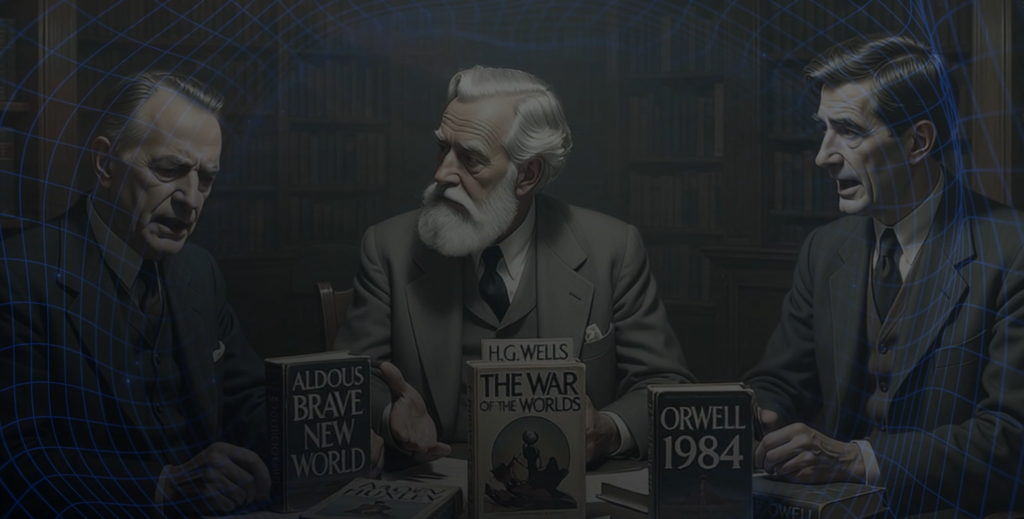
For centuries, a particular vision has been forming, largely hidden beneath the surface of history—a vision of a perfected society. Not perfected by repentance or moral transformation, but by management, design, and control. Aldous Huxley, author of the bestselling novel Brave New World, written in 1932, gave this vision its clearest literary form by describing a world in which human beings are engineered for stability, efficiency, and compliance. He wrote in interwar England, between the disillusionment of World War I and the rising mechanization and industrial optimism of the early 1930s, when mass production, behavioral science, and centralized planning were reshaping Western imagination. It was a gray season in Europe—factories humming through long winters, cities wrapped in coal smoke, and societies searching for stability after the blood-soaked mud of the trenches. What once existed as philosophy, fiction, and elite aspiration is now approaching realization.
That trajectory has now accelerated beyond theory and debate. At present, advances in genetics, reproductive technology, and biomedical science have made it possible to intervene not merely after life begins, but at its point of origin. What earlier generations imagined, argued over, or imposed through crude social programs is now addressed directly, quietly, and with technical precision—before birth itself.
In the future, designer babies are introduced not as experiments but as acts of care. Genetic selection is framed as prevention rather than alteration, a way to spare children from disease, disorder, and disadvantage before life even begins. Once a child is born healthier by design, the argument settles. There is no return to what might have been, only the quiet assumption that this is now the responsible way forward.
That assumption is no longer theoretical. At present, science has moved from speculation to application, from discussion to deployment. What earlier generations debated in philosophy or imposed through crude social programs is now being addressed directly at the point of origin—before birth itself. The imperfections once tolerated as part of the human condition are now framed as problems to be solved in advance, edited out before they can manifest, reshaping life at its earliest and most vulnerable stage.
The appeal is obvious, and the data support it. As these improvements take hold, resistance becomes harder to justify without appearing indifferent to suffering or progress itself. Over time, expectations shift and systems adapt, quietly reshaping what is considered normal and acceptable. What was once optional begins to feel like a vulnerability to avoid. And by the time deeper consequences come into view, daily life has already been reorganized around these advancements, so that returning to what once was no longer appears practical—or even possible.
In the carefully lit aftermath of World War II, in the late 1940s—when cities lay in ruin, Europe was rebuilding, and the world was desperate for meaning, order, and assurances that such horror would never return—amid cold winters, ration lines, and streets still scarred by bomb craters—the victors did something few would dare admit. They did not merely dismantle the defeated regimes. They absorbed their knowledge.
While the public was told that justice had been served at Nuremberg, behind closed doors, the United States quietly launched Project Paperclip, extracting hundreds of German scientists, engineers, and physicians from the shattered Third Reich and installing them within the American military and intelligence apparatus. Men whose research had been forged in the crucible of eugenics, human experimentation, and totalitarian control were not discarded. They were redeployed. Their crimes were sealed. Their expertise was deemed too valuable to lose.
It was in this atmosphere—where the unthinkable had proven technologically possible, where science had demonstrated its ability to reorder nations, bodies, and destinies—that Julian Huxley stepped forward not as a madman, but as a statesman of science. In 1957, at the height of postwar optimism and early Cold War confidence in science, he articulated an ancient aspiration and called it transhumanism. Humanity, he declared, need not wait on evolution nor submit to death. It could take control of its own development, no longer shaped by inheritance or limitation. Humanity, he argued, could deliberately alter its biology, its cognition, and its future, replacing natural inheritance with intentional design.
Huxley was not merely a biologist. He was Secretary-General of UNESCO, positioned at the junction of science, education, and global governance. When he spoke, curricula shifted. When he wrote, policies followed. His vision was explicit: traditional religion must be replaced with “evolutionary humanism.” God was not denied in anger, but dismissed as inefficient. The future would belong to social programs and architects of science.
Standing just behind him, always watching, was his younger brother Aldous Huxley. Brave New World was not written as a warning to those in power; it was a revelation shared among them. To the average reader—and especially to the evangelical conscience—it read as dystopia. To the intellectual and governing elite, it described a workable model. Engineered births, chemical pacification, rigid caste systems, and managed pleasure were not presented as tyranny, but as stability. Disorder was eliminated. Suffering was minimized. Resistance was unnecessary because desire itself was regulated.
Aldous moved freely among the architects of the age—Bertrand Russell, H.G. Wells, and Fabian social engineers who spoke openly of shaping society through early conditioning, education, and psychological control. Their concern was not merely social order, but preservation: the maintenance of status, continuity of influence, and control of inheritance in a world they believed must be managed from the top down. What appeared to the public as fiction functioned privately as a blueprint, tracing an elite preoccupation with bloodlines, hierarchy, and control that stretched back long before the twentieth century.
Wells, in particular, was no neutral observer. He embraced eugenics without apology. His Island of Doctor Moreau was not fiction divorced from science—it was an echo chamber. A mirror held up to a civilization intoxicated by the power to reshape flesh. Moreau was not insane. He was logical. And that was the horror. But this hunger did not originate in the 20th century. It did not begin with laboratories or institutions. It began with a boundary crossed.
Genesis records the Fall as disobedience, but it hints at something deeper: corruption of the seed itself.
Genesis records the Fall as disobedience, but it hints at something deeper: corruption of the seed itself. Genesis 6:1–4 speaks of the descent of the sons of God and their forbidden unions with the daughters of men. These unions were not incidental; they produced the Nephilim—hybrids, giants, men of renown whose violence filled the earth and accelerated its corruption. Scripture is restrained in its language, but it is deliberate in its implications.
The Book of Enoch, while not part of the biblical canon, serves as a valuable historical and theological witness to how these passages were understood in the ancient world. Enoch names what Genesis alludes to: Watchers who rebelled against their appointed order, descended to earth, taught forbidden knowledge, altered creation, and weaponized flesh. They instructed humanity in metallurgy, sorcery, warfare, and biological corruption—knowledge that was never intended for human hands. Jude 1:6–7 and 2 Peter 2:4–5 affirm this transgression, referencing angels who abandoned their proper domain and were judged for it. This was not temptation alone. It was a boundary violation, a direct assault on the created order—a transgression of design.
The Flood was not merely a judgment. It was a separation by death. Noah alone is described as righteous and “perfect in his generations”—the Hebrew word tamim (תָּמִים), indicating wholeness and purity of lineage, uncorrupted by the genetic contamination that had spread through humanity. Preservation was not only moral, but biological. God safeguarded the human line through which redemption would come.
After Babel, when God dispersed the nations, Scripture notes something chilling: He allotted them. Principalities were assigned. Power was no longer merely political—it was spiritual. Kings ruled, but never alone. And across centuries, certain bloodlines began to behave as if they remembered something humanity was meant to forget. From that point forward, an obsessive focus took hold—one that moved through religious systems, royal courts, and centers of power alike.
The unseen rulers and departed spirits assigned over the nations did not abandon their pre-Flood ambitions. They redirected them. The fixation on bloodlines, purity, and inheritance became a persistent undercurrent, whispered into the minds of kings, priests, and dynasties as the means by which authority, longevity, and legitimacy could be preserved.
Royal houses folded inward. Brothers married sisters. Uncles married nieces. Blood purity became a sacrament. Egypt’s pharaohs, Europe’s dynasties, convinced divinity could be preserved through isolation. The results betrayed them. Hemophilia rotted royal heirs. Madness crept through palaces. Sterility mocked ambition. Sin always surfaces in the body.
And beneath the crowns ran darker currents. Blood rituals whispered through stone corridors. Youth extracted. Life consumed. Elizabeth Báthory bathing in the blood of maidens. Vlad the Impaler—remembered as Dracula—impaling thousands, drinking blood, not as myth, but as a rite. These were not isolated madmen. They were heirs to an idea: that life could be extended, power preserved, decay delayed through violence and blood.
Vampirism was never about immortality alone. It was about inheritance—about the transfer of life, strength, and essence from one body to another in the belief that what was lost in Eden could be reclaimed through blood. Beneath the folklore and horror, the fixation was always biological and generational. Blood was viewed as the carrier of power, memory, and legitimacy, a substance that could be harvested, preserved, and passed down to maintain dominance across time. The act was not merely to live longer, but to secure continuity—to ensure that authority, vitality, and their family bloodlines endured beyond a single lifespan.
When Luigi Galvani sent electricity through dead muscle and watched limbs twitch, the age felt it had brushed against forbidden fire. Life appeared transferable. Triggerable. If motion could be induced, could life be assembled? Could death be negotiated?
Mary Shelley understood the danger intuitively. She was writing during damp English winters and smoke-filled summers, when the Industrial Revolution darkened the skies of early nineteenth-century England and scientific salons debated galvanism by candlelight. Writing in early nineteenth-century England during the Industrial Revolution—an era of steam engines, mechanized factories, and galvanic experimentation—she was surrounded by both scientific optimism and social upheaval. Frankenstein was not gothic entertainment. It was an indictment. Victor Frankenstein does not seek evil—he seeks mastery. He wants to correct nature without repentance. The creature is not the monster. The belief is. Shelley showed what happens when man attempts resurrection without submission. The result always turns on its maker.
Then, in the mid-nineteenth century, as Victorian England confronted industrial expansion, colonial expansion, and scientific confidence, Charles Darwin reframed life itself. No longer sacred. No longer authored. Merely selected. From that soil grew eugenics, as articulated by Francis Galton, who described humanity as livestock. Sterilization laws followed. Clinics hummed. Mercy was replaced by math.
By the time the Third Reich emerged in Germany during the 1930s—amid economic collapse, national humiliation, and a cultural obsession with renewal and purity—the ideology was fully armed. It was a season of banners and bonfires, mass rallies under floodlights, and a nation attempting to thaw its wounded pride through myth and force. Adolf Hitler did not invent eugenics. He applied it mythologically. The Aryan ideal was not merely racial—it was Nephilim nostalgia. God-men returned. Laboratories replaced temples. Camps replaced altars. Millions were sacrificed for the perfected society.
And when the world recoiled in horror, it swore the ideology had died. It had not. It had simply learned to hide—carried forward quietly through sealed files, classified programs, and the unbroken confidence that control systems, once proven effective, would inevitably be used again. See part 2 here.