
- You are here:
- Home »
- Leadership »
- The Parabel of the Sower
The Parabel of the Sower
The Parable of the Sower: Jesus, Discipleship, and the Law of the Kingdom
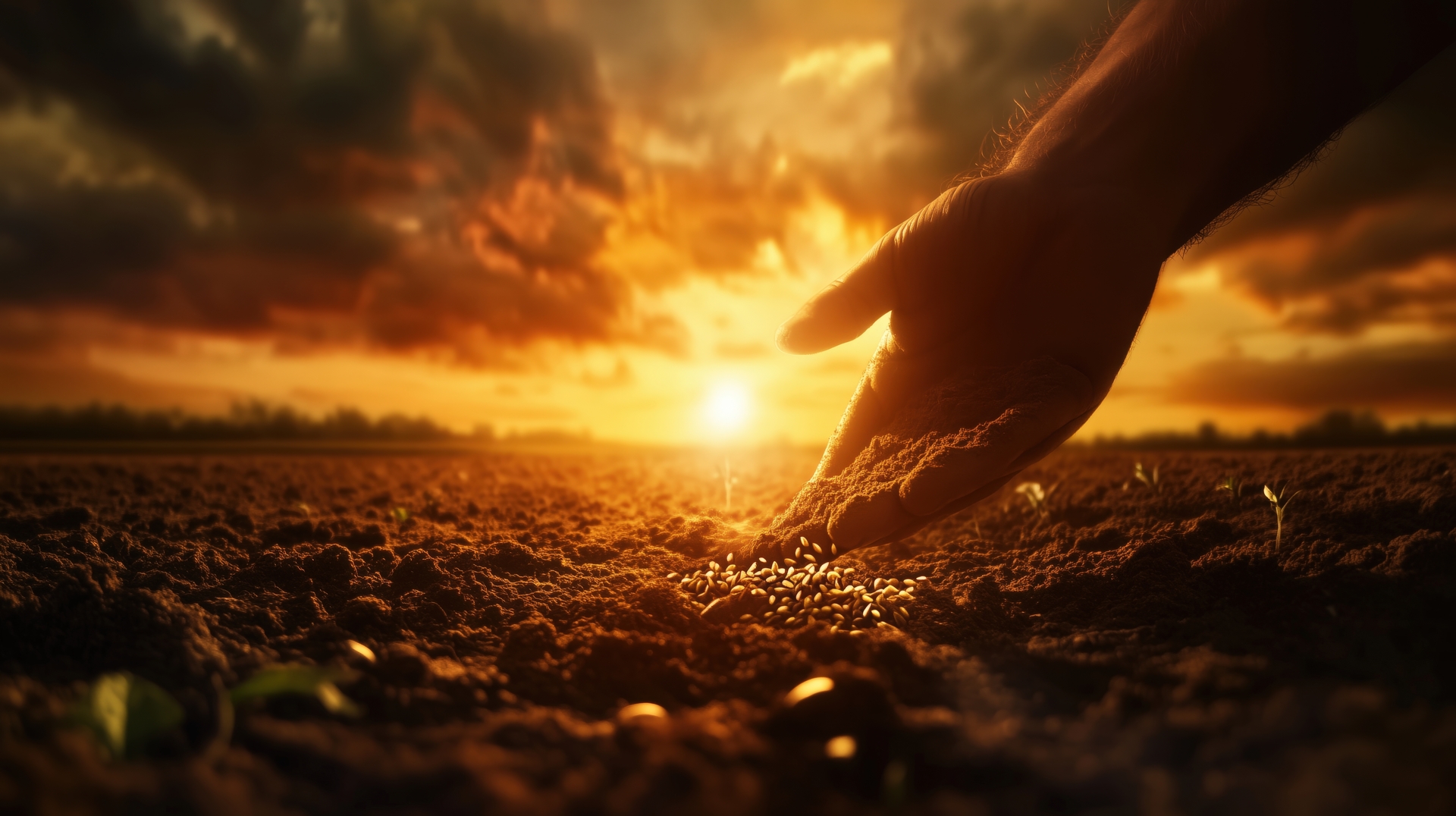
Jesus often spoke in parables drawn from the everyday world His listeners knew best—the world of farming, soil, seed, and harvest. Among these, the Parable of the Sower stands as one of the most revealing teachings about the Kingdom of God. Told in Matthew 13:1–23, Mark 4:1–20, and Luke 8:4–15, it paints a vivid picture: a farmer goes out to sow seed, scattering it generously across the field. Some fall on the path, some on rocky ground, some among thorns, and some on good soil. Only the last produces an abundant crop.
“Behold, a sower went out to sow. And as he sowed, some seeds fell along the path, and the birds came and devoured them. Other seeds fell on rocky ground, where they had little soil, and immediately sprang up, since they had no depth of soil. But when the sun rose, they were scorched, and since they had no root, they withered away. Other seeds fell among thorns, and the thorns grew up and choked them. Other seeds fell on good soil and produced grain, some a hundredfold, some sixty, some thirty.”
(Matthew 13:3–8)
At its deepest level, this parable is about Jesus Himself as the primary Sower. He is the One who broadcasts the word of the kingdom—the living message of salvation, reconciliation, and new life in Him. From the very beginning of Scripture, God reveals Himself as the divine Farmer (Genesis 2:8–9). As far back as Genesis 3:15, He plants the first gospel seed: the promise of a coming Offspring who would crush the serpent’s head. Paul later declares that this Seed is Christ (Galatians 3:16). Isaiah compares God’s word to rain and snow that fall from heaven, watering the earth and causing seed to sprout and yield bread; so God’s word will never return to Him empty but will accomplish what He purposes (Isaiah 55:10-11). From that first promise in Eden, the seed was never left unguarded. It was carried forward through generations by those who saw the vision from afar and chose to protect it with their lives.
Abraham believed what he could not yet see and walked as a sojourner, preserving the promise through faith.
“Indeed, I will greatly bless you, and I will greatly multiply your seed as the stars of the heavens and as the sand which is on the seashore; and your seed shall possess the gate of their enemies.” (Genesis 22:17)
Isaac sowed in famine, refusing to abandon the ground God had given him. Jacob endured exile and struggle, holding fast to a blessing spoken before his birth. And David—shepherd, psalmist, and king—stood as both guardian and signpost of the promised seed, defending God’s people with a shepherd’s heart and a warrior’s courage, even as the greater Son vowed to come through his line waited still. These men did not fulfill the promise; they safeguarded it. They kept the seed alive through obedience, worship, and trust, until in the fullness of time the Seed Himself would step into the field. It was a season of divine incubation—a long winter beneath the soil—where promise lay hidden, protected, and quietly alive. The bloom would not come early, nor could it be forced. Heaven waited.
Prophets caught glimpses of this mystery and spoke in wonder rather than detail. Isaiah asked, “Shall a nation be born in one day?” (Isaiah 66:8), sensing that God could compress centuries of waiting into a single moment of birth. Ezekiel saw a valley of dry bones—scattered, lifeless, forgotten—until breath entered them and they rose, not as individuals, but as a vast living body (Ezekiel 37:1–14). And John, much later, would see a sign in heaven: a woman laboring, a child brought forth, and a struggle that reached beyond time itself (Revelation 12:1–5).
These visions were not interruptions of the promise but echoes of it. The same Seed first spoken in Eden would bring forth not only the Messiah at Bethlehem, but many sons and daughters through Him—a people born of promise, awakened by breath, formed through suffering, and revealed in their appointed time. History itself became the womb, and God remained patient, faithful, and exact, until what was latent was ready to rise.
The prophets echo this call across generations. Hosea cries, “Sow for yourselves righteousness; reap steadfast love; break up your fallow ground, for it is the time to seek the Lord, that He may come and rain righteousness upon you.” (Hosea 10:12)
Jeremiah warns, “Break up your fallow ground, and sow not among thorns.” (Jeremiah 4:3) God has always been the One who sows righteousness, who prepares hearts, who causes growth. Yet woven into this divine work is a sober reality the prophets understood well: not every seed finds soil, not every scattering results in fruit, and not every moment of sowing yields an immediate harvest. Some seed is carried away before it ever takes root. Some is exposed to the light for a moment, stirred briefly by warmth and promise, yet never penetrates deeply enough to survive. Some is received, even welcomed, but slowly crowded out by competing growth. This loss is not failure—it is part of the field, part of the mystery of human hearts, part of the cost of sowing in a broken world. Still, the Sower does not withhold His hand. He continues to scatter generously, faithfully, knowing that even if many seeds miss the soil, the ones that do take root will bear fruit far beyond what was lost. And this pattern is not revealed merely to be admired, but to be followed—a way of sowing that does not calculate loss or withhold seed out of fear. From the beginning, God’s people are taught that the way of the Kingdom advances is not through selective sowing but faithful scattering. And so God calls His people not to measure success by immediate yield, but to participate with Him—to submit themselves to the disciplines of the field, the patience of waiting, and the cost of formation—trusting that the harvest belongs to Him alone.
The seed itself is the Word of God—living, incorruptible, enduring forever (1 Peter 1:23). In first-century Palestine, farmers sowed by hand, walking the field and broadcasting seed before plowing. That is why seed landed everywhere: on the hard-packed path, on thin soil over rock, among weeds, and finally on rich, prepared ground. The seed is perfect; its potential for life is complete. The responsibility of the sower is not to improve the seed or pre-judge the ground, but to keep sowing—again and again—according to the pattern set by God Himself. Everything depends on the soil—the human heart. Yet even here, the farmer does not pause to analyze where each seed falls. He sows in hope, knowing the work of preparation often happens unseen, long after the seed has been scattered.
This agricultural imagery was not abstract to the people of Scripture. The patriarchs lived it. Abraham walked fields as a sojourner, trusting promises he would not see fulfilled in his lifetime. Isaac sowed in famine and reaped a hundredfold, not because conditions were ideal, but because the blessing of the Lord rested on obedience and trust (Genesis 26:12). Jacob labored the land and tended flocks, learning through hardship, deception, and endurance that blessing comes through perseverance, not shortcuts.
Moses, raised in Pharaoh’s house, had to be undone before he could be used (Exodus 2:11–25; 3:1). He fled to Midian and spent forty years tending sheep—learning patience, humility, attentiveness, and the rhythms of life far from power—the man who would lead Israel through the wilderness first learned to follow animals through barren land. Shepherding formed him the same way sowing forms a farmer: through daily faithfulness, obscurity, and waiting for growth that cannot be forced.
David was shaped in the fields before he ever wore a crown (1 Samuel 16:11–13; 17:34–37). He learned courage, protection, and trust in God while guarding sheep no one else valued. Ruth gleaned behind harvesters, faithful in small acts of obedience, and through that faithfulness became part of the lineage of Christ (Ruth 2:2–12; Matthew 1:5). Again and again, Scripture reveals the same pattern: God forms His servants in soil and pasture long before He entrusts them with influence or authority. Growth always precedes visibility.
Jesus Himself names the deeper law beneath the parable when He says:
“Unless a grain of wheat falls into the earth and dies, it remains alone; but if it dies, it bears much fruit.” (John 12:24)
Life in the Kingdom comes only through surrender. Growth requires burial. Faith for the yield means consenting to go down into the ground first—to be hidden, pressed, and broken open—so that something new can rise. This is not only true of Christ, who gave Himself entirely, but of all who follow Him. We are buried with Him in death so that we may also share in His life (Romans 6:3–5).
Jesus explains four kinds of soil, four conditions of the heart that receive His word. The path is hard and trampled, where the seed cannot penetrate and is quickly taken away. This hardened heart is not surprised by loss; it has been walked over too long. The rocky ground receives the seed with joy, but it lacks depth. Light reaches it, warmth awakens it, but endurance never forms. When heat comes, the plant withers. The thorny ground allows growth but tolerates rivals. The seed is not rejected, but it is never allowed to reign alone. Cares, wealth, and competing desires slowly choke what once looked promising. And yet, none of these soils stops the Sower from sowing. Each scattering reveals the heart, exposes the condition, and invites transformation.
Then there is the good soil—deep, broken, receptive ground that hears the word, understands it, holds it fast in an honest and good heart, and bears fruit with patience—thirty, sixty, even a hundredfold. This soil does not exist by accident. It is formed through repentance, endurance, humility, and trust. It is the heart promised in the New Covenant: a new heart, a new spirit, a life made ready to receive what God gives.
Yet the parable does not end with Jesus alone. The Sower calls those who follow Him to take up His rhythm and His resolve—to sow as He sows, to love as He loves, and to trust the Father with the outcome. He calls us to become fellow sowers. “Go and make disciples,” He commands. Paul explains the mystery plainly: “I planted, Apollos watered, but God gave the growth.” (1 Corinthians 3:6) We sow generously, not sparingly, because discipleship is imitation before it is instruction. To follow Jesus is to adopt His way in the world—to sow truth, mercy, and testimony freely—without fear of loss, without calculating return, and without retreating when seed is taken, or growth is slow. We speak, teach, witness, and love without certainty of outcome. Some seed will be lost. Some will only glimpse the light. Some will grow for a time and fade. This is not a reason to withdraw—it is the reason to remain faithful. The calling of the sower is not to control the field, but to trust the One who owns it.
We are not responsible for the outcome. We are responsible for obedience. The harvest is supernatural, far beyond what human effort could produce. Jesus, the faithful Sower, continues His work through us until the final plentiful harvest, when He returns as Lord of the harvest. Until then, we break up our own fallow ground, pull out our own thorns, deepen our own roots, and submit to the slow, costly, holy work of formation.
And so we arrive at the paradox of the gospel—the truth that has been quietly echoing from the beginning. Life comes through death. Gain comes through surrender. Fruit comes through what is first buried and unseen. The seed that refuses the ground remains alone, but the seed that yields itself is multiplied beyond measure. This is the way of the Kingdom, the wisdom of God that confounds the world.
And when the fields of this age are finally reaped, the truth that has carried this story from Eden to now will stand clear: the Kingdom was never advanced by control, calculation, or certainty, but by faithful sowing that trusts God for the increase. Every seed cast in obedience—seen or unseen, buried in silence or carried through generations—will bear witness that the Master Sower knew the field far better than those who merely walked upon it. He sowed not because success was guaranteed, but because eternal love, joined with divine vision, awakens mission and destiny—and life always follows surrender.
This is the quiet call hidden within the parable. Not all will hear it, and not all are meant to. Only those who recognize the Shepherd’s voice will understand the way of the Sower—to walk the fields without fear, to release the seed without grasping the outcome, and to trust that what is given in faith will rise in its appointed time. It is unfortunate that, in many seasons, sowing has been reduced to a formula for personal gain—redefined as a means to reap exponential increase in wealth or temporal success. But the message of the Kingdom reaches far beyond such measures. The Sower looks not to earthly return, but to eternal inheritance. The true measure is not what we accumulated, but how deeply we loved souls—whether we inspired faith, cultivated hearts, and helped prepare a people worthy of Christ, His Bride. The question is not whether the seed will grow, but whether we will follow Him into the field and sow as He sows.
The Sower looks not to earthly return, but to eternal inheritance. The accurate measure is not what we accumulated, but how deeply we loved souls—whether we inspired faith, cultivated hearts, and helped prepare a people worthy of Christ, His Bride. The question is not whether the seed will grow, but whether we will follow Him into the field and sow as He sows.