
- You are here:
- Home »
- Film and Music »
- The Ghost in the Midi Notes
The Ghost in the Midi Notes
A Musician’s Encounter with the Digital Tapistry and God’s Creative Blueprint.
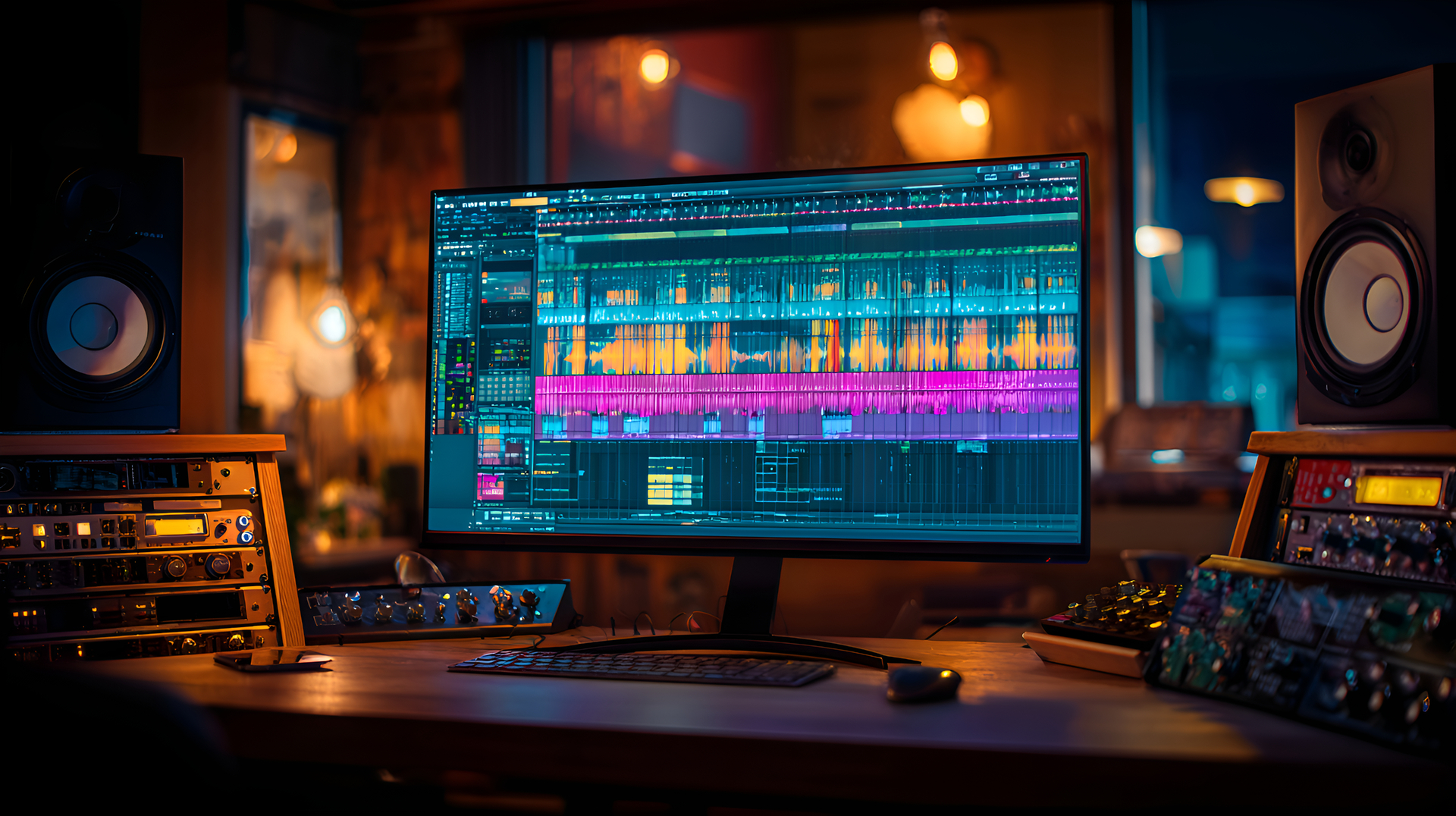
It appeared before it ever sounded. A faint, translucent shape hovered on my MIDI timeline—barely there, almost an idea more than an object. It wasn’t a note yet. But it existed. Snapping softly to the grid as I moved the cursor, it followed rules I hadn’t consciously invoked, aligning itself to invisible divisions of time and pitch as if the system already knew where it belonged.
As I watched, faint squiggly waveforms appeared between events, erratic and branching, like tiny bolts of lightning trying to connect gaps in the timeline. As I worked, I wasn’t only seeing this instability; I could hear it. I was editing MIDI vocals, and the voice itself sounded as if it were seeking resolution, hovering between pitches and phrasing, restless until the timing and placement finally agreed. Artifacts of the system were attempting to interpolate, preview, or represent potential continuity between discrete instructions.
Technically, this happens because MIDI contains no waveform at all—only note-on, note-off, and control data—yet the DAW’s graphics and audio engines are constantly running predictive routines. As a ghost note is moved, the system rapidly recalculates timing offsets, velocity curves, envelopes, buffer previews, and instrument responses. The display refreshes faster than the values can settle, producing jagged, branching traces that resemble lightning. It is the visual side effect of discrete data being evaluated against continuous models—a momentary instability where the system searches for coherence before intent is finalized.
I stopped. Because in that moment, it didn’t feel like I was creating anything. It felt like I was interacting with something that was waiting. I slid the ghost note left. Wrong. I moved it right. Still wrong. A fraction forward—almost imperceptible—and suddenly the grid felt quiet, expectant. When I released the mouse and committed the note, the ghost solidified. Sound emerged as it should have appeared on the midi tapestry. The phrase is locked. The track breathed. And a familiar sensation washed over me—the same one I’ve felt for decades, whether staring at a non-linear editing system, hardware sequencer, or a modern DAW timeline. All audio-to-digital conversations follow the same principles.
I wondered if the song I was writing was already written. That realization didn’t fade when the sound decayed. It stayed with me, heavier than the music itself, because what I’ve experienced doesn’t seem to be simply a function of software. I imagined that I was tapping into God’s digital tapestry, the ordered speech Scripture hints at when it says, “And God said…”—creation responding not to force, but to intent spoken into structure. It felt like an interaction with a construct—a structured reality that already contained the answer, waiting for alignment rather than invention.
I’ve been programming MIDI since the eighties, back when the interface was a lot less user-friendly. Back when audio and video were on physical media, it took longer—clock signals. External boxes responding to messages they did not generate themselves. MIDI never carried sound. It carried instructions. Note numbers. Velocity. Duration. Channel. It was intended to make it legible to machines.
That distinction mattered then, and it matters even more now.
MIDI was always a translation layer, and the closest physical analogy I’ve ever found for it is a player piano. This technology emerged in the late nineteenth century and reached wide popularity around the turn of the twentieth century. A player piano follows encoded instructions punched into a long paper roll. As the roll advances at a fixed speed, holes pass over a reader, opening valves that trigger hammers to strike strings. Pitch is determined by where the hole is placed across the roll, timing by when it appears along its length, and dynamics by how long it remains open and how the mechanism responds.
The piano still resonates with wood, wire, felt, and air, but the performance is driven by a multitude of raised intentions moving through a mechanical system. MIDI works the same way. Notes aren’t waves; they are instructions. Velocity isn’t force; it is a value that tells the system how hard the hammer should fall. Time isn’t fluid; it is subdivided, measured, and advanced step by step, like the roll feeding forward. And yet, when the instructions are written with care, it feels alive. It swings. It breathes. It carries feel. The structure is rigid, but the life comes from how intent is encoded, a paradox that followed me through every technological shift that came after.
When sound finally entered the chain—when microphones, instruments, and voices passed through analog-to-digital converters—the illusion deepened. Analog, with all its infinite variation, was suddenly forced to explain itself numerically. Voltage became samples. Flow became snapshots. Breath became a value measured against a clock.
Converters were marketed as transparent. Neutral. Faithful.
They never were.
A converter is a gate, much like the Nyquist boundary in signal theory. This necessary limit defines what can pass through without distortion, reminding us that every translation requires constraint. A checkpoint. A place where something continuous must agree to become discrete. Before analog can cross, it must be filtered. Smoothed. Tamed. Anything too fast, too sharp, too wild must be removed so it doesn’t violate the rules on the other side. Only then is it sampled—measured tens of thousands of times per second—and each measurement rounded to the nearest available step.
Astonishingly, it works at all.
Digital audio and digital video are built on the same bargain. Vision becomes pixels. Sound becomes samples and bits. Color, tone, texture, motion—all reduced to ones and zeros arranged so quickly and densely that our senses forgive the lie. And it is a lie. A beautiful one. A useful one. But a lie nonetheless. Because life does not exist in steps.
I’ve watched entire generations fall in love with the grid—its precision, its recall, its promise of perfection. I understand the appeal. The grid offers control. It offers certainty. It provides the intoxicating sense that, if everything is aligned correctly, meaning will emerge automatically.
But it never does.
Meaning doesn’t come from the grid. It passes through it.
Just like that ghost note.
The more I worked in digital systems, the more they began to feel ancient, as if modern tools were only revealing patterns that had always existed. A construct with rules. Boundaries. Expectations. A structure that doesn’t generate life on its own, but responds when intent is placed correctly.
That realization pushed me beyond technology into theology. John’s Gospel opens with the words, “In the beginning was the Word,” not as poetry alone, but as architecture—meaning, order, and expression preceding form.
I began to suspect that the digital construct is not merely a human invention, but a reflection—a shadow—of something far more profound. I’ve come to believe it may resemble the mind of God itself. Not God reduced to code, but God expressed as order, possibility, sequence, and becoming. A blueprint vast enough to contain not only what is, but every future step that humanity will ever take.
Creation, then, is not static. It is unfolding. Each moment experienced in time by us, yet already known in fullness by Him.
When Scripture says that all things are held together, it doesn’t describe a frozen universe. “In Him all things hold together,” Paul writes, pointing to a sustaining intelligence rather than a static mechanism. It represents a living system—history and possibility braided together. In that sense, the construct is not merely space; it is sequence. It is a design that anticipates expression without coercing it.
That is why the grid feels like it’s waiting.
And this is where the analogy from the blockchain world suddenly makes sense. In distributed systems, there is a leading chain—the source of truth—and side chains. Extensions. Ripples. Paths of creativity and experimentation that remain anchored to the original ledger. Side chains do not rewrite the source. They build upon it. They add expression without breaking integrity.
Creation feels like that.
God’s mind is the master ledger—the blueprint containing every possibility, every outcome, every future step. Humanity does not rewrite that chain. We are allowed to build side chains. Art, culture, music, technology, design—ripples of creativity anchored to something eternal. We are not sovereign authors. We are participants granted access.
That access is a gift.
The construct, digital or otherwise, is not God. But God expresses Himself through structure. Through systems that wait. Through order that anticipates meaning. Through frameworks designed not to dominate, but to receive. A MIDI grid doesn’t write music, but it is ready when music arrives. Reality feels the same way.
This is where confusion enters the modern world. We mistake the canvas for the artist. The system for the source. The grid for the song. In a culture racing toward simulation—virtual bodies, synthetic voices, algorithmic creativity—we begin to believe that increasing resolution will eventually cross the line from imitation into creation.
It never does.
Because the soul does not quantize, breath does not subdivide cleanly. Emotion does not obey clocks. Presence cannot be sampled without loss. You can copy a voice’s sound, but not the courage it took to speak. You can map the timing of a performance, but not the intention behind the hesitation. You can recreate the waveform, but not the will.
That is why the most moving moments in music and film still come from the edges—the hiss, the crack, the imperfection, the timing that shouldn’t work but does. That is where the real leaks through. That is where the construct reveals its limits.
Art, then, is not about mastering the construct. It is about listening within it and listening for what already exists beneath the grid—listening for the ghost note, listening for the place where alignment feels inevitable rather than imposed.
Art is not invented from nothing. It is cooperation. It is humility disguised as creativity.
That is why the song always feels like it was already written. Because in a way, it was—not as data, not as notes, but as meaning waiting for breath. When I reached across that invisible doorway into code, it felt less like I was entering a machine and more like I was touching a living pattern. I wasn’t imposing will onto a system; I was stepping into alignment with something that already existed, something vast and quietly ordered.
That ghost note on my timeline didn’t teach me about software. It taught me about reality. It revealed that the construct—digital or otherwise—is responsive, not sovereign. It does not originate life, but it recognizes it. It waits for intent. It remains dormant until something living speaks into it. In that moment, it felt as though I was brushing against the signature of God’s own mind—the blueprint beneath creation, the architecture that holds possibility before it becomes form.
I began to wonder if this was the code itself—not artificial code, but divine logic made perceptible through modern tools. Scripture says the word of God framed the worlds, that what is seen was made from what is unseen, and that thought alone reframed everything I was touching. A glimpse of the underlying order God uses to express Himself in time and space. Artists, then, are not inventors in isolation, but stewards granted access—given a narrow gateway into that blueprint so creativity can ripple outward without breaking its source.
God, who speaks worlds into being, still works the same way—through structure that waits, order that listens, and creation that responds. When the note is finally placed where it belongs, the construct does not resist. It agrees.
The ghost becomes sound. The sound becomes life. And the art lives—not in the grid, not in the code, not in the construct—but in alignment with the blueprint that existed before time began.
About the Author Mark Thomas
Mark is a visionary leader and writer who helps others discover their God-given purpose. See his teaching series www.LiveandGrowonPurpose.com